
I've spent nearly two decades in IT infrastructure — starting as a systems administrator back in 2006, moving through DevOps leadership roles at companies like Ciklum and SoftServe, and eventually co-founding GART Solutions. Over that time, I've watched countless industries wrestle with cloud adoption. But healthcare? Healthcare is a category of its own.
The sector sits at a strange crossroads. On one hand, the pressure to digitize is enormous — patient expectations, regulatory mandates, the sheer volume of data generated by modern diagnostics and wearables. On the other, the stakes of getting it wrong are uniquely high. A misconfigured server in e-commerce might cost you revenue. In healthcare, it can cost lives.
So let me share what I've learned from working with healthcare organizations navigating this transition, and why I believe the conversation around cloud computing in healthcare needs a serious reset.
The Real Barrier Isn't Technology — It's Infrastructure Debt
When healthcare executives talk about "going to the cloud," they usually mean migrating applications and data from on-premise servers to AWS, Azure, or GCP. That's the easy part to conceptualize. The hard part is what sits underneath.
Most healthcare organizations are running on decades-old infrastructure. Legacy EHR systems, fragmented databases, networking equipment that predates the smartphone era. Before you can even think about cloud migration, you need to understand what you're working with. That means getting serious about your IT infrastructure components — mapping out every server, every integration point, every dependency that nobody documented because the person who built it left the company eight years ago.
This is where IT infrastructure modernization becomes not a nice-to-have, but a prerequisite. You can't build a modern cloud architecture on a foundation of technical debt. I've seen organizations try — they end up with a hybrid mess that's more expensive and less reliable than what they started with.
Digital Transformation in Healthcare Is Not a Single Project
One of the most common misconceptions I encounter is treating digital transformation as a one-time initiative. "We'll migrate to the cloud, check the box, move on." That's not how it works in any industry, and it's especially not how it works in healthcare.
Real digital transformation in healthcare is a continuous process that touches clinical workflows, patient engagement, data analytics, compliance, and operational efficiency simultaneously. It requires rethinking how systems communicate, how data flows between departments, and how clinicians interact with technology at the point of care.
The organizations that succeed are the ones that approach this iteratively — starting with high-impact, lower-risk workloads and building institutional knowledge before tackling the complex, mission-critical systems.
The Cost Trap Nobody Warns You About
Here's the thing that doesn't make it into most cloud migration pitch decks: cloud can be significantly more expensive than on-premise if you're not disciplined about it. And healthcare organizations, with their complex compliance requirements and unpredictable workloads, are particularly vulnerable to cost overruns.
I wrote extensively about the cloud cost optimization traps that catch even experienced engineering teams off guard. Things like over-provisioned instances running 24/7 for workloads that peak for two hours a day. Or storage costs silently ballooning because nobody set up lifecycle policies for medical imaging archives. Or the classic — spinning up dev environments that mirror production and forgetting to tear them down.
For organizations running primarily on AWS — which is common in healthcare due to its HIPAA-eligible services — there are specific AWS cost optimization strategies that can dramatically reduce spend without compromising performance or compliance. Reserved instances, Savings Plans, right-sizing, and intelligent tiering for S3 storage are just the starting points.
The key insight is that cost optimization isn't something you do after migration. It needs to be baked into your architecture from day one.
Why Managed Services Make Sense for Healthcare (But Not for the Reasons You Think)
The usual pitch for managed IT services in healthcare centers on cost savings and reduced headcount. And while those are real benefits, they miss the more important point.
Healthcare IT teams are stretched thin. They're managing compliance audits, responding to security incidents, maintaining legacy systems, supporting clinical staff, and — if they're lucky — squeezing in some innovation work. Adding cloud infrastructure management on top of that isn't just unrealistic; it's a recipe for burnout and mistakes.
The value of a managed services partner isn't that they're cheaper than hiring. It's that they bring specialized expertise in cloud operations, security, and automation that would take years to develop internally. They've seen the failure modes. They know what breaks at 2 AM and why.
Infrastructure as Code: The Foundation You Can't Skip
If there's one technical practice that separates successful cloud deployments from chaotic ones, it's Infrastructure as Code. I've seen the difference firsthand — organizations that adopt IaC best practices early move faster, break fewer things, and recover from incidents in minutes instead of hours.
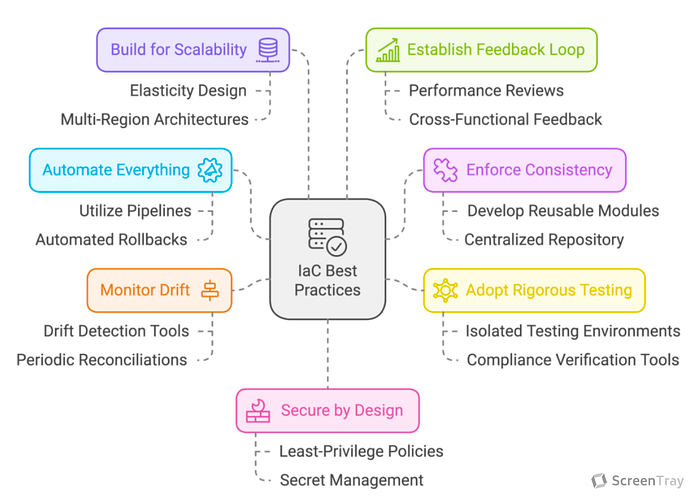
In healthcare, where you need to maintain identical environments for compliance validation, where audit trails matter, and where a configuration drift could mean a HIPAA violation — IaC isn't optional. It's essential. Every environment should be reproducible from code. Every change should be version-controlled, peer-reviewed, and automatically tested before deployment.
Terraform, CloudFormation, Pulumi — the specific tool matters less than the discipline of treating your infrastructure with the same rigor you'd apply to application code.
What I'd Tell Every Healthcare CTO Right Now
If I could sit down with every healthcare technology leader making cloud decisions today, here's what I'd say:
Start with an honest assessment of where you are, not where you wish you were. Map your infrastructure. Understand your dependencies. Acknowledge the technical debt.
Don't try to transform everything at once. Pick a workload that matters, migrate it well, learn from it, and iterate.
Budget for optimization from the start. Cloud economics are not "set and forget." You need ongoing governance, monitoring, and adjustment.
Invest in automation early. IaC, CI/CD, automated compliance checks — these aren't luxuries. They're what make cloud sustainable at scale.
And consider whether your team has the bandwidth and expertise to manage all of this alongside their existing responsibilities. Sometimes the smartest move is bringing in a partner who's already solved the problems you're about to discover.
The healthcare industry has enormous potential to benefit from cloud computing. But realizing that potential requires more than enthusiasm and a migration timeline. It requires discipline, expertise, and a willingness to do the foundational work that makes everything else possible.
Fedir Kompaniiets is the CEO & Co-Founder of GART Solutions, a DevOps and Cloud services company specializing in infrastructure modernization, cloud migration, and managed IT services. With nearly 20 years in IT infrastructure and previous leadership roles at Ciklum, SoftServe, and N-iX, Fedir helps organ