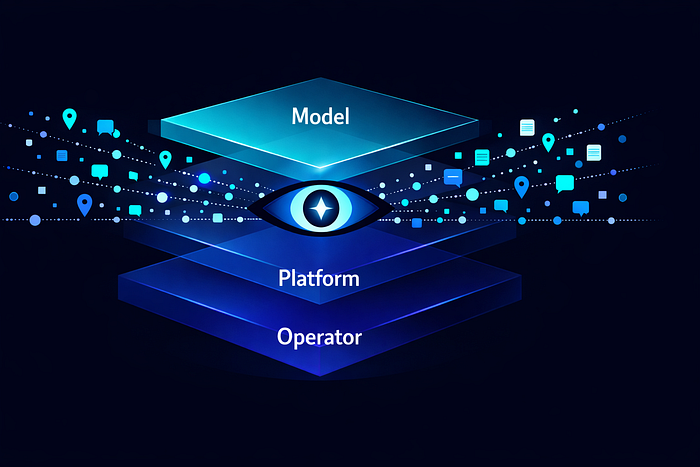

The Anthropic–Pentagon standoff isn't just about an AI model. It's about the stack — and the integration layer that turns a model into a surveillance capability.
A modern definition of "mass surveillance"
When people hear "mass surveillance," they picture a single, centralized system watching everyone.
That's not how it works anymore.
Today, the more realistic risk is **surveillance by aggregation**: a thousand scattered data sources — many of them individually legal or tolerated — becoming a near-total portrait of a person's life once they can be cheaply joined, searched, and summarized.
In 2026, the interface that makes this aggregation effortless is increasingly a large language model (LLM).
That's the deeper story behind the public standoff between Anthropic and the U.S. Department of Defense (also referred to in some reporting as the "Department of War"): not a morality play about whether Claude is "good" or "bad," but a fight over **who gets to set the limits** once AI is embedded into the data fusion layer.
What's happening between Anthropic and the Pentagon (fast timeline)
Late February 2026 brought a burst of coverage about Anthropic refusing to accept updated Pentagon contract language that would allow "any lawful use" of Claude.
Anthropic's CEO Dario Amodei responded with a public statement arguing that two carve-outs must remain in place:
- No mass domestic surveillance - No fully autonomous weapons (humans fully out of the loop)
Anthropic's core point isn't "we oppose national security work" It's the opposite: they present themselves as strongly supportive of defense applications — with boundaries.
So far, this reads like a familiar "ethics vs. government power" argument.
But to understand why this dispute matters (and why it could repeat with every frontier model), you have to look at the stack.
The stack view: model vs. platform vs. operator
In most commentary, Anthropic is treated as "the AI company", and the Pentagon is treated as "the user". That collapses the most important middle layer.
A clearer mental model has three roles:
1) Model provider (Anthropic) - Builds the model (Claude) - Writes usage policy - Negotiates contract language
2) Integrator / platform layer (e.g., Palantir AIP, classified cloud environments) - Determines what data the model can access - Embeds the model into real interfaces and workflows - Turns a model into an operational capability
3) Operator / customer (DoD / intelligence community) - Chooses missions - Sets internal rules and oversight norms - Deploys the integrated system at scale
Why this matters: as LLMs become more general-purpose, the platform is where the leverage sits. The platform decides whether your AI is a chatbot answering harmless questions — or a copiloted analyst sitting on top of vast sensitive datasets.
If you want to understand where "mass surveillance" risk lives, it's rarely in the model alone. It lives in the model plus data access plus workflow integration.
Why Palantir shows up in this story
This is where the "Palantir layer" matters.
Semafor's reporting describes Anthropic's Claude appearing on screens of officials in sensitive contexts via both Amazon's top secret cloud and Palantir's Artificial Intelligence Platform (AIP) — and suggests that platform dependencies are part of why the relationship deteriorated.
Source: - Semafor: https://www.semafor.com/article/02/17/2026/palantir-partnership-is-at-heart-of-anthropic-pentagon-rift
You don't need to take every detail of any single report as gospel to see the structural point:
- Palantir-style systems are built for data fusion (joining, resolving entities, building operational "views"). - LLMs are built for language (querying, summarizing, drafting, reasoning).
Combine them and you get a capabilities multiplier:
- Natural-language access to complex datasets ("show me everything connected to X") - Faster generation of briefs, analyses, and action proposals - Lower friction for broad exploratory querying
That "lower friction" is the hinge. It's what turns a set of dispersed, messy data sources into something that can function like a modern surveillance apparatus.
What "mass domestic surveillance" means (without tinfoil)
A key line in Anthropic's statement is the idea that powerful AI makes it possible to assemble scattered, individually innocuous data into a comprehensive picture of a person's life — automatically and at massive scale.
This is worth unpacking because it's not the cartoon version of surveillance.
In practice, "mass surveillance by aggregation" can be built out of ingredients like:
- Location trails and movement data acquired through brokers or third parties - Social graph signals (who interacts with whom, when, and how) - Public web content, media, and open-source intelligence - Administrative datasets and metadata that were never designed to be combined
Even when each dataset alone feels mundane, the combined system can become:
- Highly identifying - Highly predictive - Highly actionable
And once an LLM sits on top, querying becomes less like "write SQL against a schema you understand" and more like "ask for a person's network and narrative."
That is the modern surveillance risk: not one illegal tap, but continuous, cheap inference at population scale.
The "any lawful use" trap
At first glance, "any lawful use" sounds like a reasonable procurement clause: the government will follow the law, therefore it should be allowed.
The problem is that law is not the same as governance, and laws often lag capability.
"Lawful" can include practices that were once too expensive or too manual to matter, but become transformative once automation arrives.
That's why some legal and policy analysts argue the dispute shouldn't be resolved by bilateral negotiations between an agency and a startup CEO.
One strong articulation of that view: - Lawfare: Congress — not the Pentagon or Anthropic — should set military AI rules — https://www.lawfaremedia.org/article/congress-not-the-pentagon-or-anthropic-should-set-military-ai-rules
In other words: if "lawful" expands in practice as technology expands, then "any lawful use" is not a stable boundary. It's an envelope that grows.
There's also a precedent risk here. If a leading U.S. frontier model provider signs an "any lawful use" deal under pressure, other governments (democratic and authoritarian) can point to that as the industry baseline: if the U.S. gets it, why can't we? Even if the original dispute is framed as "domestic surveillance of Americans," the underlying capability is portable. Once models are integrated into intelligence and security stacks, the same data-fusion + LLM workflow can be used for population-scale monitoring in other countries as easily as in the U.S.
This doesn't mean every government request is identical, or that lawful foreign intelligence is the same thing as domestic mass surveillance. But it does mean that contract language matters beyond one customer: it can become the template everyone else demands.
Where guardrails actually need to live (multi-layer controls)
If the concern is system-level — model + data + integration — then guardrails must also be system-level.
1) Model-layer guardrails (necessary, but limited) Model safety measures can reduce obvious misuse. But they're fragile when:
- The operator has broad discretion - The system can be deployed behind closed networks - The customer can switch to a different model
Model guardrails are not a substitute for governance.
2) Platform-layer controls (high leverage) If you want to make mass surveillance harder, you need controls at the integration layer:
- Strict access control (role-based, least privilege) - Audit logs that tie prompts/queries to datasets accessed and outputs produced - Rate limits and anomaly detection to reduce "fishing expedition" patterns - Retention limits (what gets stored, for how long) - Purpose binding (hard, but conceptually critical: *why* was this query allowed?)
This is the layer where a system becomes enforceable — or not.
3) Oversight/policy layer Finally, you need durable rules:
- Contract language that defines prohibited uses clearly - Independent audits and reporting - Consequences for misuse
Anthropic's contract carve-outs can be read as an attempt to force governance into the binding layer — because once a platform/operator combination has "any lawful use," everything else becomes easier to waive.
The uncomfortable conclusion
This isn't a simple story about an AI lab being virtuous and the government being villainous.
It's a story about how modern stacks reduce the cost of turning data into decisions.
If you believe mass domestic surveillance is a line we shouldn't cross, you can't solve that problem with model-only guardrails. You have to solve it where capabilities are created:
- at the integration layer, - in procurement language, - and in democratic oversight.
Because once "any lawful use" meets data fusion, the boundary between "useful analysis" and "population-scale surveillance" becomes thinner than most people want to admit.