
In today's cybersecurity landscape, outdated services and unpatched systems remain a critical attack vector. Recently, I conducted a hands-on Linux penetration testing exercise to simulate a real-world attack scenario, and the results reinforced how chained vulnerabilities can lead to full system compromise.
Step 1: Network Reconnaissance & Service Enumeration
The first step in any penetration test is understanding the attack surface. Using Nmap, I performed:
- Full port scans
- Service version detection
- OS fingerprinting
During this phase, I discovered an exposed legacy service — distccd — vulnerable to unauthenticated remote code execution (RCE). This marked the first critical point in the attack chain.
Tools Used: Nmap, Netcat
Step 2: Initial Access via distccd RCE
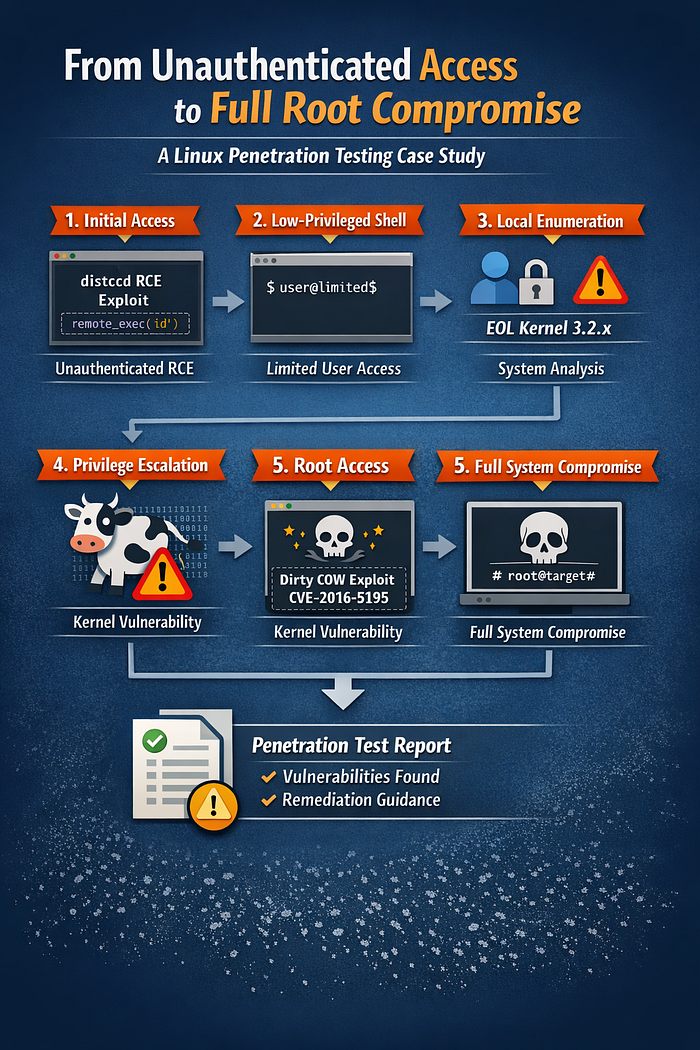
With the vulnerable distccd service identified, I executed an RCE exploit to gain initial access. This allowed me to open a low-privileged shell under the service user account, providing the first foothold on the system.
Key Lesson: Unpatched, exposed services can provide attackers full system entry without credentials.
Step 3: Post-Exploitation Enumeration
After gaining access, I performed detailed local enumeration to understand the system environment:
- Users and groups
- Sudo privileges
- Linux kernel version
- Installed tools (gcc, wget, curl)
The system was running an end-of-life Linux kernel (3.2.x), which is highly susceptible to known privilege escalation vulnerabilities.
Tools Used: Bash shell, Linux CLI
Step 4: Privilege Escalation with Dirty COW
The outdated kernel enabled exploitation of Dirty COW (CVE-2016–5195), a kernel-level vulnerability that allows local privilege escalation. Using this exploit:
- Compiled the exploit on the target system
- Modified system files to escalate privileges
- Successfully obtained root access
Outcome: Full administrative control over the Linux server.
Skills Demonstrated: Linux privilege escalation, kernel exploitation, post-exploitation analysis
Step 5: Reporting & Lessons Learned
After completing the attack chain, I compiled a client-ready penetration test report including:
- Vulnerability assessment
- Exploitation evidence
- Risk and impact analysis
- Remediation recommendations
Key Takeaways:
- Security failures often result from chained vulnerabilities, not single issues
- Exposed legacy services + unpatched kernels are a high-risk combination
- Regular patch management, system hardening, and monitoring are essential
Skills & Tools Applied
- Penetration Testing
- Linux Security
- Remote Code Execution (RCE)
- Linux Privilege Escalation
- Vulnerability Assessment & Reporting
- Metasploit Framework
- Nmap, Bash, gcc
Conclusion
This penetration testing case study highlights the importance of offensive security practices for Linux systems. Simulating real-world attacks helps uncover vulnerabilities before malicious actors do, while demonstrating the full impact of chained exploits.