June 6, 2026
Zero-Knowledge Proofs: Proving Something Without Revealing Anything
Introduction

Robert Broeckelmann
10 min read
Introduction
Modern computing systems are built around a strange tradeoff in that proving identity or trust usually requires revealing information. Passwords, account numbers, private keys, medical records, financial history — all of these are routinely exposed simply to verify a claim.
Zero-Knowledge Proofs (ZKPs) challenge that assumption.
A Zero-Knowledge Proof allows one party to prove a statement is true without revealing the underlying information itself. It sounds almost paradoxical at first, but it is one of the most important developments in modern cryptography. This is a theoretical game changer for privacy.
ZKPs are shaping:
- Cryptocurrencies
- Privacy-preserving identity systems
- Secure authentication
- Cloud computing
- AI and machine learning verification
- Blockchain scalability
- Confidential enterprise computing
Despite sounding abstract, the core idea is surprisingly intuitive.
The Cave Analogy
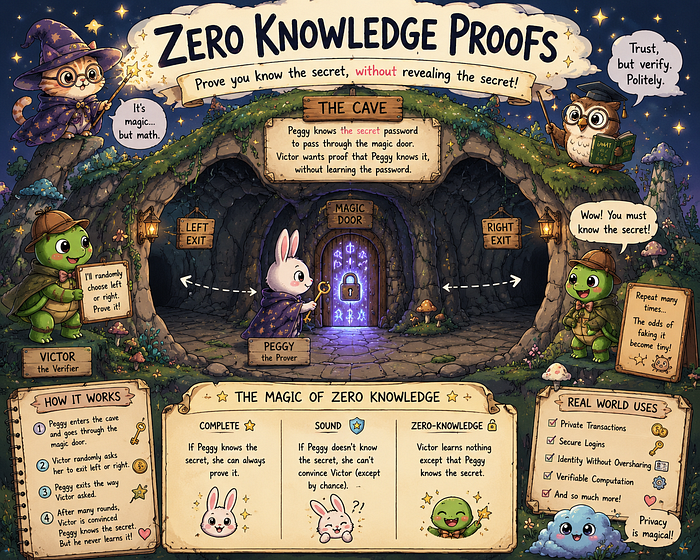
One of the classic explanations involves a cave with a hidden magic door (see image above).
Imagine, if you will:
- Peggy knows the secret word to open the door.
- Victor wants proof that Peggy knows the word.
- Peggy does not want to reveal the secret itself.
The cave is circular with two paths:
- Left path
- Right path
The magic door blocks the middle connection.
Peggy enters the cave while Victor waits outside. Victor then randomly asks Peggy to emerge from either the left or right path.
If Peggy truly knows the secret word, she can open the hidden door inside the cave and emerge from whichever side Victor requests.
If she does not know the secret, Victor can only guess correctly 50% of the time.
After enough repeated rounds, Victor becomes statistically convinced Peggy knows the secret without ever learning the password itself.
That is the essence of a Zero-Knowledge Proof.
Three Properties of ZKPs
A true zero-knowledge proof system has three important properties.
- Completeness: If the statement is true, an honest Prover can convince the Verifier.
- Soundness: If the statement is false, a dishonest Prover cannot reliably fool the Verifier.
- Zero-Knowledge: The Verifier learns nothing except "the statement is valid." No additional secrets are revealed.
Why ZKPs Are Important
Traditional authentication often leaks information.
For example:
- Passwords can be stolen
- Database hashes can be cracked
- API tokens can leak
- Identity systems expose excessive personal data
ZKPs enable verification without exposure.
Some examples where ZKPs could be useful:
- Proving you are over 21 without revealing your birthday
- Proving you have sufficient funds without revealing your account balance
- Proving you possess a credential without exposing the credential itself
- Proving a computation was performed correctly without re-running it
This approach dramatically changes the security model.
ZKPs in Cryptocurrency
Cryptocurrency is where most people first encountered ZKPs.
Well-known cryptocurrency projects use ZKPs extensively, including:
- Zcash
- Ethereum Layer-2 ecosystems
- Modern rollup architectures
In privacy coins, transaction details remain hidden while:
- Transactions can be validated
- Balances remain consistent
- Double-spending is prevented
This enables selective privacy rather than fully-transparent ledgers.
Implementations: zk-SNARKs, zk-STARKs, and PLONKs
zk-SNARKs and zk-STARKs are the two most famous modern implementations of ZKPs.
zk-SNARKs
Zero-Knowledge Succinct Non-Interactive Arguments of Knowledge (zk-SNARKs). Features include:
- Small proof sizes
- Fast verification
- Widely used in blockchain systems
It's main weakness is that many systems require a trusted setup ceremony.
zk-STARKs
Zero-Knowledge Scalable Transparent Arguments of Knowledge (zk-STARKs) is another modern implementation. It's features include:
- No trusted setup
- Better scalability
- Quantum-resistant design characteristics
The tradeoff is larger proof sizes.
These are rapidly evolving research areas with major investment from both academia and industry.
PLONK
Permutations over Lagrange-bases for Oecumenical Noninteractive arguments of Knowledge (PLONK) is a widely used zk-SNARK protocol that represents computations as polynomial constraints and enables efficient, reusable, and scalable zero-knowledge proofs through a universal trusted setup. Now, you may be wondering "What the f**k does oecumenical mean?" Oecumenical means universal, broadly applicable, or intended to work across many groups.
PLONK is a popular zero-knowledge proof system that allows a Prover to demonstrate that a computation was performed correctly without revealing the underlying data. The key innovation of PLONK is that it provides a universal proving system. Meaning, same trusted setup can be reused for many different circuits and applications.
Earlier zk-SNARK systems often required a separate trusted setup for each circuit, which was operationally cumbersome.
Use Cases
Zero-Knowledge Rollups
One of the largest, current ZKP applications is blockchain scalability.
Blockchains like Ethereum struggle with:
- Transaction throughput
- High fees
- Scalability limits
ZK rollups solve this by:
- Processing many transactions off-chain
- Generating a cryptographic proof
- Submitting only the proof to the blockchain
The chain verifies the math and the state transition validity without reprocessing every transaction. This massively improves efficiency.
Identity and Authentication
ZKPs may fundamentally reshape digital identity.
Instead of exposing :
- Full IDs
- Passports
- Addresses
- SSNs
Users could prove basic identity information without revealing unnecessary personal information such as:
- Citizenship
- Age
- Employment status
- Authorization level
This aligns closely with:
- Privacy-by-design principles
- Data minimization
- Modern regulatory goals
Potential future systems with much stronger privacy guarantees may allow:
- Passwordless authentication
- Anonymous credential verification
- Decentralized identity
Enterprise and Cloud Applications
ZKPs are beginning to appear in enterprise infrastructure as well.
Potential use cases include:
- Proving data integrity in cloud systems
- Verifying outsourced computation
- Secure supply chain auditing
- Confidential database queries
- Proving compliance without exposing proprietary data
For example, a cloud provider could prove:
- A workload executed correctly
- On approved infrastructure
- With compliant configurations
without exposing the customer's data itself.
ZKPs and Artificial Intelligence
An emerging area is AI verification.
Questions organizations increasingly ask:
- Was this model tampered with?
- Did inference occur on approved hardware?
- Was the output generated by the claimed model?
- Was the training data handled correctly?
ZK systems may eventually enable:
- Verifiable AI inference
- Provable model integrity
- Privacy-preserving ML
- Confidential training verification
This is still early-stage, but the research momentum is enormous.
Challenges and Limitations
Despite the excitement, ZKPs are not magic; though, the details are a bit complicated.
ZKPs remain:
- Mathematically complex
- Computationally expensive
- Difficult to implement correctly
Challenges include:
- Prover computation costs
- Engineering complexity
- Developer tooling maturity
- Interoperability
- Trusted setup concerns
- Specialized cryptographic expertise requirements
Poor implementations can still introduce:
- Security flaws
- Side channels
- Pperational risks
And like all cryptography correctness is unforgiving.
Philosophical Shifts: Academia and Industry
ZKPs represent a broader philosophical shift in computing. For decades, systems assumed that to verify something, you must reveal information. ZKPs show that assumption is often unnecessary. This is profoundly important in a world increasingly concerned with:
- Surveillance
- Data breaches
- AI governance
- Identity theft
- Privacy erosion
The long-term impact of ZKPs may extend far beyond cryptocurrency. ZKPs could become foundational infrastructure for trust in digital systems, which enabling verification, compliance, and coordination without requiring constant exposure of sensitive information.
That is a very different model for the future of the internet.
The Real-World Limitations and Implementation Challenges of ZKPs
ZKPs are often described as revolutionary cryptographic technology capable of transforming privacy, identity, scalability, and trust on the internet. Mathematically, ZKPs are quite remarkable, but there is a large gap between:
- Elegant cryptographic theory
And,
- Deployable production systems
The reality is that ZKP systems remain difficult to engineer, expensive to operate, and challenging to integrate into existing infrastructure.
Despite the excitement around zk-SNARKs, zk-STARKs, rollups, and privacy-preserving computation, many organizations underestimate how hard ZKP systems are to implement correctly at scale.
Computational Cost
One of the largest practical challenges is computational overhead. Zero-knowledge systems typically involve two roles:
- The Prover
- The Verifier
Verification is often intentionally lightweight; proof generation, however, can be extremely expensive. In many ZKP systems:
- Generating a proof may require massive amounts of CPU time
- Large memory consumption
- Specialized hardware acceleration
- GPU optimization
This creates an asymmetric system:
- Proving is expensive
- Verifying is cheap
That asymmetry is useful for scalability, but painful operationally. For large computations:
- Proof generation latency can become substantial
- Infrastructure costs increase rapidly
- Real-time applications become difficult
This is one reason why many ZKPs are still impractical for high-throughput general-purpose computing.
This, also, starts to sound similar to the same types of problems cryptocurrency, AI, and other modern industry problems are experiencing.
Circuit Design Complexity
Modern ZKP systems usually require computations to be represented as arithmetic circuits.
This is one of the biggest conceptual barriers for developers.
Normal software engineering uses:
- Loops
- Conditionals
- Mutable state
- Memory references
- Dynamic execution
ZKP systems instead require developers to translate computations into:
- Constraint Systems: A mathematical representation of a computation that expresses what must be true for a statement to be valid. Think of it as a set of equations that define the rules a valid solution must satisfy. For example, instead of proving "I know x = 7", a ZKP system might prove "x² = 49" without revealing "x". The constraint system contains the mathematical relationships "x * x = 49" and the Prover demonstrates knowledge of a value that satisfies those constraints. Yes, this is a profoundly simplistic example; it's meant to be.
- Finite Field Arithmetic: This is arithmetic performed within a fixed set of numbers where every operation produces a result that remains inside the set. The most common example is modular arithmetic where "7 + 8 = 15" and "15 mod 11 = 4". So, in the finite field modulo 11, "7 + 8 = 4". Unlike ordinary integers, finite fields "wrap around" after reaching a certain value. Again, a simple example meant to provide understanding. There are far more complex sets that exhibit similar behavior with arithmetic operations defined upon them.
- Polynomial Relationships: Are used to represent computations and constraints in a form that can be verified efficiently. Instead of proving that thousands or millions of individual constraints are satisfied, the Prover converts those constraints into one or more polynomials and proves properties about those polynomials. For example, a constraint such as "(a + b) × c = d" can be encoded into polynomial form as "ac + bc — d = 0" (imagine c is 'x' that you may have seen in your high school algebra book). The Prover then demonstrates that the resulting polynomial evaluates correctly at specific points without revealing the secret values. If two polynomials are equal in enough places, they are almost certainly the same polynomial. This allows ZKP systems such as PLONK and zk-STARKs to compress large computations into compact proofs that can be verified quickly.
That is profoundly unintuitive for most software engineers.
Even simple business logic may explode into thousands, millions, or billions of constraints. Developers frequently discover that algorithms efficient in traditional computing become extremely inefficient in ZKP circuits. This creates a completely different optimization landscape.
Poor Developer Ergonomics
The tooling ecosystem for ZKP development is still immature compared to mainstream software engineering. The typical developer will have to learn:
- Unfamiliar programming models
- Cryptographic primitives
- Field arithmetic
- Proof system internals
- Circuit optimization strategies
Matters have improved significantly with modern frameworks, but the learning curve remains steep. Check out:
- Circom
- Noir
- Halo2
- Cairo
- gnark
However, debugging is notoriously difficult. Traditional debugging tools often do not translate cleanly into proof systems, including:
- Stack traces
- Runtime inspection
- Variable introspection
A single invalid constraint may be extremely difficult to trace.
Good luck!
Trusted Setup Risks
Many zk-SNARK systems require a trusted setup ceremony. This is one of the most controversial aspects of certain ZKP architectures. The setup phase generates cryptographic parameters used later for proofs. If the setup is compromised:
- Attackers may generate fraudulent proofs
- Undetectable counterfeiting may become possible
- System integrity collapses
This leads to complicated "multi-party ceremonies" where:
- Many participants contribute entropy
- Toxic waste must be destroyed
- Operational trust assumptions become critical
Even when ceremonies are performed correctly, organizations may remain uncomfortable with:
- The governance implications
- Centralization risks
- Long-term trust assumptions
zk-STARKs partially emerged as a response to this issue. See the earlier discussion in this post.
Large Proof Sizes
Some ZKP systems generate relatively large proofs. This affects:
- Bandwidth
- Storage
- Synchronization
- Blockchain costs
Tradeoffs vary heavily between proof systems. For example:
- zk-SNARKs often have compact proofs.
- zk-STARKs typically produce larger proofs but avoid trusted setup requirements.
The following become increasingly important as systems scale:
- Proof aggregation
- Recursive proofs
- Compression strategies
Without these optimizations, systems can become operationally impractical.
Slow Proving Times
Latency remains a serious limitation. Complex proofs may take seconds, minutes, or longer to generate. This becomes problematic for:
- Interactive applications
- Real-time authentication
- Low-latency financial systems
- Dynamic AI workloads
Some applications tolerate this tradeoff:
- Rollups
- Batch settlement systems
- Offline verification
Others do not.
The performance bottleneck is one reason specialized ZKP hardware acceleration is becoming a major industry focus.
Hardware Requirements
Large-scale proving systems increasingly depend on:
- GPUs
- High-memory servers
- Parallelized proving clusters
This creates:
- Infrastructure costs
- Operational complexity
- Cloud dependency concerns
Ironically, systems designed for decentralization may become dependent on highly centralized proving infrastructure.
This is becoming a major topic within blockchain ecosystems.
This also leaves the ZKP ecosystem susceptible to the same industry hardware shortages / delays that AI, Cryptocurrency, and large-scale data centers are experiencing.
Difficult Security Auditing
ZKP systems are cryptographically sophisticated. That makes auditing difficult A complete review may require expertise in:
- Algebraic cryptography
- Elliptic curves
- Finite fields
- Compiler internals
- Arithmetic circuits
- Protocol design
The talent pool for this expertise is relatively small.
This increases:
- Audit costs
- Implementation risk
- Ecosystem fragility
Small mistakes can completely invalidate security assumptions and unlike traditional software bugs, cryptographic flaws may remain invisible for years.
Side Channel Risks
Even mathematically secure systems may leak information operationally. Potential side channels include:
- Timing attacks
- Memory access patterns
- Power analysis
- Proving latency variations
- Metadata leakage
For example:
- A proof may hide transaction contents
- While network-level metadata still exposes user relationships
Privacy systems frequently underestimate these indirect leaks.
Perfect cryptography does not guarantee perfect privacy.
Quantum Computing Concerns
Some proof systems rely on cryptographic assumptions that may weaken under future quantum computing advances. This creates long-term uncertainty. Different ZK architectures vary in quantum resistance. For example:
- zk-STARKs are often promoted as more quantum-resistant
- Pairing-based SNARKs may face greater long-term risk
Post-quantum cryptography is still an evolving area.
Integration Challenges
Existing enterprise systems were not designed around ZK architectures. It can require major redesigns to integrate ZKPs into:
- Databases
- APIs
- Authentication systems
- Identity platforms
- Cloud infrastructure
Organizations often discover:
- The cryptography is only part of the problem
- Operational integration dominates the engineering effort
This includes:
- Key management
- Proof lifecycle management
- Verification infrastructure
- Distributed coordination
- Compatibility layers
Regulatory and Compliance Ambiguity
Privacy-preserving systems introduce regulatory complications. Governments may become uncomfortable with systems that:
- Conceal transactions
- Obscure identity
- Prevent centralized inspection
This tension is especially visible in:
- Cryptocurrency regulation
- Anti-Money Laundering (AML) / Know Your Customer (KYC) frameworks
- Financial surveillance debates
Organizations deploying ZKP systems may face:
- Uncertain legal treatment
- Evolving compliance obligations
- Jurisdictional conflicts
Economic Tradeoffs
ZKP systems often shift costs rather than eliminate them. For example:
- Blockchain scalability improves
- Prover infrastructure costs increase
Or:
- Privacy improves
- Computation becomes more expensive
These are engineering tradeoffs, not magic efficiency gains.
Organizations must carefully evaluate whether the privacy or verification benefits justify the operational costs
In some cases, traditional cryptographic approaches may still be more practical.
The "Hammer Looking for Nails" Problem
The excitement around ZKP technology has produced substantial hype.
As a result, some projects attempt to apply ZKPs where simpler solutions would suffice.
Not every problem requires:
- Advanced cryptographic proofs
- Recursive SNARKs
- Verifiable computation systems
Sometimes traditional solutions are simpler and more maintainable:
- Traditional signatures
- Encryption
- Access controls
- Standard authentication
The sophistication of ZKPs can itself become a risk if organizations adopt them without clear necessity.
Summary
Zero-knowledge proofs are unquestionably one of the most important developments in modern cryptography. But, ZKPs are not easy technology to deploy. Today's ZKP ecosystem still resembles:
- Early cloud computing
- Early distributed systems
- Early containerization
ZKPs are powerful, promising, and transformative, but operationally immature in many areas. Over time:
- Tooling will improve
- Proving costs will decrease
- Hardware acceleration will mature
- Developer ecosystems will stabilize
But for now, organizations adopting ZKP systems should do so with a clear understanding that:
- Complexity remains high
- Expertise requirements are substantial
- Operational costs are real
- Implementation mistakes can be catastrophic
The mathematics may be elegant, but the engineering, however, is often brutal.
Notes
- AI / GenAI / ChatGPT / etc were not used to generate the text of this article.
- ChatGPT was used to generate the images.
- I used em dashes in my writing before the current GenAI wave was a thing. Not planning on changing now.
- Names have been changed to protect the guilty.
- None of the hostnames or users used in examples actually exist.
- Feel free to post any comments or suggestions below.