
Modern apps try to make everything easy. A feedback feature feels pretty harmless, right? Yeah, I thought the same until curiosity led me to something much bigger.
It Started with a Simple Observation
While testing an application, I came across a feedback submission feature.
The workflow was straightforward:
- A user submits feedback via a form
- The application processes it
- The same feedback is emailed back to the user
At first glance, nothing unusual. No sensitive action. No visible reflection. No obvious impact.
But in security testing, "nothing interesting" is often where things begin
Digging Deeper: What Happens to My Input?
I started with basic input testing. Instead of plain text, I tried injecting HTML:
<a href=https://google.co.in><b>malicious link</b></a>
Observation:
- The application accepted HTML without sanitization
- The payload didn't reflect on the web UI
- But it rendered perfectly inside the email
That changed things.
Now, the application was: 1. Taking my HTML 2. Embedding it into an email 3. Sending it from a trusted source
First Crack: HTML Injection in Emails
This wasn't just HTML injection it was HTML injection inside a trusted communication channel.
That means:
- Clickable attacker controlled links
- Delivered via legitimate application emails
- No suspicion from the victim
Still, this alone felt like low to medium impact.
So I kept digging.
Second Crack: Something Felt Off with Requests
Next, I shifted focus to request behavior.
I captured the feedback submission request and generated a CSRF Proof of Concept (PoC).
POC:
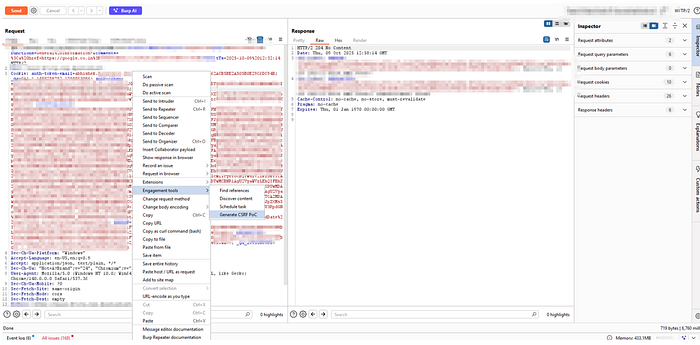
To validate:
- I created the PoC using Account A1
- Then executed it while logged in as Account A2
Result:
The request was accepted.
The application:
- Did not validate CSRF tokens properly
- Relied on weak or missing cookie protections
- Allowed cross user request execution
This confirmed a classic: CSRF vulnerability due to improper request validation
The "Aha" Moment Chaining the Bugs
Individually:
- HTML Injection = Low/Medium
- CSRF = Medium
But together? That's where things got interesting.
Full Exploitation Flow
Here's how the attack unfolds:
- Attacker crafts a feedback payload with a malicious HTML link
- Generates a CSRF PoC for the feedback endpoint
POC
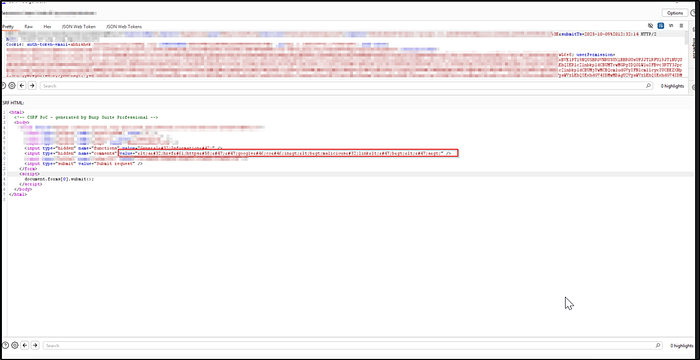
3. Tricks the victim into visiting the malicious page
4. CSRF silently submits the feedback on behalf of the victim
5. Application processes it as legitimate
6. Victim receives an official email from the application
7. Email contains the attacker controlled clickable link
Why This is Dangerous
This is not just a bug. It's a trust abuse chain.
The victim:
- Receives an email from a trusted application
- Sees content that appears to be their own submission
- Clicks a link that feels completely safe
This opens doors to:
- Phishing attacks
- Credential harvesting
- Redirection to malicious websites
- Social engineering at scale
The Key Insight
The most important lesson here: Impact is not defined by individual vulnerabilities, but by how they interact.
What looked like:
- A harmless feedback feature
- A non reflective input field
Turned into:
- A fully weaponized attack chain using trust, automation, and user behavior
How to Fix This
To stop this kind of attack, a few simple things can make a big difference:
1. Handle User Input Safely
- Always clean (sanitize) and encode user input
- Don't allow raw HTML in emails
2. Add Proper CSRF Protection
- Use strong CSRF tokens
- Check origin and referer headers
- Set cookies with proper
SameSitesettings
3. Secure Your Emails
- Treat email content as untrusted
- Avoid adding user controlled HTML directly into emails
Until next time, if you like this blog, stay connected. I'll keep sharing knowledge here don't forget to follow.