
They hand you a laptop, point to a seat in the SOC, and say, "You'll get the hang of it." No one mentions that your first week will involve 17 browser tabs, Slack pings every 90 seconds, and the quiet dread of an alert you don't know how to triage.
This isn't a failure of preparation; it's a failure of onboarding. Most organisations assume analysts will "absorb" context through osmosis. They don't. What separates the overwhelmed from the emerging isn't raw talent. It's having the right scaffolding during those first fragile weeks.
After walking dozens of analysts through this transition, I've found that three simple tools consistently bridge the gap between panic and progress. Not expensive platforms. Not certification dumps. Just practical aids that solve human problems.
Problem #1: "I see an alert, but is it actually dangerous?"
That firewall alert about "suspicious outbound traffic"? It could be ransomware exfiltrating data… or someone from Marketing streaming a Netflix documentary during lunch.
Your tool: MITRE ATT&CK Navigator
This free web tool turns vague panic into structured curiosity. Instead of asking "Is this bad?" (unanswerable), you ask: "What stage of an attack does this behaviour match?"
- Open the MITRE ATT&CK Navigator
- See an alert about PowerShell running weird scripts? → Click Execution → Command and Scripting Interpreter
- Suddenly, you're not guessing, you're comparing. "Yes, this matches technique T1059… but the process tree looks clean. Probably legit."
Your Week 1 action: Pick one alert from your ticketing system. Map it to a MITRE technique, even if you're wrong. The act of trying rewires your brain from "alert = panic" to "alert = puzzle."
Problem #2: "I keep forgetting what normal looks like."
Your brain isn't built to remember that "port 445 traffic spikes at 2 AM every Tuesday because of patching." Yet you'll get dinged in a review for missing that pattern.
Your tool: A dead-simple runbook (Notion or Google Doc)
Externalise your memory so you can focus on thinking, not recalling. Build yours with three columns:
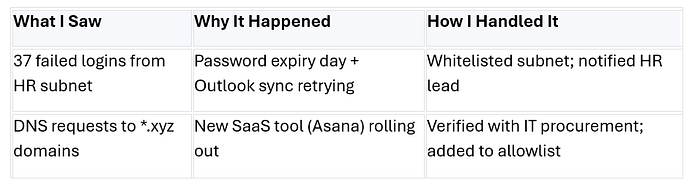
Your Week 1 action: Create a blank table today. Every time you resolve a ticket, even a boring one, add one row. In 30 days, you'll have a personalised "cheat sheet" no senior analyst can give you.
Problem #3: "I'm scared to ask 'stupid' questions."
You notice weird traffic on port 5355. You Google it. You find conflicting answers. You freeze, "If I ask, they'll think I'm incompetent."
Your tool: SANS Internet Storm Centre (ISC) Diary
This free community resource is a judgment-free zone where even experts say, "I don't know, let's figure it out together."
- Visit isc.sans.edu
- Search "port 5355" → You'll find a recent entry: "LLMNR traffic spiking after Windows update KB5034441"
- Suddenly, your "weird alert" is a known behaviour. You can now say confidently: "This matches a documented Windows update pattern, low risk."
No shame. No ego. Just collective problem-solving.
Your Week 1 action: Bookmark the ISC homepage. When an alert confuses you, search there before asking a human. You'll either solve it yourself or walk into a conversation armed with context ("I saw the ISC entry about X, but our environment shows Y, thoughts?"). That's how you grow.
The Real Secret Nobody Mentions
Tools don't make you a good analyst. Curiosity does.
The MITRE framework, your runbook, and SANS ISC aren't magic wands. They're curiosity amplifiers. They turn "I'm lost" into "Let me test a hypothesis."
That shift, from panic to inquiry, is what separates overwhelmed analysts from rising stars. And it starts not with certifications, but with the courage to document one weird alert today.
Your Move This Week: Open a blank doc right now. Title it "My SOC Runbook." Add one row based on an alert you saw this week, even if it was "nothing." That single act breaks the cycle of feeling like you should already know everything.
What's the one alert that still makes your palms sweat? Reply below, and I'll help you map it to a MITRE technique or ISC diary. No judgment. We've all been there.