
Toward a Constraint-Driven Engine of Intelligence
Most modern AI systems are built on a single assumption: that intelligence is the ability to predict the next token in a sequence.
This assumption has produced powerful tools — but also fundamental limitations: hallucination, instability, lack of traceability, and weak grounding in reality.
OPHI begins from a different premise.
Intelligence is not sequence prediction. Intelligence is geometry under constraint.
The Paradigm Shift: From Tokens to Geometry
Traditional AI systems operate over 1D symbolic sequences. Their outputs are probabilistic approximations of language patterns.
OPHI operates over structured geometric state spaces.
Instead of predicting text, it evolves states on a manifold, where meaning exists as relational geometry, not surface language.
This leads to a fundamental shift:
- LLMs → probabilistic sequence prediction
- OPHI → deterministic control over geometric states
Language becomes a projection — not the substrate of thought.
The 3-Layer Manifold Stack
OPHI organizes cognition into three layers:
Layer 0 — Raw Signal
The continuous influx of physical or digital measurements.
Layer 1 — The Latent Semantic Manifold (LSL)
A geometric space where concepts exist as structured relationships. High-curvature regions act as stable semantic anchors.
Layer 2 — Surface Interface
The projection layer where language, symbols, or outputs are expressed.
Meaning is not stored in text. It is encoded in the geometry beneath it.
The Fundamental Operator: Ω
At the core of OPHI is the state evolution operator:
Ω = (state + bias) × α × r × γ
Where:
- state → observed system configuration
- bias → observer-dependent offset
- α (alpha) → amplification or damping factor
- r → reliability or coupling coefficient
- γ (grounding) → external reality alignment
This is not a probabilistic update. It is a controlled transformation of state under constraints.
Stability by Design: Contractive Dynamics
OPHI enforces stability using principles from dynamical systems.
The system operates in a contractive regime, defined by:
- Spectral radius ρ ≤ 1
- Perturbations decay over time
- Divergence is mathematically suppressed
Three mechanisms maintain this:
- Drift Engine (Ψ) — enables controlled exploration
- Recursion Lock (π) — enforces invariant projection
- Φ-Manifold — stabilizes trajectories into bounded orbits
Noise does not accumulate. It is forced to decay.
Distributed Cognition: The 43-Agent Mesh
OPHI is not a single-agent system. It operates as a distributed cognitive mesh.
Key properties:
- Multiple agents generate local interpretations
- Designated anchors stabilize the system
- Asymmetric coupling prevents fragmentation
Instead of averaging outputs, the system forms a coherent field of interpretations.
Ambiguity Is Not Error
Traditional systems treat ambiguity as something to eliminate.
OPHI treats it as structured superposition.
Multiple interpretations coexist until structural invariants are detected. Then, through isomorphic collapse, they resolve into a single consistent form.
The goal is not to remove ambiguity. It is to resolve it without destroying structure.
The Dual-Gate Truth System
OPHI defines truth as:
Truth = Internal Validity × External Grounding
A state must pass two independent gates:
Gate 1 — Internal (SE44)
Ensures structural integrity through strict invariants:
- Coherence ≥ 0.985
- Entropy ≤ 0.01
- RMS Drift ≤ 0.001
If these are violated, the state is rejected.
Gate 2 — External (GCL)
Ensures alignment with reality via:
- Observable signal binding
- Empirical consistency checks
- Reference model comparison
A system that is internally consistent but externally false is rejected.
Memory: Ledger vs. Shell
OPHI separates cognition into two memory domains:
The Fossil Ledger
- Append-only
- Hash-chained (Merkle structure)
- Cryptographically verifiable
This is the permanent record of accepted states.
The Mutable Shell
- Temporary buffer
- Holds rejected or unstable states
- Enables iterative refinement
Exploration is allowed. But only validated states become reality.
The 64-Codon Execution Layer
Validated states are compiled into a deterministic instruction stream.
Examples:
- ATG → Bootstrap / creation
- TTG → Ambiguity translator
- CCC → Fossil lock
This creates a closed symbolic system — an execution layer grounded in validated geometry.
External Grounding Is Mandatory
A system cannot claim truth without physical accountability.
OPHI enforces this through:
- Direct observation binding
- Alignment with real-world data
- Compatibility with validated models
A valid state must correspond to something observable.
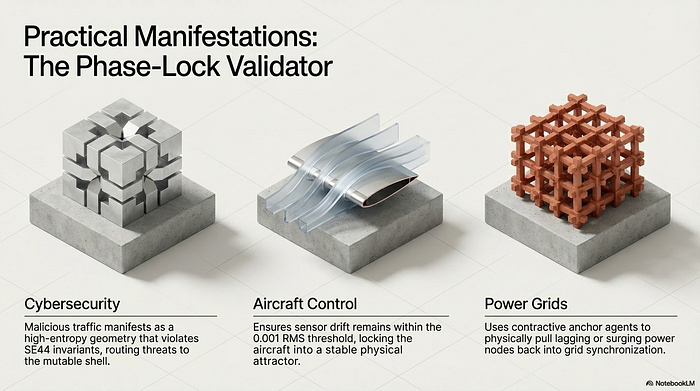
Practical Implications
This architecture is not theoretical. It has immediate applications:
- Cybersecurity → detect high-entropy anomalies as structural violations
- Aircraft control → enforce drift bounds within stable attractors
- Power systems → stabilize distributed nodes through anchored coupling
In each case, instability is not patched — it is prevented by design.
Synthesis: Reality as Consensus
Traditional physics assumes reality exists independently, and observers measure it.
OPHI proposes the inverse:
Reality emerges from synchronized, constrained interpretations.
Formally:
Reality = Consensus(Ωᵢ)
Where each Ωᵢ is a bounded, validated transformation within the system.
Closing
Most AI systems optimize for output.
OPHI optimizes for validity, stability, and traceability.
It does not ask: "What is the most likely answer?"
It asks: "What state can exist without violating the structure of reality?"
That is a fundamentally different question — and it leads to a fundamentally different kind of intelligence.