
June 6, 2026
Weaponizing the Weakest Link: How Attackers Exploit Cascading Failures in Microservices (And How to…
In the world of cybersecurity, we often obsess over SQL Injection, XSS, or zero-day exploits. However, one of the most devastating and…

Pau Dang
4 min read
In the world of cybersecurity, we often obsess over SQL Injection, XSS, or zero-day exploits. However, one of the most devastating and difficult-to-mitigate attacks isn't a complex buffer overflow — it's an Application-Layer Denial of Service (DoS) that turns your own microservices against each other.
Welcome to the concept of Cascading Failures. In this article, we will explore how hackers exploit poor internal network assumptions, how Node.js is uniquely vulnerable if not configured correctly, and the "Resilience Trio" (Timeout, Retry, Circuit Breaker) required to neutralize this threat.
The Attack Scenario: Exploiting the Weakest Link
Imagine an e-commerce platform built on a robust Node.js microservices architecture. The front-facing API Gateway is protected by a Web Application Firewall (WAF), Rate Limiting, and strict authentication.
However, deep inside the system, the core OrderService communicates with a low-priority, internal EmailNotificationService to send order receipts.
The Hacker's Mindset
An attacker (let's call him Mallory) knows he can't brute-force the API Gateway. But he discovers that generating an order triggers a synchronous or awaited call to the EmailNotificationService. What if he can slow down or disrupt this internal Email service?
Mallory uses a botnet to spam the application with legitimate-looking, low-volume requests that specifically trigger the email flow. He doesn't need to overwhelm the CPU, he just needs to create wait time.
The System Collapse (The Weakness)
Here is where the vulnerability lies: Unbounded Promises and Infinite Waits.
Node.js runs on a single-threaded Event Loop. While it handles non-blocking I/O brilliantly, if the OrderService calls a dying EmailNotificationService and awaits a response without a strict Timeout, the connection hangs.
-
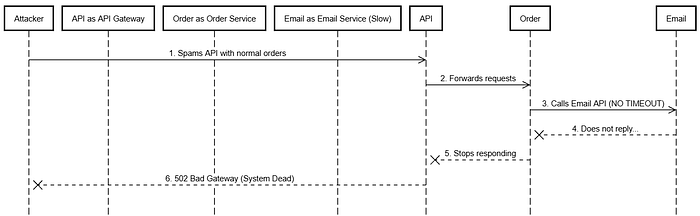
Connection Exhaustion: Hundreds of requests to the OrderService are now stuck in a PENDING state, waiting for the Email service to respond.
-
Resource Starvation: Memory usage spikes. The connection pool to the database is tied up by pending transactions that cannot complete.
-
The Domino Effect: Because OrderService is out of resources, it stops responding to the API Gateway. The Gateway queues up requests until it too runs out of memory and crashes.
The entire e-commerce platform goes offline. The attacker successfully weaponized a non-critical internal service to cause a catastrophic, system-wide DoS.
The Attack Flow (Cascading Failure)
The Defense: The Resilience Trio
To prevent your system from being its own worst enemy, you must adopt a "Zero Trust" mindset regarding internal network calls: assume every downstream service will eventually fail or hang.
We implement defense-in-depth using three core patterns: Timeout, Exponential Backoff Retry, and the Circuit Breaker.
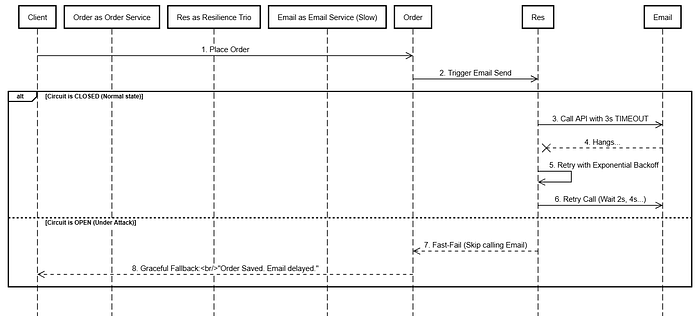
The Prevention Flow (Resilience Layer)
1. The Shield: Timeout (Preventing Resource Hanging)
Never trust the default HTTP timeout (which can be minutes). You must enforce strict application-level timeouts.
// Example Implementation Strategy
export const withTimeout = <T>(promise: Promise<T>, ms: number): Promise<T> => {
    return Promise.race([
        promise,
        new Promise<T>((_, reject) => setTimeout(() => reject(new Error('Operation Timed Out')), ms))
    ]);
};
// Example Implementation Strategy
export const withTimeout = <T>(promise: Promise<T>, ms: number): Promise<T> => {
return Promise.race([
promise,
new Promise<T>((_, reject) => setTimeout(() => reject(new Error('Operation Timed Out')), ms))
]);
};Security Impact: When Mallory tries to hang the Email service, withTimeout forcefully severs the connection after a few seconds. The OrderService frees up its memory and database connections, staying alive to serve other legitimate customers.
2. The Shock Absorber: Advanced Retry (Exponential Backoff)
When a timeout occurs, naive systems immediately retry the request. This leads to a Retry Storm (The Thundering Herd Problem), where your own services effectively DDoS the recovering downstream service.
// Conceptual Exponential Backoff with Jitter
const delay = Math.pow(2, attempt) * 1000 + Math.random() * 1000;
await sleep(delay);
// Conceptual Exponential Backoff with Jitter
const delay = Math.pow(2, attempt) * 1000 + Math.random() * 1000;
await sleep(delay);Security Impact: By adding exponential backoff and jitter (randomness), the retry traffic is smoothed out. The attacker cannot force your services to amplify their attack, giving the downstream service breathing room to recover.
3. The Kill Switch: Circuit Breaker
If a service is under attack, sending any traffic to it is dangerous. The Circuit Breaker monitors the failure rate. If it crosses a critical threshold (e.g., 50% failure rate over 10 seconds), the circuit "Trips" (opens).
// When the circuit is OPEN, fail fast without hitting the network
if (circuitBreaker.isOpen()) {
    throw new Error('Circuit is OPEN - Fast Failing');
}
// When the circuit is OPEN, fail fast without hitting the network
if (circuitBreaker.isOpen()) {
throw new Error('Circuit is OPEN - Fast Failing');
}Security Impact: When the Email service gets bogged down, the Circuit Breaker trips. The OrderService instantly returns a "Graceful Degradation" response (e.g., "Order placed, email will be sent later") without even attempting to open a TCP connection. The attacker's DoS attempt is completely neutralized.
Implementing Resilience Without the Boilerplate
Implementing this "Resilience Trio" correctly from scratch can be tedious and error-prone. A single misconfiguration in the Retry logic, and you might accidentally build a DDoS cannon into your own system.
To solve this for my own projects, I've open-sourced a reference implementation where these enterprise-grade security and resilience patterns are integrated out-of-the-box.
If you are starting a new Node.js microservice and want to ensure it is protected against cascading failures from day one, you can check out the Nodejs Quickstart Generator on GitHub.
It is a CLI tool that scaffolds a production-ready architecture (Clean Architecture or MVC) with the full Timeout, Retry, and Circuit Breaker trio already configured, along with other security best practices.
You can test out the resilient architecture scaffold using:
npx nodejs-quickstart-structure@latest init -n "nodejs-service" -l "TypeScript" -a "Clean Architecture" -d "MySQL" --db-name "demo" -c "REST APIs" --caching "None" --ci-provider "GitHub Actions" --auth JWT --terraform None --no-include-security --resilience Timeout Retry CircuitBreaker --advanced-optionsnpx nodejs-quickstart-structure@latest init -n "nodejs-service" -l "TypeScript" -a "Clean Architecture" -d "MySQL" --db-name "demo" -c "REST APIs" --caching "None" --ci-provider "GitHub Actions" --auth JWT --terraform None --no-include-security --resilience Timeout Retry CircuitBreaker --advanced-optionsExplore the Architecture:
-
GitHub : Nodejs Quickstart Generator
-
Documentation: Application Resilience
-
Author: Pau Dang (Senior SE)