

Tuesday morning. Senior engineer opens the bug ticket. "Checkout flow broken in production." No screenshot. No network logs. No environment details. Just five words and a severity tag.
The engineer messages QA: "Can you provide reproduction steps?"
Twelve hours pass. QA responds with steps. Engineer tries to reproduce locally. Can't. Messages back: "What browser? What account type? What payment method?"
Another day passes. QA provides browser version. Engineer discovers it only happens with specific payment provider. Messages: "Can you capture the network request when it fails?"
Day three. QA doesn't know how to export network logs from browser dev tools. Engineer schedules video call to walk through it. Call happens day four. Network logs reveal the issue: API timeout on a third-party service.
Four days. One bug. Three engineers involved. Five back-and-forth exchanges.
The actual fix took thirty minutes.
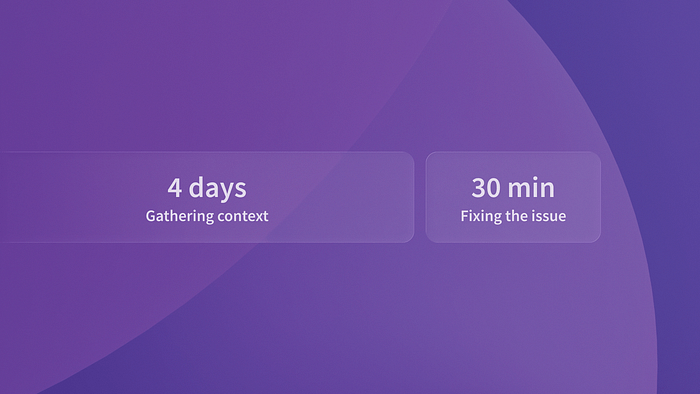
The bug report that took four days to fix
Why incomplete tickets cost engineering teams more than you think
Tuesday morning. Senior engineer opens the bug ticket. "Checkout flow broken in production." No screenshot. No network logs. No environment details. Just five words and a severity tag.
The engineer messages QA: "Can you provide reproduction steps?"
Twelve hours pass. QA responds with steps. Engineer tries to reproduce locally. Can't. Messages back: "What browser? What account type? What payment method?"
Another day passes. QA provides browser version. Engineer discovers it only happens with specific payment provider. Messages: "Can you capture the network request when it fails?"
Day three. QA doesn't know how to export network logs from browser dev tools. Engineer schedules video call to walk through it. Call happens day four. Network logs reveal the issue: API timeout on a third-party service.
Four days. One bug. Three engineers involved. Five back-and-forth exchanges.
The actual fix took thirty minutes.
The hidden cost of incomplete bug reports
Most engineering leaders see QA-developer communication friction as a process problem. Better templates. Clearer guidelines. More training on what to include in bug reports.
They miss the fundamental issue. This isn't about teaching QA teams to write better tickets. It's about the structural impossibility of manually capturing everything developers need to reproduce and fix issues immediately.
When Islands reviewed fix cycle times across eight client projects in early 2025, they discovered the pattern. Average bug report contained three pieces of information: description, reproduction steps, expected behavior. Average developer response required two additional pieces: environment configuration and network state. That gap triggered 2.3 rounds of back-and-forth per bug on average. Multiply by thirty bugs per sprint. Sixty-nine clarification exchanges. Each exchange adding hours or days depending on timezone differences and QA availability.
The communication overhead wasn't the problem. The incomplete initial documentation was.
Developers need a few things to fix bugs without extra questions:
· They need clear steps that reproduce the issue locally.
· They need screenshots or video that show what happened.
· They need network request and response data to spot API failures or timeouts.
· They need environment details like browser version and device type.
· They also need accurate severity so they can set priorities.

Manual bug reporting can't capture all of this consistently. Not because QA teams lack skill. Because people under deadline pressure forget details. They skip steps that seem obvious. They also lack simple tools to export network logs. They may not have tools to record reproduction steps.
The Katalon 2025 State of Software Quality Report found that 61% of QA teams use AI-driven testing. They use it to automate routine tasks. The industry momentum isn't just about test execution. It's about eliminating manual overhead in the entire testing loop, from generation through reporting.
What comprehensive bug tickets actually look like
Late 2024. Engineering team at a fintech startup running QA flow autonomous testing noticed something. Bug tickets from automated runs included information their QA team never captured manually. Full network request and response bodies. Exact DOM state when errors occurred. Step-by-step reproduction with millisecond timestamps. Screenshots at every interaction point. Browser console logs. Environment fingerprints.
Developers stopped asking clarifying questions. They just fixed the bugs.
The difference wasn't better process. It was architectural. When systems run tests and generate bug reports automatically, they capture context that humans can't document by hand. Network layer visibility requires intercepting requests in real-time. Reproduction accuracy requires recording every interaction. Environment details require programmatic collection. Severity classification requires analyzing error patterns across thousands of historical bugs.
QA Flow's automated bug ticket generation reached 94.7% accuracy in severity classification. It learned from patterns found across millions of test runs. Not because the AI understands business impact better than humans. Because it sees correlations between error types, affected user flows, and historical fix urgency that manual classification misses.
The GitLab 2025 Global DevSecOps Report signals where this goes next. 85% of respondents predict compliance will be built directly into code and automatically applied by 2027. The shift from manual to automated quality gates extends beyond test execution into every aspect of quality documentation.
Comprehensive bug tickets eliminate communication overhead by giving developers everything upfront. When reproduction steps include exact DOM selectors and interaction sequences, developers reproduce issues on first try. When network logs show request timing and response codes, they identify timeout and API issues immediately. When screenshots capture visual state at each step, they see what users saw. When severity classification comes from ML models trained on historical patterns, they prioritize accurately without debate.
The back-and-forth disappears. Not because communication improved. Because the initial ticket answered every question.
Why the testing loop matters more than test automation
Most conversations about test automation focus on execution. Can you run tests faster? Can you cover more scenarios? Can you reduce flakiness?
They ignore what happens after tests run. Someone still has to document failures. Create bug tickets. Gather context. Chase down reproduction steps.
That manual gap is where days disappear.
The ResearchAndMarkets.com Automation Testing Market Report 2026 projects growth from $19.97 billion in 2025. It expects the market to reach $51.36 billion by 2031. The 17.05% CAGR isn't driven by faster test execution alone. It is driven by demand for end-to-end testing solutions that cover the full loop. This includes test generation and clear, complete bug reporting.
Companies scaling rapidly can't afford release delays from incomplete tickets. When Timecapsule analyzed their January 2025 release cycle, they found bug-related delays averaged 4.2 days per issue. Not fix time. Communication time. QA providing additional context. Developers attempting blind fixes. QA verifying. Developers requesting more information. The actual development work took hours. The coordination took days.
Closing the testing loop means treating bug documentation as part of automated testing infrastructure, not manual follow-up work. When test systems capture comprehensive context automatically, fix cycles compress from days to hours. Not because developers work faster. Because they start working immediately instead of gathering information first.
The competitive advantage isn't having automated tests. It's having automated tests that produce comprehensive bug reports without human effort. That gap determines whether your release cycles are measured in weeks or days.
The documentation problem disguised as communication problem
Engineering leaders see QA-developer ping-pong and diagnose communication breakdown. They implement better processes. Clearer templates. More detailed guidelines for bug report structure.
The patterns described in [Bug report template: structure, tips, and example] help teams standardize manual reporting. But templates don't solve the fundamental constraint. Humans can't manually capture network request bodies, timing data, and environment fingerprints with the detail developers need. Not consistently. Not under time pressure. Not without tooling that makes capture automatic.
The real problem is documentation infrastructure. Manual bug reporting asks people to do a job better handled by automated systems. These systems capture context as a byproduct of running tests.
When you reframe incomplete bug tickets as infrastructure problem rather than communication problem, the solution changes. Not better training. Not clearer templates. Automated bug ticket generation that treats comprehensive documentation as architectural requirement, not manual best practice.
Teams running autonomous testing platforms like QA flow report fixing this at the system level. Tests run. Failures generate tickets automatically. Tickets include everything developers need. Fix cycles compress. As documented in [How QA flow helps QA engineers], this changes what QA focuses on. QA engineers spend less time creating tickets. They spend more time on strategic quality work. It also removes communication overhead that can delay releases.
The market momentum toward comprehensive automated testing reflects this realization. Fast test execution matters less than complete bug documentation. You can run 10,000 tests per hour. But if failures still need manual investigation and context gathering, you still have not closed the loop.
From process improvement to competitive advantage
Industry reports on [releasing twice as often with confidence] share a common pattern. Teams that double release frequency don't just automate test execution. They automate the entire testing loop, including comprehensive bug reporting that eliminates QA-developer back-and-forth.
The transformation isn't about better communication. It's about removing the need for communication by capturing everything upfront.
One bug with incomplete details costs 2–4 days in clarification exchanges. Twenty bugs per release. Thirty releases per year. The math shows weeks of accumulated delay from communication overhead alone. Not development time. Not testing time. Coordination time.
Comprehensive automated bug reporting eliminates that tax entirely. Failures generate tickets with network logs, screenshots, reproduction steps, environment details, and ML-classified severity. Developers start fixing immediately. Fix cycles compress from days to hours. Release velocity increases not because teams work faster, but because they spend less time asking questions.
That's the competitive advantage. Not faster testing. Faster fixing. Teams that close the testing loop first ship faster than competitors who still treat bug notes as manual follow-up work.
Incomplete bug tickets add days to every release. Comprehensive automated reporting gives developers everything they need immediately. The choice determines whether your release cycles are constrained by communication overhead or actual development work.