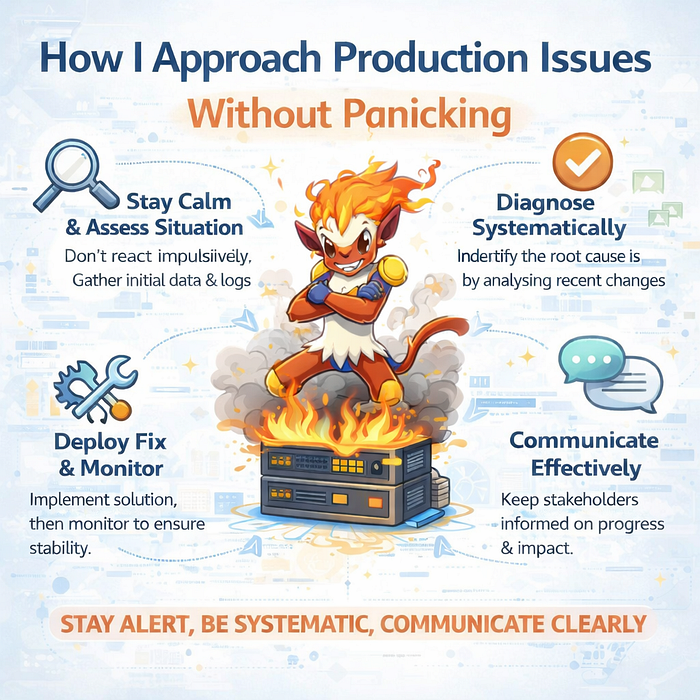
(A Backend Engineer's Playbook for Staying Calm Under Pressure)
Introduction: The First Time Production Broke
The first time I was on-call when production went down, I panicked.
Dashboards were red. Support tickets were coming in. Slack was noisy. Everyone was asking: "What happened?"
And I had no clear answer.
I jumped between logs, metrics, and code without a plan. I tried random fixes. Nothing worked fast.
That incident taught me something important:
Handling production issues is less about being fast — and more about being calm and systematic.
Over time, after dealing with multiple L3/L4 incidents, I developed a simple mental model to debug issues without losing control.
This is the approach I use today.
1. My First Rule: Don't React. Stabilize.
When an incident starts, the instinct is to "do something" immediately.
That's dangerous.
My first goal is always stability, not root cause.
I ask:
- Is the system still serving users?
- Can we reduce impact quickly?
- Do we need a rollback or temporary mitigation?
Examples:
- Scale up instances
- Disable a problematic feature flag
- Route traffic away
- Roll back last deployment
This buys time.
Time = clarity.
Without stability, every investigation becomes rushed and messy.
2. My Mental Model: Three Questions
Once things are stable, I focus on three questions:
1️⃣ What Changed?
Most incidents are caused by change.
- New deployment?
- Config update?
- Data migration?
- Traffic spike?
- External dependency issue?
I always check this first.
No change → investigation becomes harder.
Change → investigation becomes focused.
2️⃣ Where Is It Failing?
Not "what is broken", but where.
- API layer?
- Database?
- Cache?
- Queue?
- External service?
This narrows the search space.
Instead of "everything is slow", I try to reach:
"Requests are slow between Service A and DB."
3️⃣ Why Is It Failing?
Only after the first two.
This is where root cause lives:
- Resource exhaustion
- Bad query
- Race condition
- Missing validation
- Timeout mismatch
Jumping to "why" too early usually leads to wrong conclusions.
3. My Debugging Checklist
Over time, I built a personal checklist. I follow it almost mechanically during incidents.
✅ Step 1: Check Monitoring
- Latency
- Error rate
- Throughput
- CPU / Memory
- DB connections
This tells me if it's system-wide or localized.
✅ Step 2: Check Logs (With Purpose)
I don't "scroll logs".
I search for:
- Correlation IDs
- Error patterns
- First occurrence time
- Repeated failures
Random log reading wastes time.
✅ Step 3: Reproduce (If Possible)
If I can reproduce:
- In staging
- With sample payload
- With specific user
Debugging becomes 10× faster.
If I can't, I rely more on metrics and traces.
✅ Step 4: Trace the Request Path
I mentally trace:
Client → Gateway → Service → DB → External API → ResponseWhere does it slow down or fail?
Distributed tracing helps a lot here.
✅ Step 5: Validate Assumptions
During incidents, assumptions multiply.
I constantly ask:
"Do I have evidence for this?"
If not, I verify.
4. How I Prioritize During an Incident
Not all tasks are equal during production issues.
My priority order:
🥇 1. User Impact
Anything that reduces user pain comes first.
🥈 2. Data Safety
Avoid corruption, duplication, or loss.
🥉 3. Service Stability
Prevent cascading failures.
🥉 4. Root Cause
Only after the above.
Fixing root cause while users are suffering is often the wrong trade-off.
5. Communication: The Hidden Skill
Early in my career, I underestimated communication.
Now I see it as part of engineering.
During incidents, I:
✅ Share Status Regularly
Even if there is no update:
"Still investigating DB latency. Next update in 15 mins."
Silence increases anxiety.
✅ Separate Facts from Hypotheses
I clearly say:
- Fact: "DB connections are maxed out."
- Hypothesis: "Possibly due to new batch job."
This builds trust.
✅ Avoid Blame
Incidents are system failures, not people failures. Blame kills collaboration.
6. How This Approach Changed My Work
Since following this approach:
- I resolve incidents faster
- I make fewer risky fixes
- I feel less stressed
- Teams trust my updates
- Postmortems are more useful
Most importantly, I stopped feeling "out of control" during outages.
7. What I Wish I Knew Earlier
If I could tell my younger self one thing:
You don't need to know everything during an incident. You need a process.
Calm comes from structure.
Not from experience alone.
Conclusion: Panic Is Optional
Production issues will never stop.
Systems grow. Complexity increases. Failures happen.
But panic is optional.
With a clear mental model, a simple checklist, and honest communication, you can handle incidents with confidence — even when everything looks broken.
My Personal Rule Today
Before every major action, I ask:
"Is this helping users right now, or just helping me feel busy?"
That question keeps me grounded.