
Today was one of the most interesting days in my cybersecurity foundation learning journey because I started understanding the actual basics of networking and how devices communicate with each other. Before learning cybersecurity, I always thought hacking and security were only about tools and attacks, but now I understand that everything in cybersecurity starts with networking fundamentals.
I learned that a network is simply a group of connected devices communicating with each other. Devices like laptops, mobile phones, routers, switches, and servers all become part of a network when they exchange data. Networking is the process that makes this communication possible. At first, both words looked similar to me, but now I understand the difference clearly. A network is the connection itself, while networking is the communication process between devices.
One of the most important things I learned today was about routers and switches. Earlier, I used to think both devices did the same work, but now I understand their roles. A router connects different networks and provides internet access, while a switch connects devices inside the same local network. The router acts like a traffic controller between my local network and the internet, whereas the switch helps devices communicate efficiently inside the LAN.
I also learned how DHCP works in a router. Whenever a new device connects to Wi-Fi, the router automatically assigns network settings like IP address, DNS, and gateway information. This process happens using DHCP, which stands for Dynamic Host Configuration Protocol. I found this concept very interesting because earlier I never thought about how devices automatically receive internet access when connected to Wi-Fi.
Another important concept I learned today was IP addressing. I understood that every device connected to a network requires a unique IP address for communication. Public IP addresses are visible on the internet, while private IP addresses are used inside local networks like home or office Wi-Fi. I also explored IPv4 and IPv6. IPv4 is the most commonly used version today, but because internet-connected devices are increasing rapidly, IPv6 was introduced to provide a much larger number of addresses and better scalability for future networking.
I also learned about LAN and WAN networks. LAN stands for Local Area Network and is usually used in smaller areas like homes, offices, and labs. WAN stands for Wide Area Network and covers larger areas like countries and continents which is internet. The internet itself is the biggest example of a WAN. Understanding these concepts helped me see how communication works at both local and global levels.
One of the most practical things I explored today was common ports seen in Wireshark. I learned that ports help identify which service or application is communicating on the network. Some common ports I saw were:
Port 80 for HTTP Port 443 for HTTPS Port 53 for DNS Port 22 for SSH Port 67 and 68 for DHCP
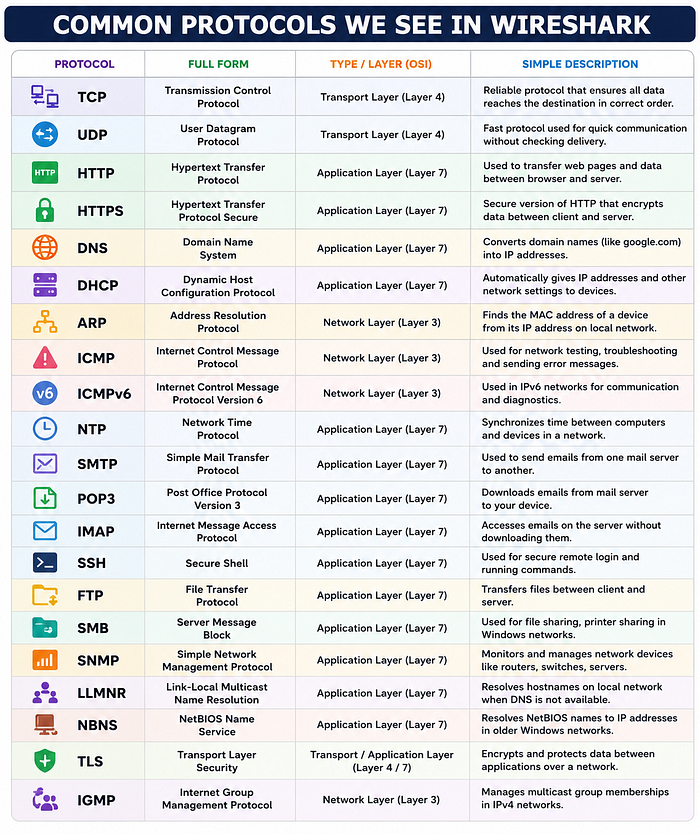
Learning these ports made packet analysis look less confusing and helped me understand how network communication actually happens behind the scenes.
I also came across many small networking terminologies like packets, protocols, MAC addresses, DNS, NAT, and firewalls. Earlier these terms looked very complicated, but now I am slowly starting to understand their purpose and importance in cybersecurity.
Day by day, I am realizing that cybersecurity is not just about hacking systems. It is more about understanding communication, networks, protocols, devices, and how data is travels between systems securely. Networking fundamentals are becoming the strongest base for my cybersecurity journey, and I feel more confident compared to my first day.
This is only my fifth day of learning cybersecurity foundations, but every small concept I learn now feels like an important building block for advanced cybersecurity topics in the future.
#CyberSecurity #Networking #NetworkSecurity #Wireshark #CyberOps #LearningCyberSecurity #TCPIP #NetworkAnalysis #BeginnerFriendly #CyberLearning #TechLearning #CyberWorld #CyberFundamentals