
Disclaimer
I personally do not advocate any process or procedure contained in any of my 100% human publications. Information presented is not intended to provide legal, lawful, financial or medical advice, diagnosis, treatment, cure, nor prevent any disease. Views expressed are for educational purposes only. I surround, protect, purify and make harmless the following information.
Major label changes in the food world
Feb 18, 2026
The "Black Box" of the grocery store is here: in 2026, new labeling laws are forcing Big Food to put warning labels on products containing harmful additives and high sugar. Learn why food companies are suing to keep you in the dark and how you can shop for "real food" to protect your family's health.
- Not recommended for human consumption
- The global magnifying glass
- Secret clean up and lawsuits
SB 25 Update: Texas Adopts Final Food Labeling Rule Before 2027 Deadline
Feb 26, 2026
Texas has finalized its rule implementing SB 25's ingredient warning label requirement. Although enforcement is currently blocked by a federal court injunction, food manufacturers selling in Texas must prepare for potential compliance by January 1, 2027. The rule raises significant First Amendment and federal preemption questions that could reshape state-level food labeling authority nationwide.
https://jurislawgroup.com/sb-25-update-texas-adopts-final-food-labeling-rule-before-2027-deadline/
AI-generated answer. Please verify critical facts.
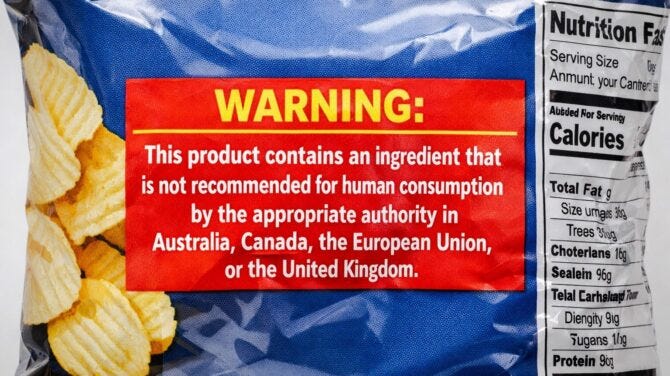
Texas has enacted Senate Bill 25, known as the "Make Texas Healthy Again Act," which requires warning labels on packaged foods sold in the state containing any of 44 specific ingredients. The label must state: "WARNING: This product contains an ingredient that is not recommended for human consumption by the appropriate authority in Australia, Canada, the European Union, or the United Kingdom."
This requirement applies only to food products developed or copyrighted on or after January 1, 2027, and is limited to FDA-regulated packaged foods — excluding USDA-regulated meats, poultry, and foods prepared in restaurants.
The law targets ingredients such as Red 40, Yellow 5, titanium dioxide, BHA, BHT, and partially hydrogenated oils, which are legal in the U.S. but restricted or banned in other countries. However, the law is currently under legal challenge. A federal court has temporarily blocked enforcement of the warning label requirement while reviewing claims that it violates the First Amendment, is preempted by federal law, and contains inaccurate or misleading information.
Food industry groups argue the labels are misleading because many ingredients are approved by the FDA and not universally banned abroad. A decision on the preliminary injunction is expected in early 2026. Until then, the law remains in legal limbo, and its nationwide impact depends on the outcome of the litigation.
Time to care and share
Each of us has a responsibility to share beneficial information that finds us. Please contribute to reducing the negative impact of toxins ingested from food by sharing this information.
Please share and subscribe free.
Without prejudice and without recourse Doreen Agostino