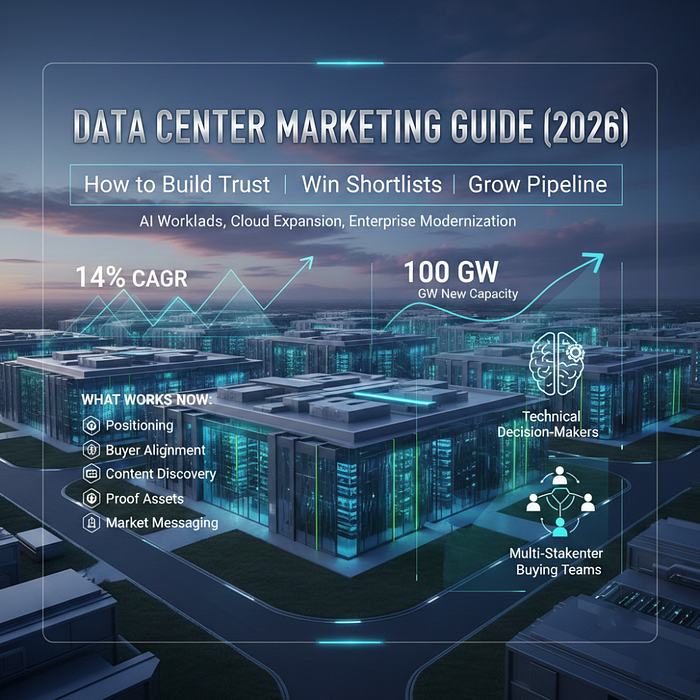
Colocation, interconnection, edge, and connectivity services don't sell themselves — even when the infrastructure is world-class. The providers that consistently win shortlists and grow accounts are the ones that show up during the buyer's research phase with clear answers, credible proof, and a digital presence built for evaluation. That's what a modern data center marketing guide needs to address.
This isn't about brand awareness campaigns or trade show booths. It's about building a marketing engine that generates trust before a buyer ever picks up the phone — and continues to earn that trust through procurement, deployment, and account expansion.
What Is Data Center Marketing?
Data center marketing is the strategy and execution used to generate demand for colocation, interconnection, edge, connectivity, and related digital infrastructure services. It focuses on showing up during the buyer's research phase, answering the evaluation questions that actually drive decisions, and providing evidence that reduces perceived risk.
Effective programs combine market positioning, technical content, earned credibility, and sales enablement so that marketing supports the full buying journey — from initial awareness through procurement and beyond.
How Is Data Center Marketing Different from Typical B2B?
Most data center deals involve large buying committees that span IT, security, procurement, finance, legal, and operations. Timelines are longer, decisions carry higher operational risk, and buyers want proof — not promises. Three realities shape the programs that actually win:
• Buyers research quietly before contacting providers. By the time someone fills out a form or requests a tour, they've already built a shortlist. If your digital presence didn't help them during that research phase, you're not on it.
• Proof beats promises. Uptime records, compliance certifications, power availability documentation, and deployment timelines matter more than brand messaging or taglines. Buyers are evaluating risk, not aesthetics.
• Speed and structure matter after first contact. Slow follow-up after events, tours, and first meetings loses deals. Marketing should enable sales with ready-to-send assets, not slow them down.
Who Are You Marketing To?
Not all data center buyers evaluate the same way. Understanding what each segment prioritizes is essential for building content and messaging that resonates.
Hyperscalers
Hyperscale buyers prioritize power availability, density, deployment speed, expansion potential, and risk mitigation. They're evaluating at scale and moving fast — your content needs to match that pace with clear specs and capacity data.
Enterprises and Regulated Industries
Enterprise and regulated-industry buyers prioritize security posture, compliance credentials (SOC 2, ISO 27001, HIPAA, PCI DSS), uptime SLAs, and predictable pricing. These buyers need to justify the decision internally across multiple stakeholders, so make your proof easy to find and share.
Telecom and Network Buyers
Telecom and network buyers prioritize carrier neutrality, interconnection options, routes and latency, and partner density. Your ecosystem story — who else is in the building and what connectivity options exist — is often the deciding factor.
How to Build for the Data Center Buyer Journey
A strong data center marketing guide maps directly to how buyers actually move through their evaluation. Here's what that looks like at each stage.
Awareness: Become Known Before the RFP
• Earn visibility through credible industry and regional coverage — not just paid placements.
• Publish executive and technical viewpoints tied to real milestones: expansions, certifications, new market entries.
• Use clear positioning that highlights what makes your facilities and operations genuinely different from competitors in the same metro.
Consideration: Become the Most Useful Evaluation Resource
• Create comparison content and checklists that match how teams actually evaluate vendors internally.
• Publish facility and solution pages that answer requirements directly: power, cooling, security, compliance, and connectivity.
• Offer tools such as TCO explainers, latency estimators, or deployment timeline planners that make your site a working resource, not just a brochure.
Decision: Reduce Friction in Procurement
• Provide virtual tours, photo and video walkthroughs, and facility maps that buyers can share with their teams.
• Offer downloadable spec sheets and structured RFP response resources.
• Make it frictionless to request pricing, schedule a tour, and start security questionnaires.
Expansion: Grow Accounts After the First Win
• Use customer stories, reference programs, and QBR-style updates to deepen trust with existing accounts.
• Enable cross-sells: additional cabinets, cross-connects, connectivity upgrades, and multi-site deployments.
• Publish regional or industry-specific expansion content that gives current customers a reason to consolidate with you.
What Pages and Assets Actually Convert?
If your site is missing conversion assets, you may be generating traffic but not pipeline. These are the pages and assets that data center buyers consistently engage with during active evaluations:
• Market pages by metro or region with local power, network, and availability details that match how buyers search.
• Facility pages with power, cooling, security, and connectivity specs written for evaluators — not marketers.
• Compliance and security hub pages summarizing certifications and operating processes in a format that's easy to scan and share internally.
• Spec sheets (web and PDF) for fast evaluation and internal distribution.
• Case studies tied to specific industries, workloads, and measurable outcomes.
How to Build Market-by-Market Messaging
Demand is geographic. Even global buyers start with a specific metro requirement. Building dedicated market content around your top regions is one of the highest-leverage activities in data center marketing.
For each priority market, build content that addresses:
• Power availability and constraints — what is available, when, and at what density.
• Network ecosystem — carriers, meet-me rooms, cloud on-ramps, and interconnection options.
• Latency context and routes relevant to the workloads your target buyers are running.
• Regional compliance or industry patterns: finance, healthcare, government, and manufacturing all have different priorities.
• Local credibility signals: community engagement, workforce programs, or partnerships that demonstrate long-term commitment to the market.
Frequently Asked Questions
How is data center marketing different from SaaS marketing?
Data center marketing is built for longer sales cycles, larger buying committees, higher operational risk, and more technical evaluation criteria. Content must be proof-driven and designed to help multiple stakeholders align internally — not just generate top-of-funnel leads.
What should a data center marketing agency do?
A specialized agency should understand technical buyers and long-cycle demand generation. They should build discoverable facility and market content, credible proof assets, and a follow-up system that supports sales throughout a deal cycle that can stretch months. For a deeper look at what this involves, this data center marketing guide covers the full framework.
What is the fastest way to improve inbound pipeline?
Start with your market and facility pages. Upgrade the content to answer evaluator questions directly, publish downloadable spec sheets, and simplify the tour and pricing request workflow. Then reinforce with credibility signals and consistent sales follow-up.
What compliance certifications matter most?
The most commonly evaluated certifications include SOC 2 Type II, ISO 27001, HIPAA, and PCI DSS. Make these easy to find on your site with downloadable documentation that buyers can share with their internal compliance and security teams.
The Bottom Line
The data center providers that consistently win aren't the ones with the biggest marketing budgets. They're the ones that made it easiest for a buying committee to evaluate, shortlist, and approve them. Every page on your site, every proof asset, and every follow-up touchpoint either accelerates that process or stalls it. A well-executed data center marketing strategy treats every interaction as an opportunity to reduce risk and build trust — from the first search result to the signed contract and beyond.