
Cyber security services help businesses identify vulnerabilities, validate security controls, and maintain compliance with regulatory standards while supporting long-term risk management.
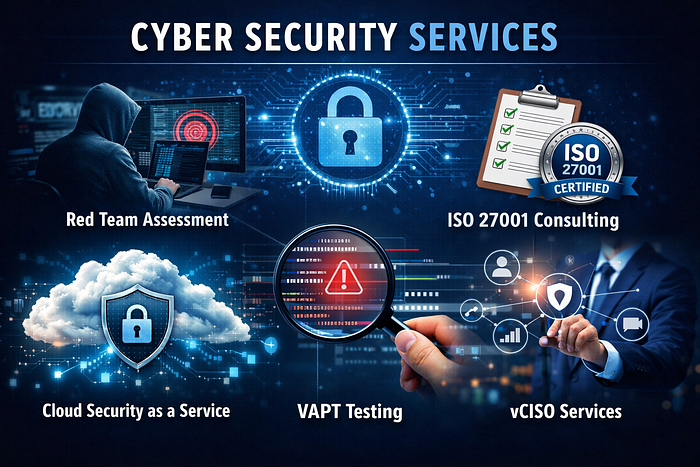
This article outlines how structured cybersecurity services address evolving threats through red team assessment, ISO 27001 consulting services, cloud security as a service, VAPT testing, and vCISO support.
The Role of Cyber Security Services in Business Risk Management
Cyber security services are designed to evaluate how systems, people, and processes respond to real-world attack scenarios. Rather than relying solely on automated tools, effective security programmes combine technical assessments, governance frameworks, and continuous oversight.
Key objectives include:
- Identifying exploitable weaknesses before attackers do
- Validating security controls across infrastructure and applications
- Supporting compliance with recognised security standards
- Providing leadership-level visibility into cyber risk
Red Team Assessment for Real-World Threat Simulation
A red team assessment evaluates how well an organisation can detect and respond to advanced attack techniques. Unlike basic vulnerability scans, red team exercises simulate real adversary behaviour, including lateral movement, privilege escalation, and social engineering where applicable.
These assessments help organisations:
- Test incident detection and response capabilities
- Identify gaps in monitoring and alerting
- Measure the effectiveness of security teams and tools
Red team assessments are particularly valuable for enterprises with mature security controls that require deeper validation.
ISO 27001 Consulting Services for Structured Compliance
ISO 27001 consulting services support organisations in implementing and maintaining an Information Security Management System (ISMS). Compliance requires more than documentation — it involves risk assessment, control selection, and ongoing governance.
ISO 27001 consulting typically includes:
- Gap analysis against ISO 27001 requirements
- Risk assessment and treatment planning
- Policy and control implementation support
- Internal audit and certification readiness
A structured approach ensures security controls align with business objectives while meeting audit expectations.
Cloud Security as a Service for Dynamic Environments
As workloads move to public and hybrid cloud platforms, cloud security as a service helps organisations manage shared responsibility models effectively. Cloud misconfigurations, insecure access controls, and exposed APIs remain common causes of data breaches.
Cloud security services focus on:
- Secure cloud architecture and configuration reviews
- Identity and access management assessment
- Continuous monitoring for misconfigurations and threats
- Alignment with compliance and governance requirements
This approach supports scalability without compromising security posture.
VAPT Testing to Identify Technical Vulnerabilities
VAPT testing (Vulnerability Assessment and Penetration Testing) remains a foundational component of cyber security services. Vulnerability assessments identify known weaknesses, while penetration testing validates whether those weaknesses can be exploited in real scenarios.
VAPT testing helps organisations:
- Prioritise remediation based on exploitability
- Reduce attack surfaces across applications and networks
- Meet regulatory and customer security requirements
Regular testing ensures security measures remain effective as systems evolve.
vCISO Services for Strategic Security Leadership
Not all organisations require a full-time Chief Information Security Officer. vCISO services provide access to experienced security leadership without long-term overhead.
vCISO support typically covers:
- Cyber security strategy and roadmap development
- Risk governance and executive reporting
- Security policy and programme oversight
- Incident response planning and tabletop exercises
This model enables organisations to align security initiatives with business priorities.
Building a Sustainable Security Programme
Cybersecurity services are most effective when integrated into ongoing business operations, rather than treated as one-time activities. Combining technical testing, compliance frameworks, cloud security, and leadership oversight allows organisations to adapt to changing threat landscapes.
A balanced security programme improves resilience, supports regulatory obligations, and provides stakeholders with clear visibility into cyber risk.