
Older computers do not compare especially favorably with more modern counterparts. Of course, the hardware was more limited, and the design of the oldest is not as similar as today. With more limited hardware, the software was also more limited.
It should be noted that those that pre-dated the PC were a good deal larger. While mainframes remain, they are not as large as the older mainframes. Some of the oldest were based more on packet-switching until Intel entered the market in the 1970s.
The early Apple models were the first real, smaller personal computers, such as the Apple Lisa. These actually introduced the mouse and larger portable disk, along with a GUI OS, but they did not include such hardware as USB slots or CD-ROMs. Of course, they had only limited Ram and storage space of mere kilobytes.
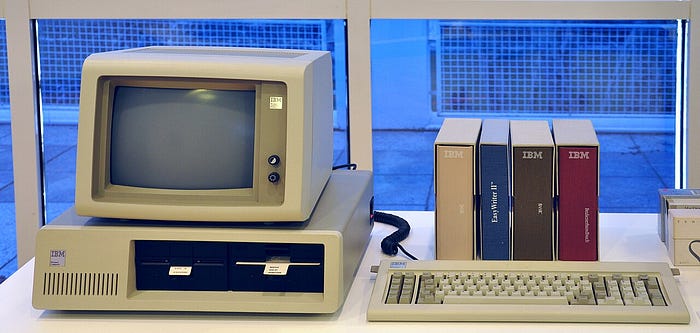
I suppose it is worth noting that the IBM PC was not so big with the GUI operating system until Windows. The PC was initially DOS-based. DOS relied more on typed input for the operating system than Windows, so the mouse was not so important. Mice were not especially prevalent in the 1980s. However, the likes of the Apple Mac were some of the first to make use of mice.
The older IBM PC also included five-and-a-quarter-inch floppy disks before the progression to smaller, more durable floppy disks. Today, the floppy disk is antiquated. In the place of the floppy disk are USB (Universal Serial Bus) slots, for USB storage devices. These are again a little smaller still.
The CD-ROM was perhaps the biggest enhancement to the PC. Although this did not entirely replace floppy disks, the superior storage of the CD was a big asset to software. With the CD, more advanced games and software could now be played on the PC for the first time. Originally, these were read-only, but now that has changed. The CD-ROM helped ensure better software, while the DVD is really just a progression of the CD, which has largely replaced it. Yet, DVD drives have gradually disappeared from more and more PCs because they've become increasingly redundant for software installation and video & music playback.
Admittedly, while there is evidently a big gap in terms of specifications, with gigabytes of storage instead of kilobytes, the actual PC hardware is similar. For example, take the overall design of keyboards, which are still QWERTY keyboards in layout, with many old and traditional keys such as Enter, Caps Lock, Space, Esc, etc. The mouse has also remained largely two-button. However, not all keyboards and mice have cables these days.
So, computers of today are a good deal smaller and cheaper than earlier alternatives. There have been a good few new additions to the PC, most notably the progression from DOS OS to Windows and USB slots. However, the keyboard and mouse remain similar in design.
Read more of my tech articles on Medium:
A Modern History of the Computer and Its Innovators
A Brief History of the Personal Computer