In the world of Bug Bounty, there is a specific kind of frustration (and excitement) that occurs when you find a critical vulnerability, but a Web Application Firewall (WAF) stands firmly in your way. This is exactly what happened during my recent assessment of redacted.org.
Here is how I moved from a failed sqlmap/ghauri scan to a successful manual data exfiltration.
1. The Initial "Aha!" Moment
It all started with an active scan. I noticed an endpoint that felt… "sluggish." After a few manual probes, I confirmed a Time-Based Blind SQL Injection using a classic sleep primitive:
Payload: ,(select*from(select(sleep(20)))a)
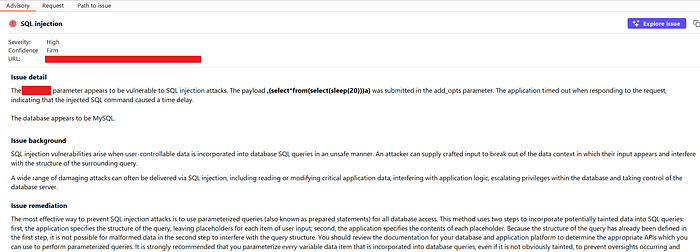
The server hung for exactly 20 seconds. Jackpot. But the celebration was short-lived.
2. When Automation Fail
I immediately fired up sqlmap and ghauri to automate the data dumping. To my surprise, both failed. The target was behind a sophisticated WAF that recognized the signature patterns of automated tools and blocked them instantly.
I realized that if I wanted the data, I'd have to get it the hard way: Manual Exploitation.
To perform a Blind SQLi, you need to ask the database "True/False" questions. I started by testing a simple conditional query to see what the WAF would allow:
The "TRUE" Query: ,(SELECT 1234 FROM (SELECT(SLEEP(5)) WHERE 1=1)ABCD) Result: A successful 5-second delay.
3. The Battle of the Blacklist
However, the real challenge began when I tried to exfiltrate data. I needed to read the database name, user, and hostname, but the WAF was watching every common string manipulation function like a hawk:
- ❌ SUBSTR() / SUBSTRING() / MID(): BLOCKED
- ❌ LEFT() / RIGHT(): BLOCKED
- ❌ LIKE / REGEXP: BLOCKED
The security team had effectively "muted" the usual suspects of SQL data extraction. I initially thought so.
Beyond just changing the function names, I discovered that the WAF's signature matching was strictly looking for standard function call patterns (e.g., FUNCTION(arg1, arg2)). To evade this, I utilized an alternative SQL syntax for the MID() function.
Instead of the common comma-separated syntax:
❌ MID(column, pos, 1)
I used the expression-based syntax, which leverages SQL keywords to define the offset and length:
✅ MID(column FROM pos FOR 1)
This subtle shift in syntax completely bypassed the filter, as the WAF did not recognize the FROM…FOR structure as a malicious slicing attempt. This proves that even when a function name is not blocked, the way you call it can be the key to a successful bypass.

4. Leveraging AI to Build an Automated Extraction Engine
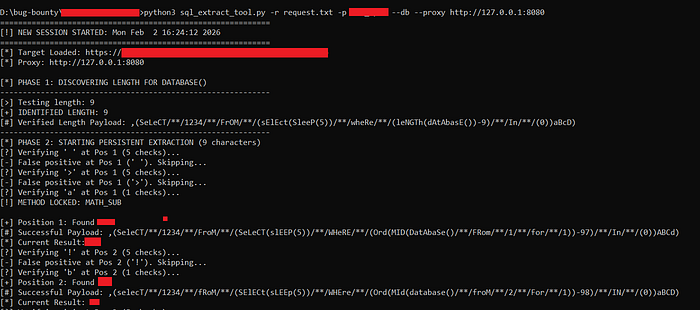
Armed with a clear logical blueprint, I collaborated with Gemini AI to bridge the gap between theory and execution, resulting in an automated tool that turns complex bypass techniques into functional code.
The Three Core Pillars
- Non-comma Syntax Bypass: Traditional functions like MID(str, 1, 1) are easily flagged by WAF signatures due to the use of commas. MASIE utilizes the ANSI SQL Standard syntax: MID(str FROM 1 FOR 1). Eliminating commas allows payloads to slip through common detection rules.
- Adaptive Method Locking: During the extraction of the first character, the tool "probes" the target with various techniques (Math subtraction, Between, Case When, etc.). Once a working bypass is confirmed, this tool locks that specific method for the remainder of the session. This optimizes the request count and maintains a consistent, stable traffic fingerprint.
- Strict Multi-Verification: To combat network jitter and False Positives, this tool employs a tiered verification system. It double-checks alphanumeric characters and performs 5 consecutive checks for special characters to ensure 100% data integrity.
Link tool: https://github.com/thanhnx9/sqlinjecion-bypass-filter