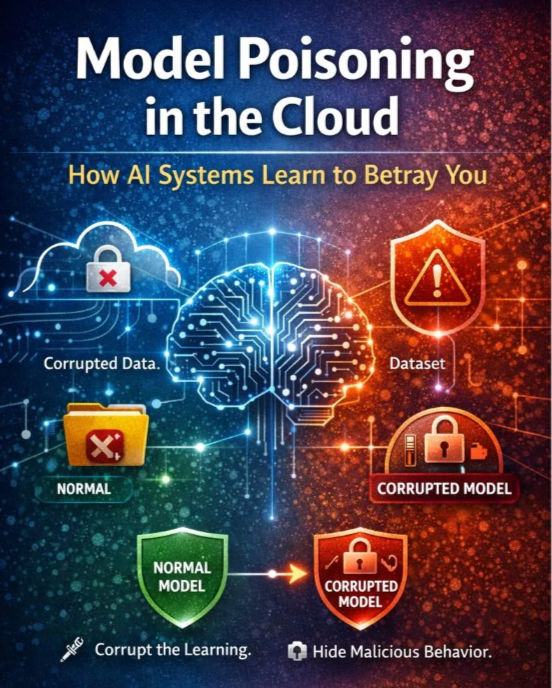

Most security incidents are noisy. Something breaks. Something crashes. Something triggers an alert. Model poisoning doesn't do any of that. Your AI system keeps running. Accuracy metrics look acceptable. Dashboards stay green. And yet the model is no longer doing what you think it is.
What Model Poisoning Really Is (Beyond the Textbook Definition)
Model poisoning is not just "bad data."
It is intentional manipulation of the learning process so that a model internalizes behavior that benefits an attacker, often in ways that are invisible during normal operation.
A poisoned model:
- Appears normal under standard evaluation
- Behaves incorrectly under specific conditions
- Can be biased, backdoored, or selectively unreliable
The key danger is this:
The model learns the attack.
Once learned, the attack becomes part of the system's intelligence.
Why the Cloud Is a Perfect Environment for Poisoning
Cloud AI platforms are designed for:
- Speed
- Automation
- Collaboration
- Continuous improvement
These are exactly the conditions attackers need.
Let's look at a typical cloud-native AI pipeline:
External Data
     ↓
Cloud Storage (S3 / Blob / GCS)
     ↓
Automated ETL & Validation
     ↓
Distributed Training (GPU/TPU)
     ↓
Model Registry
     ↓
Deployment & Inference
     ↓
Continuous Feedback Loop
This pipeline assumes trust at every stage. Model poisoning exploits that assumption.
The Many Faces of Model Poisoning in the Cloud
1. Data Poisoning: The Quietest Entry Point
Most cloud AI systems ingest data at scale:
- User submissions
- Web crawls
- Sensor data
- Partner feeds
- Logs and telemetry
Attackers don't need access to your infrastructure. They just need influence over what your model learns from.
Examples:
- Subtle label manipulation
- Biased sampling targeting specific classes
- Backdoor triggers hidden in normal-looking data
- Gradual distribution shifts that normalize harmful behavior
At scale, even a small poisoned fraction can dominate learning.
2. Backdoor Poisoning: Models With a Secret Switch
Backdoor attacks are especially dangerous.
The model behaves perfectly until a specific trigger appears.
Normal Input → Correct Output
Triggered Input → Attacker-Controlled Output
Triggers can be:
- A pattern in text
- A specific phrase
- A visual artifact
- A signal in audio
- A combination across modalities
Cloud systems rarely test for this.
3. Pipeline-Level Poisoning
In the cloud, data rarely moves manually.
It flows through:
- Scheduled jobs
- Serverless functions
- CI/CD pipelines
- Automated retraining loops
If an attacker gains:
- Write access to a bucket
- Control over a preprocessing script
- Permission to modify training configuration
They don't need to touch the model. They poison the learning environment.
4. Poisoned Pretrained Models and Foundations
Modern AI depends heavily on:
- Pretrained models
- Open checkpoints
- Community repositories
This creates a supply chain problem.
A poisoned foundation model can:
- Embed hidden behaviors
- Leak information through outputs
- Bias downstream fine-tuning
- Remain undetected for months
The cloud makes reuse easy. Security makes verification rare.
5. Continuous Learning as an Attack Multiplier
Continuous retraining sounds smart:
New Data → Retrain → Deploy → RepeatBut without controls, it becomes:
Poison → Reinforcement → Normalization → DeploymentOnce poisoning enters:
- It reinforces itself
- It becomes statistically "normal."
- It is harder to detect over time
The model doesn't just learn the attack, it believes it.
Why Traditional Security Models Fail Here
Most cloud security focuses on:
- Confidentiality
- Availability
- Access control
Model poisoning attacks:
- Integrity
- Behavior
- Trustworthiness
Your system can be:
- Fully encrypted
- Perfectly IAM-restricted
- Network-isolated
…yet they can still produce harmful, biased, or malicious outputs. Because the attacker didn't break in. They taught your system something wrong.
A Simple Mental Model
Think of AI like a human trainee.
If you:
- Teach them biased examples
- Reward incorrect behavior
- Expose them to manipulated information
They don't malfunction.
They learn incorrectly.
Cloud AI systems are no different.
Detecting Model Poisoning Is Hard But Possible
Watch Behavior, Not Just Accuracy
Accuracy can remain high while behavior is compromised.
Instead, monitor:
- Class-specific error spikes
- Output distribution drift
- Rare input sensitivity
- Unexpected correlations
- Performance anomalies under edge cases
Security metrics must evolve beyond loss curves.
Compare Models Across Time
Poisoning is often gradual.
Compare:
- Current vs previous model behavior
- Decision boundaries
- Feature importance shifts
If learning changes without explanation, investigate.
Defending Against Model Poisoning in the Cloud
There is no single fix. There is only discipline.
1. Treat training data as if it were executable code.
Because it is. Apply:
- Versioning
- Access control
- Integrity checks
- Provenance tracking
If you can't explain where data came from, you shouldn't train on it.
2. Separate Trust Zones in the Pipeline
Do not allow:
- External data to directly reach training
- Training systems to write back to raw data
- Inference systems to influence training unfiltered
Boundaries matter.
3. Lockdown Retraining Authority
Ask:
- Who can trigger retraining?
- Who can approve new datasets?
- Who can promote models to production?
Automation without oversight is an attack surface.
4. Validate Before You Train
Introduce:
- Statistical anomaly detection
- Label consistency checks
- Backdoor scanning techniques
- Human review for high-impact updates
Speed is not worth silent corruption.
5. Assume Poisoning Will Happen
Design systems that:
- Limit blast radius
- Allow rollback
- Support forensic analysis
- Preserve training artifacts
Hope is not a security strategy.
The Strategic Risk No One Talks About
A poisoned model doesn't just harm accuracy.
It can:
- Discriminate silently
- Manipulate decisions
- Influence behavior at scale
- Damage trust irreversibly
In regulated domains, this is not just a bug. It's organizational liability.
Final Thought
In cloud AI, attacks don't always look like attacks.
Sometimes they look like they are learning.
If you don't protect how your model learns, You can't trust what it knows.
Model poisoning is not a future threat. It's already here and it's patient.