
Introduction
The challenge presents a student portal where our objective is to modify the grades of a student named "Natasha" to help her attend a camp.
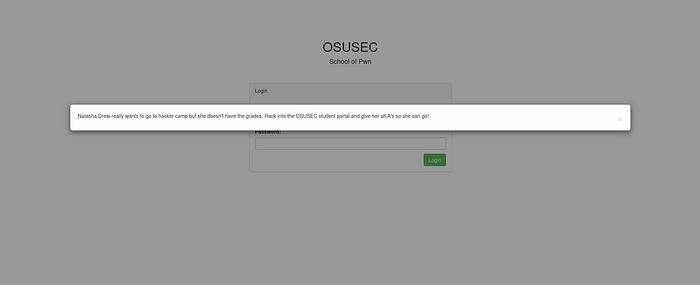
Initial Access: SQL Injection
I started with an automated scan using sqlmap:
sqlmap -u "https://.../login" --data="username=admin&password=password" --method=POST --ignore-code=401 --batchDue to persistent HTTP 401 errors, sqlmap failed to identify the vulnerability. Switching to manual testing, I successfully bypassed the login screen using a classic SQL injection payload:
' OR 1=1 #Analyzing the Session and Token
Once logged in as rhonda.daniels, I noticed a token cookie. Decoding it revealed a Base64-wrapped SHA-512 hash. While I attempted to forge a token for "Natasha" or "Admin", the server-side validation was robust enough to prevent simple hash substitution.
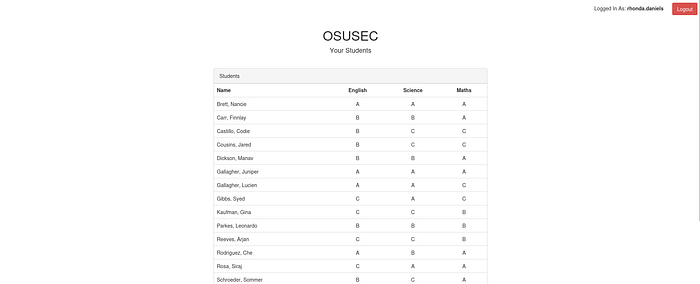
Exploiting Client-Side Logic Digging into the source code, I analyzed assets/js/app.min.js. I discovered that the application relied on a global JavaScript object to determine user permissions. I performed a Client-Side Authorization Bypass by executing the following in the browser console:
staff.admin = true;

setupLinks();
This enabled the "Edit" functionality across the student table by re-binding the event listeners.
Insecure Direct Object Reference (IDOR)
Clicking a student link redirected me to /update-student/[Base64_ID].
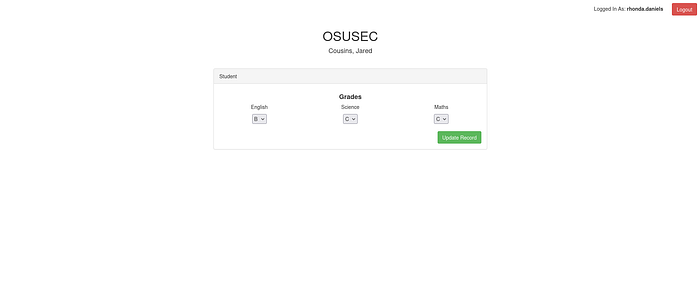
Since Natasha was not in the initial list, I manually crafted an IDOR payload:
- Encoded
Natasha_Drewinto Base64:TmF0YXNoYV9EcmV3. - Navigated directly to:
/update-student/TmF0YXNoYV9EcmV3.
Final Flag Extraction
I accessed Natasha's private grade modification form, changed all grades to "A", and submitted the form. The server responded with the flag.
Prevention & Remediation (How to Secure the Application)
To prevent the vulnerabilities exploited in this challenge, the following security best practices should be implemented:
- Mitigating SQL Injection (SQLi)
The authentication bypass was possible because user input was directly concatenated into the SQL query.
- Solution: Use Prepared Statements (Parameterized Queries). This ensures that user input is treated as data, not as executable code.
2. Enforcing Server-Side Authorization (Broken Access Control)
The most critical flaw was relying on a client-side JavaScript variable (staff.admin) to grant administrative privileges.
- Solution: Never trust the client. Authorization checks must be performed on the server-side for every request. Before rendering a sensitive page or processing an update, the server must verify the user's session and their specific roles/permissions in the database.
3. Protecting Against IDOR (Insecure Direct Object Reference)
The application allowed access to any student's record simply by changing the Base64-encoded ID in the URL.
- Solution: * Object-Level Access Control: The server should check if the currently logged-in user has the explicit right to view or edit the requested
student_id.
4. Secure Session Management
The use of a weak, predictable token format (Base64 + Hash) makes the application vulnerable to session hijacking and forging.
- Solution: Use industry-standard session management tools like JWT (JSON Web Tokens) with strong signing algorithms (e.g., RS256) or secure, random, server-stored session cookies. Ensure cookies are set with
HttpOnlyandSecureflags.