June 3, 2026
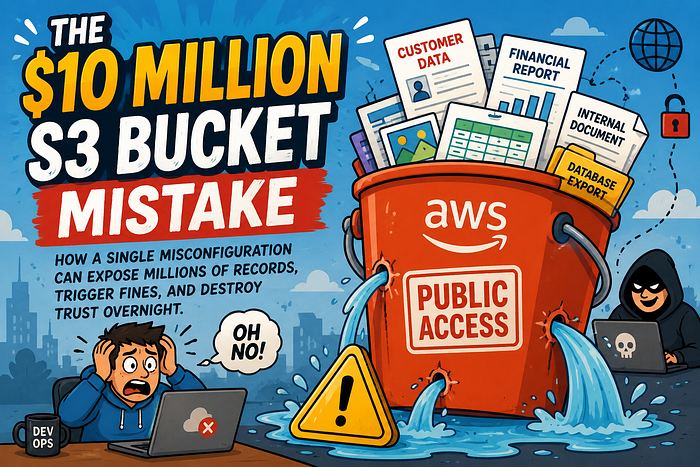
The $10 Million S3 Bucket Mistake
How a single public S3 bucket can trigger data breaches, compliance fines, customer distrust, and multi-million-dollar losses.

Jaswinder Kumar
5 min read
Cloud outages make headlines.
Cloud breaches make headlines.
But some of the most expensive cloud disasters don't involve sophisticated hackers, zero-day vulnerabilities, or nation-state attackers.
Sometimes all it takes is a single checkbox.
A single configuration.
A single S3 bucket.
And suddenly a company is facing millions of dollars in damages.
The terrifying part?
Amazon S3 is one of the most reliable services ever built.
The problem is rarely S3 itself.
The problem is how humans configure it.
Let's dive deep into the infamous "S3 bucket mistake" and understand why organizations continue repeating it despite years of warnings.
The Day Everything Became Public
Imagine you're a cloud engineer.
Your team launches a new web application.
The application needs to serve images publicly.
You create a bucket:
company-assets-prodcompany-assets-prodYou enable public access because the website needs to load images.
Everything works perfectly.
Weeks later, another team starts using the same bucket.
Instead of storing website images, they upload:
- Customer reports
- Financial spreadsheets
- Internal documents
- Database exports
- Backup archives
Nobody realizes the bucket is publicly accessible.
Months pass.
Then a security researcher discovers the bucket.
Thousands of files are exposed.
Customer information leaks.
News outlets publish stories.
Regulators begin investigations.
Lawyers get involved.
Stock prices fall.
What started as a convenience becomes a multi-million-dollar incident.
Why S3 Is So Dangerous and So Powerful
Amazon S3 is deceptively simple.
At its core, S3 only stores objects.
That's it.
No operating system.
No database engine.
No application runtime.
Just objects and metadata.
Yet S3 powers enormous portions of the internet.
Organizations store:
- Application logs
- Database backups
- Financial records
- Medical records
- Machine learning datasets
- Source code artifacts
- Static websites
- Customer documents
Many companies have petabytes of data sitting inside S3.
The simplicity that makes S3 easy to use also makes it easy to misuse.
Understanding Public Access
An S3 bucket becomes dangerous when access controls are misunderstood.
There are multiple layers controlling access:
Bucket Policies
Bucket policies define who can access bucket resources.
Example:
{
  "Effect": "Allow",
  "Principal": "*",
  "Action": "s3:GetObject",
  "Resource": "arn:aws:s3:::example-bucket/*"
}
{
"Effect": "Allow",
"Principal": "*",
"Action": "s3:GetObject",
"Resource": "arn:aws:s3:::example-bucket/*"
}The star (*) means anyone.
Not your company.
Not your AWS account.
Everyone.
Every person on Earth.
Every bot.
Every search engine crawler.
Every attacker.
Access Control Lists (ACLs)
Historically, S3 supported ACLs.
Many organizations accidentally granted:
AllUsersAllUserspermissions.
Which effectively means:
"The internet may access this content."
AWS has spent years pushing customers away from ACLs because they frequently caused confusion.
Block Public Access
AWS introduced Block Public Access specifically because organizations kept exposing buckets.
The feature acts as a safety net.
Even if someone accidentally creates a public policy, Block Public Access can prevent exposure.
Yet many organizations disable it for convenience.
That's where trouble begins.
How Attackers Find Exposed Buckets
Many people imagine hackers manually guessing bucket names.
Reality is much more automated.
Attackers run scanners continuously.
They search for patterns such as:
backup
database
prod
production
logs
exports
finance
customer-data
backup
database
prod
production
logs
exports
finance
customer-dataThey also analyze:
- DNS records
- Website source code
- Public GitHub repositories
- CloudFormation templates
- Terraform code
- Employee documentation
Once a bucket name is discovered, automated tools immediately test permissions.
The entire process can take seconds.

The Capital One Lesson
One of the most famous cloud security incidents involved a misconfigured cloud environment that exposed sensitive customer information.
The resulting consequences included:
- Massive investigation costs
- Legal expenses
- Regulatory scrutiny
- Reputational damage
- Hundreds of millions in impact
The technical failure wasn't that AWS was insecure.
The failure was in cloud security controls and access management.
This distinction matters.
Cloud providers secure the infrastructure.
Customers secure their configurations.
This is the essence of the Shared Responsibility Model.
The Real Cost of an Exposed Bucket
Many engineers assume the biggest risk is data theft.
In reality, the financial impact spreads everywhere.
Let's break down a hypothetical breach.
Incident Response
Security teams mobilize.
External consultants arrive.
Forensics begin.
Cost:
$200,000 - $1,000,000+$200,000 - $1,000,000+Legal Fees
Law firms become involved.
Notifications are prepared.
Regulatory communication starts.
Cost:
$500,000+$500,000+Customer Notification
Affected customers must be informed.
Support teams scale up.
Call centers expand.
Cost:
Hundreds of thousands of dollarsHundreds of thousands of dollarsRegulatory Fines
Depending on geography:
- GDPR
- HIPAA
- PCI DSS
- CCPA
Violations can trigger enormous penalties.
Cost:
Millions of dollarsMillions of dollarsLost Business
This is often the largest cost.
Customers lose trust.
Contracts disappear.
Prospects walk away.
Revenue declines.
Cost:
Potentially tens of millionsPotentially tens of millionsWhy Engineers Keep Making This Mistake
The issue isn't ignorance.
Most engineers know public buckets are dangerous.
The problem is operational complexity.
Common scenarios include:
Temporary Testing
Someone says:
"Let's make it public for five minutes."
Nobody remembers to revert it.
Shared Ownership
Multiple teams use the same bucket.
No single owner exists.
Security assumptions break down.
Infrastructure Drift
Terraform defines one configuration.
Manual console changes introduce another.
Months later nobody knows the true state.
Lack of Visibility
Organizations often manage:
- Thousands of buckets
- Hundreds of AWS accounts
- Multiple cloud regions
Tracking every permission becomes difficult.
How Modern Organizations Prevent This
Elite cloud security teams treat S3 exposure as a policy violation, not an engineering preference.
1. Block Public Access Everywhere
This should be enabled by default.
At:
- Account level
- Organization level
- Bucket level
Public access should require exceptional approval.
2. Infrastructure as Code
Every bucket should be created through:
- Terraform
- CloudFormation
- CDK
Never manually.
Code creates visibility.
Code creates reviews.
Code creates accountability.
3. Continuous Policy Scanning
Use tools such as:
- Prowler
- Checkov
- Wiz
- Prisma Cloud
- Steampipe
to continuously inspect bucket configurations.
A dangerous policy should trigger alerts immediately.
4. Security Guardrails
Organizations increasingly deploy:
- AWS Organizations SCPs
- OPA
- Kyverno
- Cloud Custodian
These guardrails prevent risky configurations before deployment.
The best security control is the one that stops mistakes automatically.
5. Data Classification
Not all buckets are equal.
Classify data as:
- Public
- Internal
- Confidential
- Restricted
The stricter the classification, the stronger the controls.
The Terraform Example
A secure bucket configuration often includes:
resource "aws_s3_bucket_public_access_block" "secure" {
  bucket = aws_s3_bucket.app.id
  block_public_acls       = true
  ignore_public_acls      = true
  block_public_policy     = true
  restrict_public_buckets = true
}
resource "aws_s3_bucket_public_access_block" "secure" {
bucket = aws_s3_bucket.app.id
block_public_acls = true
ignore_public_acls = true
block_public_policy = true
restrict_public_buckets = true
}This simple resource has prevented countless exposures.
Sometimes the most valuable security control is only a few lines of code.
The Bigger Lesson
The famous "S3 bucket mistake" isn't really about S3.
It's about cloud engineering maturity.
Cloud platforms move at incredible speed.
Engineers can provision infrastructure in seconds.
Unfortunately, mistakes can also scale in seconds.
A single bucket can hold:
- Millions of customer records
- Years of financial history
- Sensitive business secrets
The difference between safety and catastrophe may be one policy statement.
One permission.
One overlooked checkbox.
One configuration review that never happened.

Final Thoughts
The most expensive cloud incidents rarely begin with advanced attackers.
They begin with ordinary decisions.
An engineer trying to move quickly.
A temporary shortcut.
A missing review.
A forgotten permission.
Amazon S3 is one of the most durable and battle-tested storage systems ever created.
Yet every year organizations continue exposing sensitive data through preventable configuration errors.
The lesson is simple:
Cloud security is rarely defeated by complexity. It is defeated by assumptions.
And sometimes those assumptions cost $10 million.
#AWS #CloudSecurity #CyberSecurity #DevOps #Terraform #S3 #CloudComputing #InfrastructureAsCode #PlatformEngineering #AegisOps