
The most damaging data breaches are not always the ones that make headlines. Some of the worst ones happen slowly, quietly, through small decisions made during development that nobody flagged as dangerous at the time.
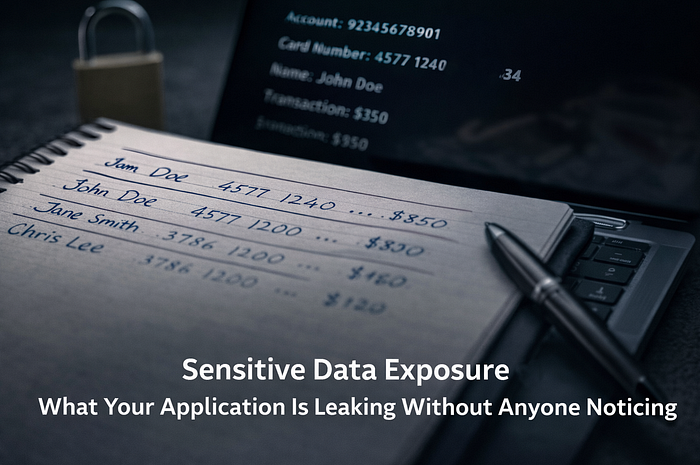
Picture a company courier who delivers confidential letters every day. The letters are sealed and addressed correctly. But the courier keeps a handwritten logbook that lists every recipient's name, address, and a summary of what was in each envelope. The logbook sits on the front desk of the office, visible to anyone who walks in. Nobody stole the letters. Nobody broke any locks. But the information inside them has been quietly accessible to anyone paying attention.
That logbook is what sensitive data exposure looks like in software. The application is working correctly. Data is being processed and delivered as designed. But somewhere in the system, that data is also being written somewhere it should not be, returned in a response that asks for too much, or stored in a format that offers no real protection if accessed.
This problem exists in every industry that handles personal information. Legal platforms that write client details into unprotected log files. Healthcare apps that return full patient records when only a summary was needed. HR systems that store employee documents in cloud buckets with public read access. E-commerce platforms that log full payment card numbers during a debugging session that never got cleaned up. The data was never stolen through a sophisticated attack. It was simply left somewhere reachable.
In fintech, sensitive data exposure carries regulatory consequences alongside the security ones. BVN numbers, account details, transaction histories, KYC documents, and card data are all regulated categories. A fintech platform that writes any of these into application logs, returns them in verbose API error messages, stores them unencrypted at rest, or transmits them over unencrypted connections is not just creating a security risk. It is creating a compliance liability that regulators and auditors will find, even if attackers do not find it first.
Technically, the failure patterns are broader than most teams initially assume. 1. Verbose error messages that include stack traces, database query strings, or internal file paths give attackers a detailed map of the system's internals. 2. API responses that return full data objects when only specific fields were requested expose everything the database holds on that record. 3. Application logs that capture request and response bodies for debugging purposes end up archiving customer passwords, OTPs, and card numbers in plaintext log files that persist for months. 4. Data stored at rest without encryption means a single misconfigured storage bucket or a compromised database backup exposes everything in it. 5. Outdated TLS configurations or mixed HTTP and HTTPS implementations create interception opportunities during data transmission.
A realistic scenario: a fintech team adds detailed request logging to their payment API during a production incident to diagnose a bug. The logging captures full request bodies. The fix is deployed, the incident is resolved, but the verbose logging is never turned off. Over the following months, every payment request processed by the API writes the user's card details, transaction amount, and account identifiers into a log file stored on the application server. A routine server migration six months later moves those log files to a cloud storage bucket. A misconfigured bucket policy makes the files publicly readable. A security researcher scanning for exposed buckets discovers them and finds months of raw financial transaction data sitting in plaintext. The team had no idea the data was there.
Protecting against sensitive data exposure requires treating data handling as a first-class engineering concern at every layer. 1. Classify data by sensitivity before writing a single line of code that touches it and apply appropriate controls at each classification level. 2. Never log request or response bodies that may contain personal or financial data, and audit existing log configurations regularly. 3. Encrypt sensitive data at rest using current, strong encryption standards and manage keys separately from the data they protect. 4. Enforce HTTPS across every endpoint without exception and test for mixed content issues. 5. Return only the minimum data fields necessary in every API response and avoid generic object serialization that dumps entire records. 6. Review cloud storage permissions as part of every deployment and implement automated checks for public accessibility on private buckets. 7. Mask or tokenize sensitive identifiers like card numbers and national IDs wherever they appear outside core processing systems.
Data does not have to be stolen to be exposed. Sometimes it just has to be left somewhere that was not meant for it, by someone who meant to clean it up later. Later has a way of never arriving.
#CyberSecurity #DataSecurity #SensitiveDataExposure #WebSecurity #ApplicationSecurity #FintechSecurity #DataProtection #SecureByDesign #OWASP #DevSecOps #SoftwareEngineering #SecurityEngineering #CTOInsights #Fintech