
Introduction
Some of the most impactful vulnerabilities don't come from complex exploitation — they come from patience, consistency, and good reconnaissance.
This is the story of how long-term monitoring, combined with small signals like HTTP status codes, led me to discover a publicly accessible security dashboard on redacted.com — exposing internal infrastructure, security posture, and even IP addresses.

Background: Playing the Long Game
I had been testing redacted.com for quite some time. Instead of rushing into aggressive testing, I focused on passive recon and monitoring.
One of my main approaches was:
- Tracking assets and IPs over time
- Monitoring those IPs on Shodan
- Watching for changes in exposed services
- Revisiting endpoints periodically
This kind of persistence often pays off — especially when configurations change silently.
The Turning Point: Watching for Small Signals
While monitoring assets, I noticed something interesting:
Some endpoints were returning 403 Forbidden responses.
Now, 403s are often ignored — but they can be very valuable. They indicate:
- The endpoint exists
- Access is restricted (or at least intended to be)
- Something might be exposed behind it
Instead of ignoring these, I started tracking and revisiting them over time.
Discovery: An Unexpectedly Open Door
At some point, one of these previously restricted endpoints changed behavior.
Instead of returning a 403…
👉 It loaded completely — without any authentication
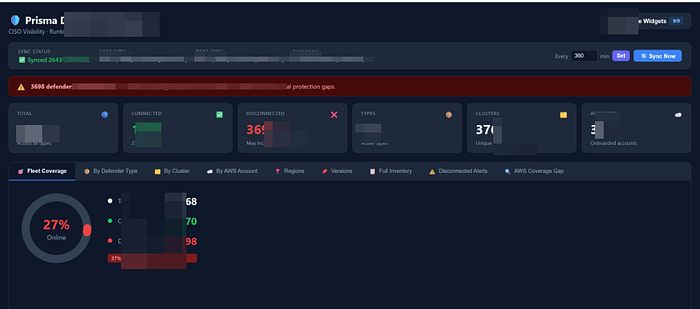
The endpoint exposed a Prisma Defender dashboard, which is typically used for runtime security and infrastructure protection.
What Was Exposed
The dashboard revealed highly sensitive internal data, including:
- Total number of workloads and defenders
- Connected vs disconnected security agents
- Cluster names and regions
- Cloud account coverage
- Security gaps across infrastructure
More critically:
- Full infrastructure inventory
- Associated IP addresses of workloads
- Extremely low protection coverage in some clusters
Escalation: The Export Feature
Things didn't stop at visibility.
The dashboard also included an export functionality, which allowed:
- Downloading the entire dataset
- Extracting infrastructure and security posture at scale
- Performing offline analysis
This transformed the issue from a simple exposure into a bulk data exfiltration risk.
Why This Was Dangerous
This wasn't just "information disclosure."
An attacker could:
- Map the entire cloud environment
- Identify unprotected workloads
- Correlate IP addresses with weak targets
- Launch targeted attacks with high precision
In other words, this dashboard provided a ready-made attack blueprint.
Key Takeaways
1. Recon is underrated
You don't always need advanced exploitation. Consistent monitoring can uncover critical issues.
2. Don't ignore 403s
Endpoints returning 403 today might be exposed tomorrow.
3. Track assets over time
Infrastructure changes frequently — what's secure today may not be tomorrow.
4. Security tools are high-value targets
Exposing a security dashboard is often worse than exposing a regular app — it reveals defensive gaps.
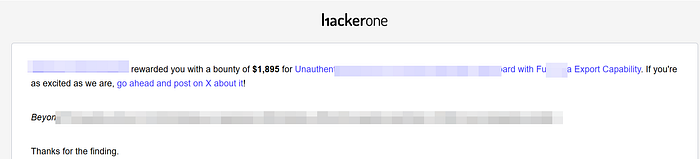
I reported the issue to HACKERONE. The issue was acknowledged and fixed, and I received a bounty of $1895.
Final Thoughts
This finding reinforced an important lesson:
You don't always find critical bugs by going deeper — sometimes you find them by waiting, watching, and revisiting.
Patience, combined with curiosity, can uncover vulnerabilities that others miss.
Thanks for reading 🙌
If you're into bug bounty and recon, keep exploring — and don't underestimate the power of small signals.
If my research, write-ups, or shared insights have helped you think more securely, improve your skills, or understand risks better, your support helps me dedicate more time to responsible research, learning, and sharing knowledge with the community.
BMC: https://buymeacoffee.com/vamproot
Let's connect: Linkedin: https://www.linkedin.com/in/vaibhav-kumar-srivastava-378742a9/