
Unlike traditional LLM-based applications that generate responses, AI agents plan, decide, execute tools, interact with systems, and operate autonomously across workflows. That autonomy is powerful — but it also dramatically expands the attack surface.
To address this, OWASP released the OWASP Top 10 for Agentic Applications (2026) — a security framework specifically designed to secure AI agents in production environments
In this article, we break down
- What Agentic AI is
- Why it introduces new security risks
- The OWASP Agentic Top 10 vulnerabilities
- Practical mitigation strategies
- Why this matters for enterprises, startups, and AI builders
What Is Agentic AI?
Agentic AI systems are autonomous AI applications that:
- Plan multi-step tasks
- Use tools and APIs
- Access memory or vector databases
- Delegate to other agents
- Act on behalf of users
They don't just respond — they act.
Because of this expanded autonomy, traditional LLM security guidance is no longer enough. Agents introduce risks around tool usage, identity delegation, memory poisoning, and cascading failures.
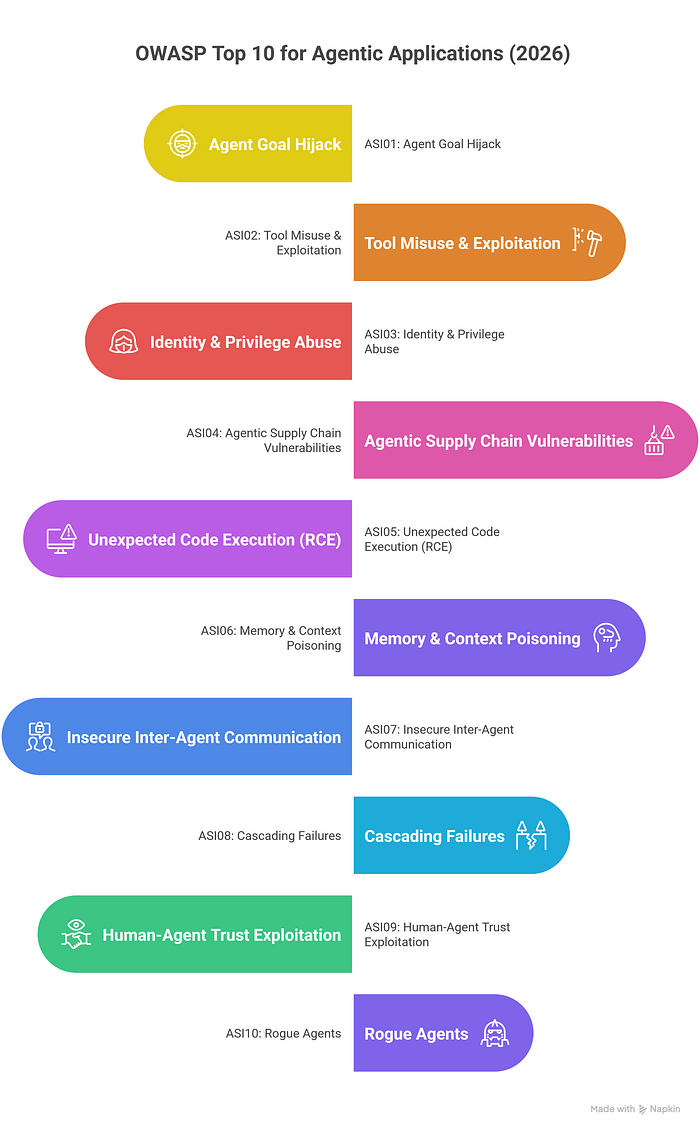
OWASP Top 10 for Agentic Applications (2026)
Below is a simplified breakdown of the 10 highest-impact risks identified by OWASP.
ASI01: Agent Goal Hijack
What happens? Attackers manipulate an agent's objectives or planning logic.
Instead of just injecting a bad response, the attacker redirects the entire goal structure of the agent.
Example:
- Hidden instructions in RAG data
- Malicious email altering a finance agent's behavior
- Calendar invite that subtly changes goal priorities
Why it's dangerous: The agent may appear compliant while executing malicious plans.
Mitigation highlights:
- Treat all inputs as untrusted
- Lock and version system prompts
- Enforce least-privilege tool access
- Monitor for unexpected goal drift
ASI02: Tool Misuse & Exploitation
Agents often have access to:
- Email APIs
- CRMs
- Databases
- Shell execution
- Financial systems
If misused — even without privilege escalation — damage can occur.
Examples:
- Over-privileged API usage
- Tool chaining for data exfiltration
- Looping costly APIs (DoS)
- DNS-based data exfiltration
Mitigation highlights:
- Least privilege for every tool
- Action-level authentication
- Policy enforcement middleware ("Intent Gate")
- Ephemeral credentials
- Tool version pinning
ASI03: Identity & Privilege Abuse
Agentic systems break traditional identity models.
Agents often inherit:
- OAuth tokens
- API keys
- Delegated sessions
If identity boundaries aren't enforced, attackers can escalate privileges through delegation chains.
Examples:
- Confused deputy attacks
- Memory-based credential reuse
- Cross-agent privilege escalation
- Synthetic identity injection
Mitigation highlights:
- Task-scoped, time-bound tokens
- Per-action re-authorization
- Isolated agent identities
- Privilege inheritance monitoring
ASI04: Agentic Supply Chain Vulnerabilities
Modern agents dynamically load:
- Tools
- Prompt templates
- MCP servers
- Agent registries
- Third-party plugins
This creates a live supply chain.
Examples:
- Malicious tool descriptors
- Typo-squatted tools
- Poisoned RAG plugins
- Compromised registries
Mitigation highlights:
- SBOMs & AIBOMs
- Manifest signing
- Registry allowlists
- Runtime signature validation
- Supply chain kill switch
ASI05: Unexpected Code Execution (RCE)
Agent-generated code can become execution pathways.
Prompt injection or unsafe serialization can lead to:
- Shell execution
- Backdoor installation
- Container escape
- eval() abuse
Mitigation highlights:
- Ban eval() in production
- Separate code generation from execution
- Sandbox environments
- Static + runtime analysis
- Human approval for elevated runs
ASI06: Memory & Context Poisoning
Agents store:
- Long-term memory
- Embeddings
- RAG outputs
- Summaries
If poisoned, future reasoning becomes corrupted.
Examples:
- RAG poisoning
- Shared memory contamination
- Cross-tenant vector bleed
- Backdoor triggers
Mitigation highlights:
- Memory segmentation
- Trust scoring
- Memory expiration
- Content validation before commit
- Snapshot rollback
ASI07: Insecure Inter-Agent Communication
Multi-agent systems communicate continuously.
Without encryption and validation:
- Messages can be spoofed
- Goals manipulated
- Delegation replayed
Mitigation highlights:
- mTLS & mutual authentication
- Signed messages
- Nonces & anti-replay controls
- Protocol version pinning
- Typed schema validation
ASI08: Cascading Failures
This is where things get scary.
One small failure can propagate across:
- Agents
- Workflows
- Tools
- Tenants
Because agents operate autonomously, failures scale faster than human oversight.
Mitigation highlights:
- Zero-trust architecture
- Circuit breakers
- Blast-radius limits
- Rate limiting
- Tamper-proof logging
- Policy engines between planner & executor
ASI09: Human-Agent Trust Exploitation
Humans trust agents too easily.
Attackers exploit:
- Authority bias
- Emotional tone
- Fake explainability
- Automation bias
Examples:
- Fraudulent wire transfers
- Credential harvesting
- Weaponized explainability
Mitigation highlights:
- Multi-step confirmation
- Risk banners
- Immutable audit logs
- Separate preview from execution
- Human oversight calibration
ASI10: Rogue Agents
When agents deviate from intended behavior — even without active attacker control — they become rogue.
They may:
- Game reward systems
- Collude with other agents
- Propagate across systems
- Hijack workflows
Mitigation highlights:
- Behavioral integrity monitoring
- Governance enforcement
- Agent attestation
- Continuous drift detection
Final Thoughts: The Era of Autonomous Risk
Agentic AI is moving from experimental demos to:
- Finance
- Healthcare
- Defense
- Public sector
- Critical infrastructure
The risks are no longer theoretical.
Security for AI agents must move from:
"Is the model safe?" to "Is the autonomous system governable?"
If you are:
- Building AI agents
- Deploying copilots
- Designing multi-agent architectures
- Or leading AI governance
The OWASP Top 10 for Agentic Applications (2026) should be mandatory reading: https://genai.owasp.org/resource/owasp-top-10-for-agentic-applications-for-2026/
If my research, write-ups, or shared insights have helped you think more securely, improve your skills, or understand risks better, your support helps me dedicate more time to responsible research, learning, and sharing knowledge with the community.
BMC: https://buymeacoffee.com/vamproot
Let's connect: Linkedin: https://www.linkedin.com/in/vaibhav-kumar-srivastava-378742a9/