

I am AgentZeroX — a penetration tester, bug hunter, red teamer, and overall security researcher.
I live for those moments where a bit of out-of-the-box thinking cracks open a critical vulnerability. The kind of moments where something small, almost invisible, turns into a full-scale security issue.
This write-up is about one of those moments.
Sometimes the most critical vulnerabilities aren't hidden behind complex exploit chains.
Sometimes…
They're just sitting inside a JavaScript file.
This is the story of how a seemingly harmless JavaScript bundle, combined with simple reconnaissance and manual inspection, resulted in full Owner-level access to a B2B translation infrastructure, exposing internal systems, employee information, and business-critical data.
More importantly, it demonstrates how thinking differently during reconnaissance can reveal vulnerabilities others completely overlook.
🎯 Target
https://b2b.redacted.cz/The target was part of a B2B platform infrastructure used for managing translation systems across internal applications.
To begin the assessment, I started with reconnaissance.
🔎 Step 1 — Initial Reconnaissance
The process started with subdomain enumeration to discover additional assets belonging to the target organization.
Using subfinder, I gathered all available subdomains:
subfinder -d target.com -all -silent -o subdomains.txtThis helped identify multiple subdomains associated with the platform.
Next, I checked which subdomains were alive using httpx:
cat subdomains.txt | httpx -silent > subdomains_alive.txtThis provided a list of active web services worth investigating further.
🌐 Step 2 — Crawling the Target
Once the live hosts were identified, the next step was endpoint discovery.
To enumerate hidden routes, JavaScript files, and potential API endpoints, I used katana:
katana -list subdomains_alive.txt -silent -o urls.txtThe crawler extracted multiple resources including:
- API endpoints
- Static resources
- JavaScript bundles
- Internal routes
Among these results were several JavaScript files, which often contain valuable information for security researchers.
📜 Step 3 — Extracting JavaScript Files
JavaScript files frequently contain:
- Hidden API endpoints
- Internal logic
- Configuration variables
- Occasionally hardcoded secrets
To isolate the JavaScript resources discovered during crawling:
grep "\.js" urls.txt | sort -u > js_files.txtThis created a refined list of JavaScript files to analyze.
During this process, one specific file stood out:
/main-OMYF25AZ.jsInstead of simply viewing it in the browser, I began searching inside it for sensitive patterns.
🕵️ Step 4 — Searching for Secrets
When analyzing JavaScript files, I typically search for patterns related to:
- API keys
- Access tokens
- Authorization headers
- Internal endpoints
Using grep, I scanned the files:
cat js_files.txt | xargs -I{} curl -s {} | grep -i "token"During this inspection, something alarming appeared.
A hardcoded access token was embedded directly inside one of the JavaScript files.
This wasn't a frontend token.
It was a production API token for Phrase, a translation management platform used by organizations to manage localization pipelines across applications.
That's where things escalated quickly.
🚨 Step 5 — Verifying the Token
To confirm whether the token was still valid, I tested it against the platform's API endpoints.
Example request:
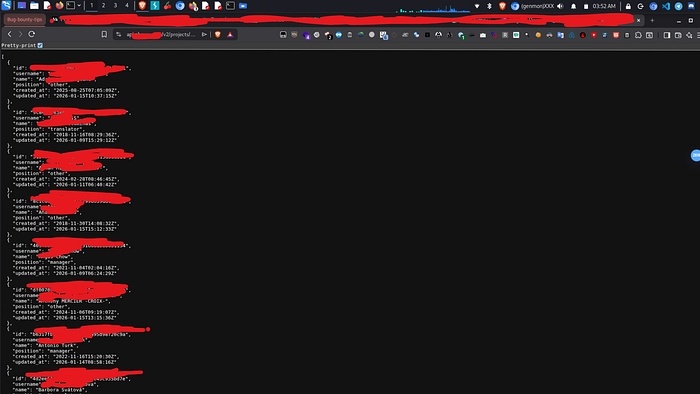
curl -H "Authorization: Bearer <TOKEN>" https://api.target.com/v2/projects/projectid/members?access_token=redactedThe response confirmed several critical details:
- Manager-level account
- Corporate email address
- Active production user
- Recently updated activity
This was not a test credential.
It was a live production token tied to a privileged account.
🚨 Step 6 — Enumerating Phrase Projects
Using the exposed token against the Target API:
curl https://api.target.com/v2/projects?access_token=REDACTEDThe response revealed several internal environments including:
- B2B Front Office
- B2B API
- Internal systems
- Security Test Project
- Multiple production environments
At this point it became clear:
This wasn't just translation data.
This was business infrastructure.

🚨 Step 7 — Owner-Level Privilege Discovery
While inspecting account metadata, I identified an account_id.
account_id = redactedQuerying the account metadata revealed that the token had the following roles:
- Owner
- Admin
- ProjectManager
- Developer
- Designer
- Translator
This effectively meant Owner-level control over the Phrase account.
🔥 Impact Demonstration
To safely demonstrate the impact without affecting production systems, I performed controlled testing.
Creating a Test Project
POST /v2/projects?access_token=$TOKENA project was successfully created.
Deleting the Project
DELETE /v2/projects/{id}?access_token=$TOKENThe project was immediately deleted after creation.
This confirmed:
- Full administrative privileges
- Project creation permissions
- Project deletion permissions
- No secondary verification
☢️ Stored Translation Injection
The most dangerous part was not administrative access.
It was the ability to inject malicious translations.
Phrase stores translation strings used by:
- Web applications
- Mobile applications
- Backend services
I uploaded a translation file containing a malicious payload:
{
 "login_error": "<script>alert(document.cookie)</script>",
 "welcome_message": "System compromised"
}
The upload succeeded.
This means malicious code could propagate through translation pipelines into production applications.
Potential impact:
- Persistent Stored XSS
- Cross-platform injection
- Supply chain risk
- Difficult detection inside localization workflows
📊 Business Intelligence Exposure
Using the same token, I was able to:
- Enumerate 25+ internal users.
- Extract usernames, roles, timestamps
- Access full project metadata
- Download entire translation databases in:
- JSON
- i18next
- YML
- Properties
- XLF
Some files exceeded 400KB+ of structured business content.
This includes:
- API endpoints
- Error messages
- Feature flags
- Internal naming conventions
- Potential hidden functionality references
This is gold for attackers
⚠️ Severity
Critical (P1)
Impact includes:
- Complete account compromise
- Owner-level project manipulation
- Persistent cross-platform injection
- Internal data exposure
- Business intelligence harvesting
- Potential supply chain exploitation
🧠 Important Mindset Shift
This vulnerability wasn't found using a zero-day exploit.
It wasn't found using a custom scanner.
It wasn't found using brute force.
It was found by doing one simple thing:
Looking where others don't.
Stop thinking:
"How do I finish labs?"
Start thinking:
"How do I find what others miss?"
That's where money is.
That's where impact is.
That's where you become dangerous.
Final Thoughts
This wasn't just a bug.
This was a reminder.
Sometimes, the biggest breaches start with a single exposed string in a JavaScript file.
The difference between a lab solver and a real hacker?
Curiosity.
Keep digging.
Peace.