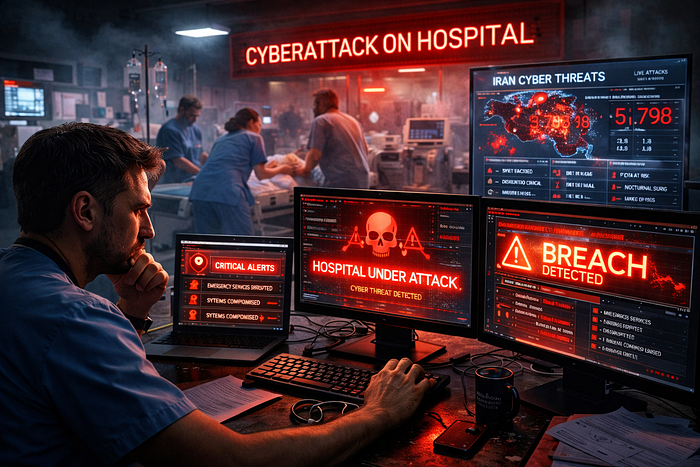

Hospitals used to imagine war as something that happened somewhere else, on another continent, on another channel, to other people. That illusion is dying fast. In 2026, healthcare is no longer just collateral damage in global conflict. It is becoming a deliberate pressure point. As the war involving Iran has escalated since February 28, 2026, the physical destruction has been obvious enough, but the digital campaign running alongside it is what should make hospital executives lose sleep. This is no longer only about missiles, air defenses, and burning infrastructure. It is also about spyware timed to moments of panic, cyberattacks against medical organizations, threats to cloud environments, and official warnings that vulnerable U.S. networks could be next.
The phrase "the hospital is the new battlefield" is not dramatic fluff anymore. It is a practical description of how modern retaliation works. Reuters reported on March 11, 2026 that the World Health Organization had verified 18 attacks on healthcare sites in Iran, resulting in deaths among health workers. That fact alone should end the comfortable fiction that health systems are somehow insulated from conflict because they are humanitarian by nature. In real wars, hospitals are essential, visible, emotionally charged, and operationally fragile. That makes them valuable targets even before you add cyber operations to the equation. Once cyber enters the picture, the attack surface gets much larger, and much uglier.
The digital side of this war is already showing exactly how cruel that logic can become. The Associated Press reported that during Iranian missile attacks, some Israelis fleeing strikes received text messages offering what looked like shelter information. The links instead installed spyware capable of accessing cameras, location, and device data. Researchers told AP the messages appeared to be synchronized with the physical attacks. That is a chilling detail because it shows the model clearly: wait until civilians are scared, rushed, and hungry for safety, then use that fear as the delivery mechanism. If you want to understand where healthcare fits into this, it is painfully simple. Hospitals are full of urgency, confusion, and people under pressure. In cyber terms, that is not just an environment. It is an opportunity.
This is why healthcare has become so attractive in geopolitical retaliation. A hospital combines emotional leverage with operational dependence. It is full of critical systems, often stretched staff, legacy technology, third-party connections, remote access tools, and a thousand little exceptions made in the name of patient care. Attack a bank and you disrupt money. Attack a manufacturer and you disrupt production. Attack a hospital and you disrupt care, trust, scheduling, surgeries, medication workflows, imaging, admissions, transfers, and every family already terrified for someone they love. That kind of chaos travels farther than the network where it starts. It becomes public fear almost immediately, and fear is part of the product.
The current conflict has already given us concrete warning shots. AP reported that Iran-linked groups have mounted nearly 5,800 cyberattacks during the war, spread across almost 50 groups, with healthcare and critical infrastructure among the sectors hit most often. Reuters separately reported that an Iran-linked group claimed responsibility for a cyberattack on Stryker, the U.S. medical device maker. Stryker said it had contained the incident and saw no indication of ransomware or malware, but the disruption still affected systems and operations. Even where facts remain contested or incomplete, the broader pattern is impossible to ignore: healthcare-adjacent organizations are now openly showing up in the retaliation map.
That should worry hospitals even if they are not being directly named in headlines. Medtech vendors, cloud providers, software suppliers, logistics partners, and device manufacturers all sit inside the real healthcare delivery chain. A hospital can have pristine intentions and still get flattened because one outside dependency was hit hard enough to interrupt orders, shipping, integrations, support, or maintenance. Reuters later reported that Stryker had largely restored manufacturing after the attack, but even a contained disruption at a company that size sends a clear message about the fragility of the ecosystem around patient care. Hospitals do not need to be the first domino to be crushed by a geopolitical cyber campaign. They only need to be standing close to one.
What makes this even worse is that state-linked or state-aligned cyber activity does not always behave like ordinary crime. Traditional ransomware actors at least pretend they want money. Geopolitical operators often want something messier: intimidation, disruption, pressure, headlines, retaliation, or public loss of confidence. AP reported that recent attacks tied to the conflict appear aimed in part at causing disruption rather than simply generating profit. Halcyon and Beazley also reported that an Iran-linked Pay2Key intrusion hit a U.S. healthcare organization in late February 2026, with the environment encrypted within hours and no evidence of data exfiltration identified in the reporting. If that account is accurate, the implication is brutal. The objective may not have been theft at all. It may have been paralysis.
Hospitals are particularly vulnerable to that kind of campaign because they are built around time-sensitive dependence. Everything depends on something else being available right now. Nurses need access now. Orders need to route now. Imaging needs to move now. Pharmacy needs to verify now. Surgeons need scheduling, anesthesia, lab work, blood products, devices, and communications all moving in sync. That means disruption often matters more than destruction. You do not need to "destroy a hospital" in a cinematic sense to create real harm. Jam enough digital arteries and the institution begins bleeding operationally on its own. A modern hospital is a living network, and attackers understand that better than many boards do.
Official warnings have been blunt about the threat. In their June 30, 2025 joint advisory, the NSA, CISA, FBI, and DC3 warned that Iranian-affiliated cyber actors and aligned hacktivists were likely to target U.S. networks, especially poorly secured, internet-connected systems. They specifically highlighted exploitation of unpatched software, weak or default credentials, DDoS activity, and ransomware risk. This is not one of those moments where defenders can honestly say the danger was unforeseeable. The government practically wrote it on the wall. If hospitals are still exposing brittle remote access, stale internet-facing systems, old endpoint management tools, or neglected vendor paths, then geopolitical tension does not create the vulnerability. It simply cashes it in.
The temptation in healthcare leadership is to hear all of this and assume the real risk belongs to giant academic medical centers, defense contractors, or nationally visible institutions. That is wishful thinking. Geopolitical cyber campaigns often exploit targets of opportunity. They do not always need the biggest hospital. They need the weakest useful one. A regional health system with aging edge devices, a specialty clinic tied into larger referral networks, a medical supplier with shaky segmentation, or a hospital whose vendor accounts still use old passwords can become the perfect target. Not because it is famous, but because it is easy, connected, and painful to disrupt. That is how modern retaliation works. It punishes where the defenses sag.
There is another reason hospitals are becoming prime targets, and it is not purely technical. Healthcare attacks produce psychological effects far beyond the organization itself. The public does not react to a hospital breach the way it reacts to a payroll outage or a downed e-commerce site. People imagine canceled surgeries, delayed chemotherapy, medication errors, inaccessible records, ambulances being rerouted, and loved ones trapped inside a failing system. That public fear is incredibly useful to an adversary. It magnifies the impact of even a limited intrusion. In geopolitical retaliation, perception matters almost as much as direct damage. A hospital attack tells the public, very clearly, that nowhere feels off-limits anymore.
So what should healthcare leaders take from this, today, on April 4, 2026? First, stop treating the war involving Iran as distant news unless you have facilities in the region. The digital spillover is already here. Second, assume your hospital's attack surface includes your vendors, device makers, cloud platforms, endpoint tools, and anyone else with privileged access into your workflows. Third, go after the boring weaknesses immediately: patch exposed systems, kill weak credentials, harden endpoint management, review third-party access, rehearse downtime procedures, and verify that the systems keeping care moving can survive targeted disruption. None of that is glamorous. That is fine. Survival rarely is.
The old idea was that hospitals should be protected because they are places of healing. The current reality is harsher. Hospitals are targeted because they are places of healing. They are essential, fragile, trusted, and deeply connected, which makes them perfect instruments for pressure in a world where cyber retaliation is cheaper than missiles and often just as effective at spreading fear. That is the part healthcare can no longer afford to misunderstand. The hospital is not standing near the battlefield anymore. The hospital is the battlefield.