

Data Sovereignty is the principle that data is subject to the laws and governance structures of the country in which it is collected, accessed, stored, or processed. This means that governments claim legal authority over data within their jurisdiction and may regulate how it is acted upon.
Data Sovereignty generally covers:
- Whether data must be stored locally
- Restrictions on cross-border transfers
- Government access requirements
- Sector-specific localization (finance, telecom, health, etc.)
For me, the most prominent point in the Data Sovereignty conversation is Localization requirements and the cross-border transfer of data. When a jurisdiction allows data to be moved across borders, it becomes subject to the new / next jurisdiction's laws.
In the case of the United States, from Wikipedia, "The CLOUD Act primarily amends the Stored Communications Act (SCA) of 1986 to allow federal law enforcement to compel U.S.-based technology companies via warrant or subpoena to provide requested data stored on servers regardless of whether the data are stored in the U.S. or on foreign soil." So, it doesn't really matter where the data is stored or what the local laws say about sharing that data with US law enforcement if you are dealing with a US company. Most notably, US big tech companies. That's an extreme example, but a very real one.
This is one of the drivers for traditional US allies to begin moving away from dependencies on US technology companies. Other notable drivers being recent examples of the US ordering companies to shut down email, credit card, and other digital services offered by US companies for members of the International Criminal Court (ICC) that the US finds disagreeable. That's a separate topic that we can explore later.
Data Sovereignty Summary
For anyone who just wants the summary, here you go.
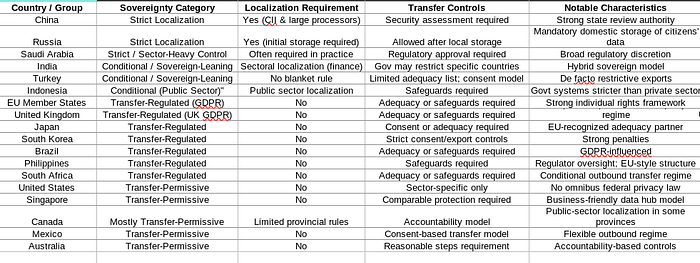
As always, the options for doing tables on medium.com are somewhat limited. Here's the data in ASCII table format.
Data Sovereignty & Cross-Border Transfer Frameworks
---------------------------------------------------------------------------------------------------------------

| Country / Group   | Sovereignty Category            | Localization Requirement           | Transfer Controls                   | Notable Characteristics                          |
|-------------------|---------------------------------|-----------------------------------|--------------------------------------|--------------------------------------------------|
| China             | Strict Localization             | Yes (CII & large processors)      | Security assessment required         | Strong state review authority                    |
| Russia            | Strict Localization             | Yes (initial storage required)    | Allowed after local storage          | Mandatory domestic storage of citizens' data     |
| Saudi Arabia      | Strict / Sector-Heavy Control   | Often required in practice        | Regulatory approval required         | Broad regulatory discretion                      |
| India             | Conditional / Sovereign-Leaning | Sectoral localization (finance)   | Gov may restrict specific countries  | Hybrid sovereign model                           |
| Turkey            | Conditional / Sovereign-Leaning | No blanket rule                   | Limited adequacy list; consent model | De facto restrictive exports                     |
| Indonesia         | Conditional (Public Sector)     | Public sector localization        | Safeguards required                  | Govt systems stricter than private sector        |
| EU Member States  | Transfer-Regulated (GDPR)       | No                                | Adequacy or safeguards required      | Strong individual rights framework               |
| United Kingdom    | Transfer-Regulated (UK GDPR)    | No                                | Adequacy or safeguards required      | Independent post-Brexit adequacy regime          |
| Japan             | Transfer-Regulated              | No                                | Consent or adequacy required         | EU-recognized adequacy partner                   |
| South Korea       | Transfer-Regulated              | No                                | Strict consent/export controls       | Strong penalties                                 |
| Brazil            | Transfer-Regulated              | No                                | Adequacy or safeguards required      | GDPR-influenced                                  |
| Philippines       | Transfer-Regulated              | No                                | Safeguards required                  | Regulator oversight; EU-style structure          |
| South Africa      | Transfer-Regulated              | No                                | Adequacy or safeguards required      | Conditional outbound transfer regime             |
| United States     | Transfer-Permissive             | No                                | Sector-specific only                 | No omnibus federal privacy law                   |
| Singapore         | Transfer-Permissive             | No                                | Comparable protection required       | Business-friendly data hub model                 |
| Canada            | Mostly Transfer-Permissive      | Limited provincial rules          | Accountability model                 | Public-sector localization in some provinces     |
| Mexico            | Transfer-Permissive             | No                                | Consent-based transfer model         | Flexible outbound regime                         |
| Australia         | Transfer-Permissive             | No                                | Reasonable steps requirement         | Accountability-based controls                    |

---------------------------------------------------------------------------------------------------------------
Here's the same data in a slightly different format.
Data Sovereignty vs Localization
Although, typically used interchangeably, data sovereignty and data localization are not the same thing.
Data sovereignty is the concept that data is subject to the laws and governance structures of the country in which it is collected, stored, or processed. It tells us which legal authority has jurisdiction over the data. Sovereignty does not automatically require domestic storage; it depends on the specific rules the local laws mandate.
Data localization is a legal requirement that certain data must be stored and/or processed within a specific country's borders. It answers the question of whether the data must be physically stored within the local jurisdiction.
The Details
For those who want a bit more information, here you go.
For EU countries,
- Data Sovereignty is centralized at the regulatory level (GDPR).
- National governments cannot create broad localization regimes.
- But they can add sector-specific rules and apply sovereignty through procurement and security law.
Argentina
Governed by: Personal Data Protection Act
Notable characteristics:
- No general localization requirement
- Transfers allowed to "adequate" jurisdictions or with safeguards
- EU recognizes Argentina as adequate
Australia
Governed by: Privacy Act 1988
Notable characteristics:
- No broad localization mandate
- Cross-border transfers allowed if reasonable steps ensure protection
- Critical infrastructure laws increase government access powers
Brazil
Governed by: Lei Geral de Proteção de Dados
Notable characteristics:
- No general data localization requirement
- Transfers allowed with safeguards or adequacy
- GDPR-influenced framework
Canada
Governed by: Personal Information Protection and Electronic Documents Act
Notable characteristics:
- No federal localization requirement
- Some provinces (e.g., BC public sector) require local storage
- Transfers allowed with accountability model
China
Governed by: Personal Information Protection Law
Notable characteristics:
- Strong localization for:
- Critical Information Infrastructure (CII)
- Large data processors
- Security assessments required for outbound transfers
- Broad state access authority
France (EU Member)
Governed by: General Data Protection Regulation
Notable characteristics:
- No blanket localization requirement
- Strict transfer rules outside EU/EEA
- Sovereignty concerns in cloud procurement (EU cloud strategy)
Germany (EU Member)
Governed by: General Data Protection Regulation
Notable characteristics:
- No mandatory localization
- Very strict enforcement culture
- Public sector cautious about foreign cloud providers
India
Governed by: Digital Personal Data Protection Act
Notable characteristics:
- No general localization requirement (earlier drafts were stricter)
- Government may restrict transfers to certain countries
- Sector-by-sector (industry-by-industry) rules (e.g., financial data) may require local storage
Indonesia
Governed by: Personal Data Protection Law
Notable characteristics:
- Private sector: cross-border allowed with safeguards
- Public sector: stricter domestic storage expectations
Italy (EU Member)
Governed by: General Data Protection Regulation
Notable characteristics:
- No general localization
- Strong enforcement
Japan
Governed by: Act on the Protection of Personal Information
Notable characteristics:
- No localization mandate
- Transfers require consent or adequacy
- EU recognizes Japan as adequate
Mexico
Governed by: Federal Law on Protection of Personal Data
Notable characteristics:
- No localization requirement
- Transfers allowed with consent and safeguards
Russia
Governed by: Federal Law on Personal Data
Notable characteristics:
- Mandatory local storage of Russian citizens' personal data
- Copies may be transferred abroad after local storage
- Strong enforcement and state access
Saudi Arabia
Governed by: Personal Data Protection Law
Notable characteristics:
- Cross-border transfers require regulatory approval
- Localization favored in practice
- Government access authority significant
South Africa
Governed by: Protection of Personal Information Act
Notable characteristics:
- No mandatory localization
- Transfers allowed with safeguards or adequacy
South Korea
Governed by: Personal Information Protection Act
Notable characteristics:
- No blanket localization
- Very strict consent and export rules
- Heavy penalties
Turkey
Governed by: Law on the Protection of Personal Data
Notable characteristics:
- Transfers require adequacy decision or explicit consent
- Adequacy list limited
- Strong de facto restrictions
United Kingdom
Governed by: UK General Data Protection Regulation
Notable characteristics:
- No localization requirement
- Transfers allowed via adequacy or safeguards
United States
Notable characteristics:
- No comprehensive federal privacy law
- No general localization requirement
- Sector-specific rules (finance, health)
- Broad government access authorities
Singapore
Governed by: Personal Data Protection Act
Notable characteristics:
- No general localization requirement
- Cross-border transfers allowed if comparable protection ensured
- Business-friendly framework
Philippines
Governed by: Data Privacy Act of 2012
Notable characteristics:
- No mandatory data localization
- Cross-border transfers allowed if adequate safeguards exist
- Enforced by the National Privacy Commission
Notes
- AI (ChatGPT) assisted with summarizing this information.
- Names have been changed to protect the guilty.
- None of the hostname or users used in examples actually exist.
- Feel free to post any comments or suggestions below.
- The information contained here may change and may be inaccurate in the finer details; consult a lawyer for anything important regarding these topics.