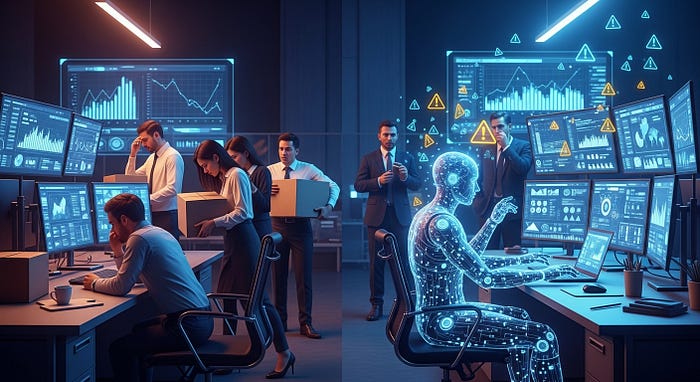


Artificial Intelligence is changing how organizations operate. From automation to predictive analytics, companies across industries are investing heavily in AI systems to improve efficiency and reduce operational costs. Over the past few years, many executives have believed that AI can replace large portions of the workforce. As a result, several companies have attempted to cut employees and rely more heavily on automation and machine learning systems.
However, reality has proven to be far more complicated.
Many organizations that rushed to replace human workers with AI have started to realize that the decision was premature. While AI can perform certain tasks extremely well, it still lacks the context, judgment, creativity, and adaptability that human professionals bring to the workplace.
This realization has led many companies to quietly reverse course. Some have rehired employees, while others have restructured their operations to bring humans back into critical roles.
In this article, we will explore why companies that fire employees in favor of AI often regret the decision later. We will examine the limitations of AI, the value of human expertise, and why the future of work is more about collaboration between humans and machines rather than replacement.
The AI Hype Cycle and Corporate Panic
Every new technology goes through a hype cycle. AI is no different.
When breakthroughs in machine learning, generative AI, and automation tools became widely available, many business leaders feared that if they did not adopt AI immediately, they would fall behind competitors.
This created a wave of rushed decisions.
Companies began cutting costs by reducing teams, believing that AI tools could replace marketers, developers, analysts, designers, and customer support staff.
Executives were excited by the idea of reducing payroll expenses. AI appeared to offer a simple solution: automate processes and eliminate salaries.
But what many organizations underestimated was the complexity of human work.
Jobs are rarely a collection of repetitive tasks that can be automated easily. Most roles involve decision-making, interpretation, communication, and problem-solving in unpredictable environments.
When companies replaced employees with AI, they often discovered that automation worked well for small parts of a workflow but failed when asked to handle the entire process.
AI Is Powerful but Narrow
Artificial Intelligence is extremely capable in specific tasks.
For example, AI can:
- Analyze massive datasets
- Generate text and images
- Detect patterns in data
- Automate repetitive workflows
- Assist with coding
- Provide customer support responses
However, AI systems operate within defined boundaries. They do not truly understand context in the same way humans do.
AI models rely heavily on training data and probabilistic predictions. This means they can produce impressive results but also make critical mistakes when the situation falls outside their training.
When companies removed experienced employees and relied solely on AI tools, they quickly encountered problems.
Tasks that appeared simple required human oversight.
Decisions that seemed straightforward needed strategic thinking.
Customer interactions demanded empathy and flexibility.
AI could assist with these tasks, but it could not fully replace the professionals who understood the business.
The Hidden Costs of Replacing Humans with AI
One of the biggest misconceptions about AI adoption is that it significantly reduces costs.
At first glance, replacing employees with software seems cheaper. But companies often fail to account for the hidden expenses involved in maintaining AI systems.
These costs include:
- AI infrastructure and computing power
- Software licensing
- Data storage and management
- AI model training and updates
- Cybersecurity risks
- Integration with existing systems
- Human supervision and monitoring
Organizations also need skilled engineers and analysts to manage AI systems. Without proper oversight, AI tools can produce unreliable results or introduce new vulnerabilities.
Many companies that attempted to reduce staff discovered that they still needed experts to validate AI outputs and ensure systems functioned correctly.
Instead of reducing costs, some organizations ended up increasing operational complexity.
AI Makes Mistakes — Sometimes Expensive Ones
AI systems can make mistakes that humans would easily catch.
These errors can occur because of biased data, misinterpretation of inputs, or unexpected situations.
For example, AI-powered customer support systems have been known to provide incorrect answers, misunderstand customer requests, or escalate minor issues into major problems.
In finance, healthcare, and cybersecurity, AI errors can have serious consequences.
A faulty decision generated by an AI model could lead to:
- Financial losses
- Legal liabilities
- Reputation damage
- Security vulnerabilities
Humans are able to apply judgment and contextual reasoning when making decisions. AI systems, on the other hand, rely on patterns and probability.
When companies remove human oversight, the risk of costly mistakes increases dramatically.
Loss of Institutional Knowledge
One of the most overlooked consequences of firing employees is the loss of institutional knowledge.
Experienced employees possess insights that cannot easily be documented or transferred into algorithms.
They understand:
- Internal processes
- Company culture
- Customer expectations
- Historical decisions
- Operational nuances
When organizations replace staff with AI, they often lose this valuable knowledge.
Later, when problems arise, companies realize that the information needed to solve those issues was never recorded.
This knowledge gap can slow down operations and make decision-making much harder.
In many cases, businesses end up hiring consultants or rehiring former employees to regain lost expertise.
Creativity Cannot Be Automated
AI can generate content, designs, and code, but creativity involves much more than generating outputs.
True creativity requires:
- Original thinking
- Understanding human emotion
- Cultural awareness
- Strategic insight
- Experimentation and intuition
AI systems are excellent at remixing existing information, but they rarely create genuinely new ideas without human guidance.
Companies that replaced creative teams with AI tools often discovered that the quality of innovation declined.
Marketing campaigns became repetitive.
Product ideas lacked originality.
Brand identity became weaker.
Human creativity remains one of the most valuable assets in any organization.
AI Needs Human Guidance
Another important reality is that AI performs best when humans guide it.
AI tools are most effective when used as assistants rather than replacements.
For example:
- Writers use AI to draft content faster.
- Developers use AI to generate code suggestions.
- Security analysts use AI to detect threats.
- Marketers use AI for data analysis and targeting.
In each of these cases, humans remain responsible for strategy, decision-making, and validation.
Companies that eliminated these roles often discovered that AI outputs lacked direction and consistency.
Without human supervision, AI systems cannot align with long-term business goals.
Customer Experience Suffers Without Humans
Customer relationships are built on trust and empathy.
AI chatbots and automated systems can handle basic inquiries, but complex situations require human interaction.
Customers often become frustrated when they cannot reach a real person.
This frustration can damage brand reputation and lead to customer churn.
Organizations that replaced large portions of their customer support teams with AI frequently saw increases in complaints and negative feedback.
Eventually, many of these companies restored human support channels.
AI works best as a support tool for customer service representatives, not as a complete replacement.
Ethical and Legal Challenges
AI adoption also introduces ethical and legal concerns.
Algorithms can unintentionally discriminate against certain groups due to biased training data.
Automated decision-making can lead to unfair outcomes in hiring, lending, insurance, and other industries.
Governments around the world are beginning to regulate AI systems to address these concerns.
For example, regulatory frameworks like the EU Artificial Intelligence Act are being developed to ensure responsible AI deployment.
Companies that rely too heavily on AI without human oversight may face legal scrutiny if their systems produce harmful outcomes.
Maintaining human involvement in decision-making helps organizations reduce these risks.
AI Security Risks
AI systems themselves can become targets for cyberattacks.
Attackers may attempt to manipulate training data, exploit vulnerabilities in machine learning models, or trick AI systems into producing incorrect outputs.
Security professionals must monitor and defend AI infrastructure.
In fields like cybersecurity, AI can assist analysts but cannot replace experienced experts who understand attacker behavior.
Human analysts are able to detect anomalies, interpret intelligence, and respond to incidents in ways that automated systems cannot replicate.
Companies that removed security teams in favor of automated AI solutions often found themselves more vulnerable to attacks.
The Productivity Paradox
Some companies expected massive productivity gains after adopting AI.
However, the results have been mixed.
Employees who remain in the organization often spend additional time reviewing AI-generated outputs, correcting mistakes, and managing automated workflows.
Instead of eliminating work, AI sometimes shifts responsibilities.
Workers move from performing tasks themselves to supervising AI tools.
This means productivity improvements depend heavily on proper integration between humans and machines.
Companies that fired too many employees discovered that the remaining staff struggled to manage AI systems effectively.
The Return of Human Talent
In several industries, companies have quietly begun rehiring employees after experimenting with AI-only operations.
They realized that removing human expertise disrupted workflows, lowered quality, and created new risks.
Some organizations have even started marketing themselves as "human-first" companies to rebuild trust with customers.
This shift highlights an important lesson: technology should enhance human capabilities, not eliminate them entirely.
Businesses that balance automation with skilled employees are more likely to succeed in the long term.
AI Adoption Requires Strategic Planning
Successful AI adoption requires careful planning.
Organizations must evaluate which tasks can be automated and which require human expertise.
This process involves:
- Workflow analysis
- Risk assessment
- Employee training
- Infrastructure planning
- Continuous monitoring
Companies that rushed into layoffs without conducting this analysis often faced operational disruptions.
A strategic approach to AI integration ensures that automation supports employees rather than replacing them prematurely.
The Future Is Human-AI Collaboration
The future of work will not be defined by humans versus AI.
Instead, it will involve collaboration between the two.
AI will handle repetitive tasks, analyze large datasets, and generate insights.
Humans will focus on strategy, creativity, decision-making, and relationship building.
This partnership can significantly increase productivity when implemented correctly.
Employees who learn to work effectively with AI tools will become even more valuable to organizations.
Rather than eliminating jobs, AI is more likely to transform them.
Lessons for Business Leaders
Executives considering AI-driven layoffs should carefully evaluate the long-term consequences.
The goal of AI adoption should not simply be cost reduction.
Instead, it should focus on improving efficiency, innovation, and decision-making.
Organizations that treat AI as a replacement for human talent risk damaging their operations and reputation.
Companies that treat AI as a powerful tool for empowering employees will achieve far better results.
Conclusion
Artificial Intelligence is one of the most transformative technologies of our time.
It offers incredible opportunities for automation, analysis, and innovation. However, the idea that AI can completely replace human workers is largely a myth.
Companies that rushed to fire employees in favor of AI often discovered the limitations of automation. They encountered hidden costs, operational disruptions, and declining quality.
Human expertise, creativity, and judgment remain essential for successful organizations.
The most effective businesses are those that integrate AI thoughtfully while preserving the strengths of their workforce.
Rather than replacing people, AI should be used to enhance what humans do best.
The companies that understand this balance will thrive in the AI-driven future.
Before You Go
If this article helped you think differently or gave you something practical to try, drop a "YES" in the comments. I genuinely read them, and they shape what I build and write next.
If you believe more people should see content like this, a clap and follow really helps. It supports independent creators and helps this work reach the right audience.
Thank you for taking the time to read till the end.
A Personal Note from Vijay Kumar Gupta
Hey, I'm Vijay Kumar Gupta.
I'm the Founder of EINITIAL24 and Digital GitHub, where I work on building practical tools, writing ebooks, and sharing real-world knowledge around technology, cybersecurity, automation, and digital growth.
I also run the In-Public Community on Discord, a space where builders, developers, and learners openly share ideas, experiments, and lessons — without fake hype or gatekeeping.
Beyond writing, I host a podcast on YouTube, where I talk about tech, startups, money, tools, and the realities behind building in public. I also write a regular newsletter on LinkedIn, sharing insights, learnings, and behind-the-scenes experiences that don't always make it into public posts.
You'll often find me:
- Sharing insights and experiments on Instagram and Facebook
- Publishing code, tools, and technical knowledge on GitHub
- Writing long-form articles on Medium
- Documenting my journey and work on my personal website
- Selling practical digital products and tools on Gumroad
- Publishing ebooks and guides on Kindle and Google Books
Everything I share is based on hands-on experience — what worked, what failed, and what I learned along the way. No sponsors, no shortcuts, just consistent effort to help others learn faster by avoiding the mistakes I already made.
If you'd like to support this work:
- Follow me across platforms where I share regularly
- Join the community and newsletter to stay connected
- And if this post helped you, clap, follow the writer, and share it with someone who might benefit
More tools, more stories, and more lessons coming soon. 🚀