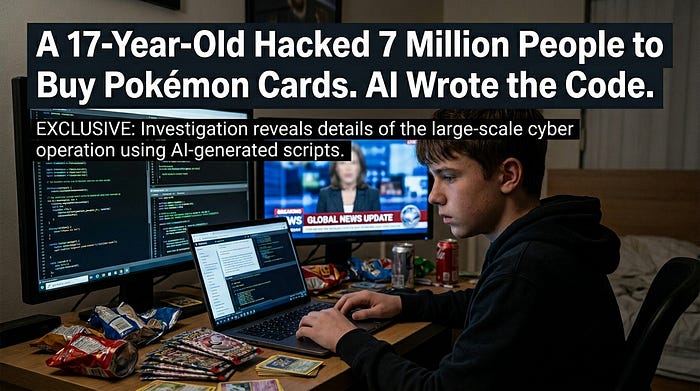

On December 4, 2025, police in Osaka arrested a 17-year-old boy under Japan's Unauthorized Access Prohibition Act.
He had just stolen the personal data of seven million users from Kaikatsu Club, the country's largest internet cafe chain.
When investigators asked him why, he gave the most 2026 answer imaginable.
He wanted to buy Pokémon cards.
Here is the part that should keep every IT manager awake at night: the kid wasn't a prodigy. He didn't write the malicious code. He didn't need to. He just asked an AI, and the AI gave him everything he needed — a working exploit, a polished phishing lure, and instructions a teenager could follow on a Tuesday afternoon.
This is not a story about one Japanese teenager.
This is the story of the next twelve months of cybersecurity.
The Year the Math Changed
Every cybercrime metric I track approximately doubled in 2025.
Not by a percentage. Doubled.
The reason is brutally simple. For thirty years, the cybersecurity industry has been built on one quiet assumption: that sophisticated attacks require sophisticated attackers. Writing a working exploit was hard. Crafting a convincing phishing email in flawless English was hard. Cloning a voice was hard. Building a fake Zoom call with three deepfaked executives was hard.
In 2025, all of that became a prompt.
Large language models crossed the threshold from "useful but error-prone coding assistant" to "end-to-end criminal infrastructure." A single attacker can now generate ten thousand unique, hyper-personalized spear phishing emails before lunch. Each one references real coworkers. Each one mentions real projects. Each one is grammatically perfect.
The barrier to entry didn't lower. It evaporated.
The May 2026 Receipts
Let me show you what this looks like in the wild.
In the first four days of May 2026, three separate campaigns hit the news. They are not theoretical. They are not red-team exercises. They are public, attributed, and ongoing.
Campaign One: VENOMOUS#HELPER. Securonix researchers exposed a phishing operation that had quietly compromised more than 80 US organizations since April 2025. The attackers used AI-written emails to trick employees into installing legitimate remote management tools — SimpleHelp and ScreenConnect — that no antivirus software flags as malicious. Once installed, the attackers had a permanent backdoor signed by the software's real publisher.
Campaign Two: AccountDumpling. A Vietnamese-linked operation hijacked roughly 30,000 Facebook accounts using Google AppSheet as a phishing relay. They didn't fight URL reputation filters. They used Google's own infrastructure against itself.
Campaign Three: A $701 million crypto seizure. A joint US-UAE-China operation arrested 276 suspects across nine scam centers running AI-powered investment fraud against American victims. The scripts, the deepfaked dating profiles, the fake trading dashboards — all generated and operated by language models running 24 hours a day.
Three campaigns. Four days. One pattern.
The phishing attack of 2026 doesn't look like a phishing attack. It looks like your IT vendor sending a normal invoice. It looks like your CEO joining a normal Zoom call. It looks like Google.
Why Your Email Filter Just Became Decoration
If you are reading this and thinking, "Sure, but our company has Microsoft 365 with the premium spam filter and a phishing simulation program," I have bad news.
The defenses we trained for the last decade were built on a set of assumptions that no longer hold.
We trained employees to spot bad grammar. AI fixed the grammar.
We trained filters to flag suspicious sender domains. Attackers compromise legitimate accounts first and email from inside trusted relationships.
We trained antivirus to block malware. The new attacks don't deploy malware — they install commercial software you can buy on a vendor website.
We deployed multi-factor authentication. The new phishing pages relay your one-time password to the attacker in real time, before it expires.
We told employees to verify by phone. The phone now sounds exactly like the CFO.
Every layer of the old defense stack assumed something the attackers can no longer afford to give you: friction. AI removed the friction.
The Six Attacks Already Hitting Inboxes Right Now
If your security team is not actively hunting for these six patterns, you are exposed:
Voice cloning. A 30-second audio sample from a podcast or earnings call is enough to clone your CEO's voice. The call usually comes on a Friday afternoon, requesting an urgent wire transfer.
RMM tool hijacking. The VENOMOUS#HELPER playbook. The attacker doesn't deliver malware. They deliver a real product, signed by a real vendor.
SaaS relay phishing. Attackers route phishing pages through Google AppSheet, Microsoft Forms, and Notion to bypass URL filters. The links look legitimate because they are legitimate.
SSO adversary-in-the-middle pages. A fake Microsoft login page that captures your token and pivots into Salesforce, GitHub, and Slack within seconds of you clicking submit.
Deepfake video calls. Multiple finance teams have already wired millions to attackers after joining Zoom or Teams calls where every executive on screen was generated.
Tax and invoice phishing. The Silver Fox campaign in May 2026 sent over 1,600 AI-written emails impersonating India's Income Tax Department to deploy ValleyRAT into industrial and retail companies.
These are not hypotheticals. These are the active campaigns from the last fourteen days.
What Actually Works in 2026
I'm not going to pretend there's an easy fix. There isn't.
The companies that are surviving this year are the ones that stopped treating cybersecurity as a checklist and started treating it as architecture.
Three things matter more than everything else combined.
One: a next-generation firewall with real SSL inspection and AI-driven sandboxing. Not a firewall from 2018. A firewall from 2024 or later, properly licensed, with the threat intelligence subscriptions actually paid for and turned on. This is the single most leveraged dollar in cybersecurity right now, and most SMBs are still running gear that pre-dates the AI threat curve.
Two: phishing-resistant MFA. That means FIDO2 hardware keys or push-with-number-matching. SMS-based MFA is now actively dangerous because it gives users false confidence while AI phishing kits relay the codes in real time.
Three: network segmentation that actually segments. When the attacker gets in — and they will get in — the difference between a bad week and a bankruptcy event is whether they can move laterally to your finance system, your customer database, and your backups. VLANs, zero-trust network access, and properly configured east-west firewall rules are no longer optional.
Everything else — EDR, awareness training, DNS filtering, email gateway upgrades — matters too. But without those three foundations, the rest is paint on a burning house.
The Next Six Months
The Japanese teenager bought his Pokémon cards. The Osaka police caught him because he made the kind of operational mistakes a 17-year-old makes.
The professionals do not make those mistakes.
The financially motivated groups, the nation-state actors, the ransomware affiliates — they have the same AI tools the kid had, plus operational discipline, plus a market of buyers willing to pay six figures for a working corporate breach.
We have one window. The next six months. The companies that audit their firewall, replace their MFA, and segment their network this quarter will be writing case studies in 2027. The companies that keep treating 2026 like 2022 will be writing breach notification letters.
The era of human-paced cybercrime is over.
Choose your speed accordingly.
If you found this useful, the full technical breakdown — including the exact firewall configurations and the seven AI phishing types in detail — is available on the Jazz Cyber Shield blog. For business-grade firewalls, network switches, and security cameras shipped across the US, visit jazzcybershield.com.
Originally published at blog.jazzcybershield.com.