
If you've been learning bug bounty for weeks… or even months… but still haven't found your first bug…
You're not alone.
Most beginners don't fail because they're not smart enough. They fail because they're unknowingly making a few critical mistakes.
I've seen this pattern again and again.
Let's fix that today.
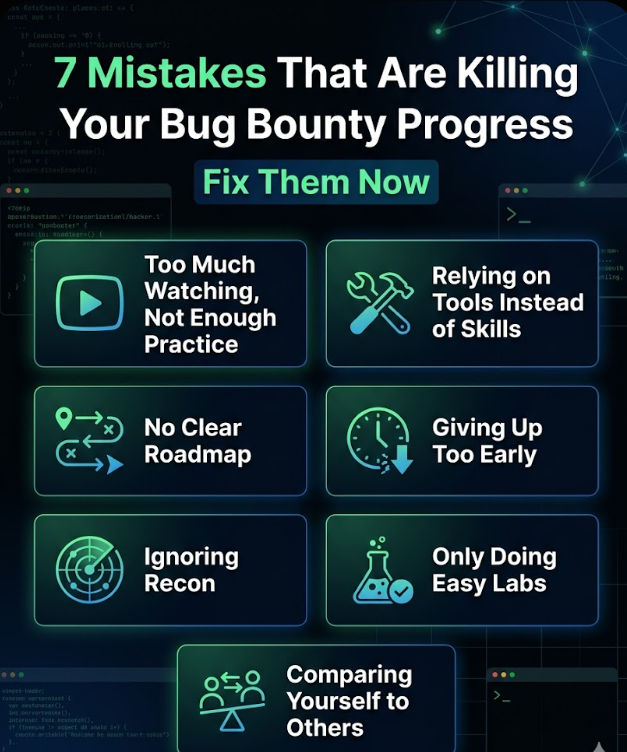
❌ 1. Consuming Too Much, Practicing Too Little
Watching tutorials feels productive.
But it's not.
You can watch 50 videos on XSS… and still fail to find one in a real application.
👉 Reality: Bug bounty is a skill, not knowledge.
✅ Fix:
- Spend 70% time practicing, 30% learning
- Use labs, real apps, and test environments
- Break things → that's how you learn
❌ 2. Chasing Tools Instead of Understanding
"Which tool should I use?" "Best tools for bug bounty?"
Wrong question.
Tools don't find bugs. You do.
👉 Many beginners rely on scanners without understanding what's happening underneath.
✅ Fix:
- Learn how vulnerabilities actually work
- Understand HTTP requests, parameters, logic flaws
- Use tools only as helpers, not crutches
❌ 3. No Clear Roadmap
Random learning = slow progress.
One day XSS. Next day SQLi. Then APIs. Then something else…
👉 That's chaos, not learning.
✅ Fix:
Follow a simple structure:
- Basics (HTTP, Web, Networking)
- One vulnerability at a time
- Practice + real-world testing
- Move to next topic
Consistency beats randomness.
❌ 4. Giving Up Too Early
You try for a few days… don't find anything… and feel like:
"Maybe bug bounty isn't for me."
This is the biggest trap.
👉 Even experienced hunters go days (or weeks) without finding bugs.
✅ Fix:
- Focus on process, not results
- Celebrate small wins (understanding, recon, testing)
- Stay consistent — results come later
❌ 5. Ignoring Recon (The Silent Killer)
Most beginners jump straight into testing.
Big mistake.
👉 Good recon = better chances of finding bugs.
Without recon, you're basically guessing.
✅ Fix:
- Spend time mapping the target
- Find subdomains, endpoints, and parameters
- Understand how the application works
Think like a researcher, not a random attacker.
❌ 6. Only Learning Easy Stuff
Only doing beginner labs won't prepare you for real-world bugs.
👉 Real applications are messy, complex, and unpredictable.
✅ Fix:
- Move beyond labs as soon as possible
- Test on real programs (within scope)
- Analyze real bug reports
Growth happens outside your comfort zone.
❌ 7. Comparing Yourself to Others
You see someone posting:
"I made $1000 from one bug"
And suddenly you feel behind.
👉 What you don't see:
- Their months/years of struggle
- Their failures
- Their learning curve
✅ Fix:
- Focus on your own journey
- Track your own progress
- Improve 1% every day
Comparison kills motivation.
🧠 The Truth About Bug Bounty
Bug bounty is not:
- Fast money ❌
- Easy wins ❌
It is:
- Skill-based ✔️
- Consistency-driven ✔️
- A long-term game ✔️
🚀 What You Should Do Next (Simple Plan)
If you're serious, follow this:
- Pick one vulnerability (e.g., XSS)
- Learn basics deeply
- Practice in labs
- Test on real targets
- Repeat daily
No shortcuts. Just progress.
💬 Final Thoughts
If you're making these mistakes — that's okay.
Everyone does at the beginning.
What matters is this:
👉 Now you're aware. 👉 Now you can fix them.
Stay consistent. Stay curious. And most importantly — don't quit.
Your first bug is closer than you think.