June 6, 2026
Why Multi-Agent Systems Are Becoming a Product Management Imperative
The gap between what AI can demonstrate in isolation and what it can deliver across a real product organization is widening. Single-agent…

Sayantan Ghosh
7 min read
The gap between what AI can demonstrate in isolation and what it can deliver across a real product organization is widening. Single-agent systems handle individual tasks well — drafting a PRD, summarizing feedback, writing a SQL query — but product management is not a sequence of isolated tasks. It is a coordination problem, and coordination requires multitasking under structured orchestration.
By early 2026, AI adoption has matured beyond experimentation. Workforce access to sanctioned AI tools rose by 50% in a single year to approximately 60% of knowledge workers, and 85% of companies now expect to customize autonomous agents to fit specific business needs. The nature of this adoption has shifted from chatbots that generate content to systems that actively orchestrate workflows, make decisions, and execute tasks across the digital economy. For product managers, this shift — often called the "Agent Leap" — represents the most significant change to the role since the transition from waterfall to agile.
The Coordination Problem That PMs Already Own
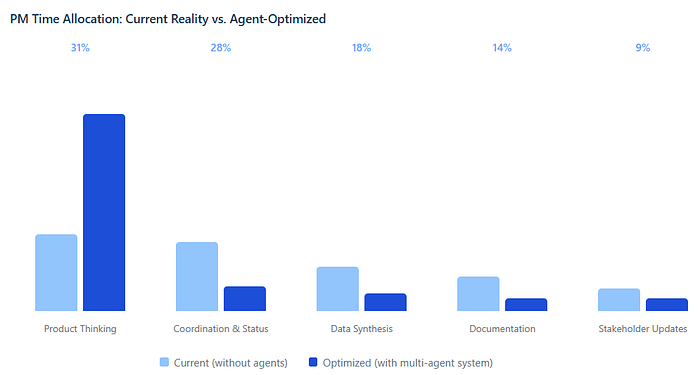
Product managers sit at the intersection of engineering, design, marketing, customer success, and leadership. Every day, they synthesize inputs from support tickets, usage analytics, competitive intelligence, stakeholder feedback, and delivery signals — all scattered across different tools, formats, and teams. The average PM spends less than a third of their working week on actual product thinking, with the rest consumed by coordination overhead: the invisible tax of operating at the center of a complex organization.
This coordination burden is not a new problem, but the scale of inputs has outgrown manual synthesis. A single product launch touches Jira for engineering progress, Figma for design specs, Mixpanel for usage metrics, Zendesk for customer feedback, and Slack for cross-team communication. Pulling these signals together into a coherent weekly update used to require hours of manual work — toggling between dashboards, reading tickets, and assembling narratives for different stakeholders. The work was never intellectually demanding, but it was time-consuming and unavoidable.
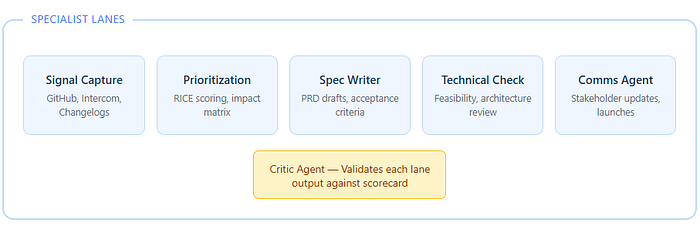
Multi-agent systems address this coordination problem directly. Rather than giving a PM a better search tool, orchestrated agents actively perform synthesis: monitoring sources continuously, extracting signal from noise, and surfacing insights at the moment they become relevant. A signal-capture agent can run every Sunday night, pulling GitHub Issues, competitor changelogs, and Slack threads, then rank them by business impact so the PM starts Monday with a prioritized digest instead of a blank slate. An analytics agent can query the data warehouse in natural language, write the SQL, execute it, and return an answer. A communication agent can listen to meeting transcripts, extract action items, and draft stakeholder updates in the appropriate tone for each audience.
The critical distinction is that these agents do not operate in isolation. A competitive intelligence agent feeds findings to a prioritization agent, which feeds signals to a spec-writing agent, which produces a document reviewed by a technical validation agent. The agents form a pipeline, and the PM orchestrates the pipeline rather than performing each step manually.
Why Single Agents Break Down
Anthropic's guidance on building effective agents makes a practical distinction: workflows use predefined code paths, while agents dynamically direct tool use. The implication for product managers is straightforward — do not buy autonomy you cannot score. Single-agent systems work well for bounded tasks with clear inputs and outputs. They fail when the task requires multiple evidence sources, parallel execution, different risk levels, or domain-specific evaluation criteria.
Consider a customer onboarding workflow. A single agent could draft an onboarding plan, but the process actually requires normalizing customer facts from CRM, extracting obligations from signed contracts, evaluating KYC and compliance constraints, provisioning workspaces, setting up billing, and drafting customer communications. Each of these subtasks needs different evidence sets, different tool access, different approval modes, and different evaluators. A compliance agent must access screening tools that a billing agent cannot. A communications agent can draft emails but must never send them without approval. A provisioning agent can create workspace plans but cannot execute them without delegated authority.
Splitting these into specialist lanes creates measurable value when the subtasks have genuinely different requirements. A decision framework for this: split into a specialist agent when the subtask needs a different evidence set, different tools, different risk class, different evaluator, or parallelizable work that reduces time. Keep it in one workflow when the same context serves every step, steps are strictly sequential, risk is uniform, and one scorecard covers the whole path. If none of these conditions are true, adding agents creates complexity without improving outcomes.
The anti-pattern is mirroring organizational politics rather than work boundaries. Creating an "engineering agent" and a "design agent" and a "marketing agent" replicates silos in code. The right decomposition follows intent and evidence: a contract review agent, a compliance agent, a provisioning agent, and a communications agent, each scoped to a specific job with specific authority. The parent orchestrator owns the final synthesis, and a critic agent verifies that each lane's output meets quality standards before the plan advances.
The PM as AI Orchestrator
Google's analysis of 2026 trends predicts that "every employee becomes an orchestrator." For product managers, this represents a fundamental shift in what the role rewards. The value of a PM is no longer in writing the perfect user story — it is in designing the autonomous system that writes it, verifies it, and delivers it. Those who master the art of managing digital colleagues — balancing speed with governance and strategic insight — will define the next generation of product leadership.
This orchestration role requires new competencies that go beyond traditional PM skills. Workflow architecture becomes essential: mapping how human-agent collaboration flows through the product lifecycle, defining the handshakes between different agents, and specifying the authority matrix that determines what each agent can and cannot do. Evaluation design replaces prompt engineering as the core technical skill — a PM must define the test cases that measure whether an agent performs correctly, including edge cases, failure modes, and brand alignment criteria. Context management becomes critical: not sharing one giant prompt across all agents, but providing per-lane context packs with scoped evidence, tools, and authority.
The emerging job titles reflect this shift. Companies are creating roles like Product Manager Gen AI, Head of AI Product, and Principal Product Manager for Agentic Experiences. These roles require deep technical fluency in multi-agent systems, RAG architectures, and evaluation frameworks — but they are product roles, not engineering roles. The PM designs the system; the engineering team builds it. The PM defines the scorecard; the agents execute against it.
Product leaders have started to approach it by building a team of AI agents — a thinking partner modeled on Steve Jobs for problem framing, a CTO agent for technical understanding, and a designer agent for rapid prototyping. Each agent has access to full context: meeting notes, conversations, documents. Before any engineering sprint, the approach is to stress-test one's assumptions with the thinking partner, pressure-tests the technical side with the CTO agent, and builds a working prototype with the designer agent. The feedback loop shrinks from weeks to days, and product managers arrives at engineering meetings with validated insights rather than assumptions.
The Control Tower Pattern
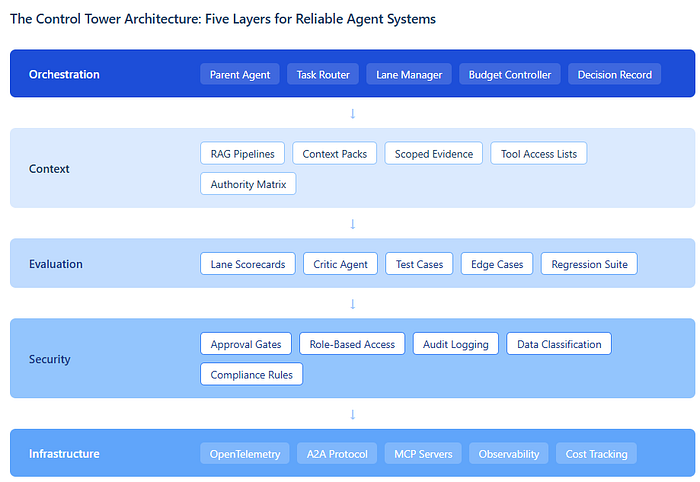
The most reliable multi-agent architecture follows a control tower pattern: a parent orchestrator that owns intent, context, budget, and the final decision record; specialist lanes that run bounded subtasks with scoped tools and context; a critic that verifies plans, scores lane outputs, and accepts or rejects synthesis; a tool gateway that enforces schemas, policy, approval modes, and audit; and a decision record that captures the final outcome, evidence, approvals, and trace.
Each specialist lane needs a mini-spec that defines its job, context sources, allowed tools, risk level, and the typed artifact it returns. If a lane cannot be specified this way, it is not ready to be a separate agent. The parent orchestrator follows strict rules: it may spawn lanes only from approved task templates, must pass each lane a scoped context, must set lane budgets, must reject lane outputs without required evidence references, must not let lane outputs directly produce side effects, and must synthesize one final plan with one final decision record.
The critic is not a quality assurance agent bolted on at the end. It verifies plan validity, evidence sufficiency, tool authorization, approval mode compliance, lane quality, and final receipt completeness. For PMs, the critic is where many acceptance criteria become executable — the point where vague requirements like "the response must be accurate" transform into measurable checks like "all claims must be supported by evidence from approved sources."
Context management across lanes requires discipline. Each lane receives an up-front briefing with stable mission, policy, owner, and output shape. It retrieves specific evidence just-in-time rather than receiving everything upfront. It compacts its context to preserve decisions and open questions while dropping raw chatter. It returns typed output to the parent rather than full lane transcripts. This structured approach prevents context bloat and ensures each lane operates with the minimum information required to do its job.
The Infrastructure Beneath the Agents
The teams moving fastest in 2026 are not building isolated AI features — they are building infrastructure that serves multiple use cases. The teams extracting compounding value are those that think in layers: a context layer that surfaces the right data to models, an orchestration layer that manages agent flows with retries, fallbacks, and guardrails, and an evaluation layer that runs before every deployment.
The context layer includes RAG pipelines, context window management, and data structures accessible to language models. The orchestration layer manages when one model calls another, handles failures, and enforces guardrails. The evaluation layer runs automated test cases on every deployment — not ten examples, but hundreds covering edge cases, different languages, and varying input lengths. If evaluation scores drop below a threshold, deployment stops.
MCP protocols have emerged as the interoperability standards of the agentic era, allowing agents from different vendors — Databricks, Atlassian, Google — to negotiate and hand off tasks. For PMs, this means a product workflow rarely lives in a single tool. It traverses customer support, engineering, design, and documentation, with agents acting as the connective tissue that creates a unified workflow graph. The PM manages a node in a vast, interconnected network of intelligent services.
Adopting Multi-Agent Systems Without Losing Control
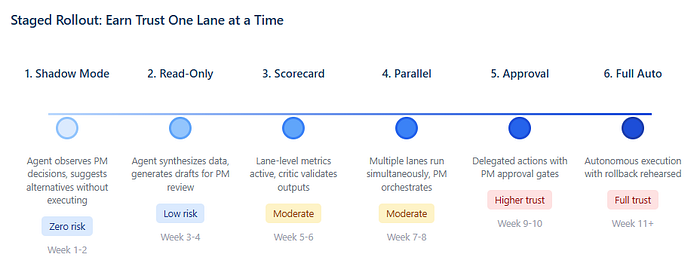
The instinct to deploy agents everywhere simultaneously is the most expensive mistake in multi-agent adoption. Product teams that succeed start with a single, high-value workflow — typically one that is repeatable, cross-tool, and consumes disproportionate PM time. Weekly product health updates, competitive monitoring, or stakeholder reporting are strong candidates because they have clear inputs, defined outputs, and measurable time savings.
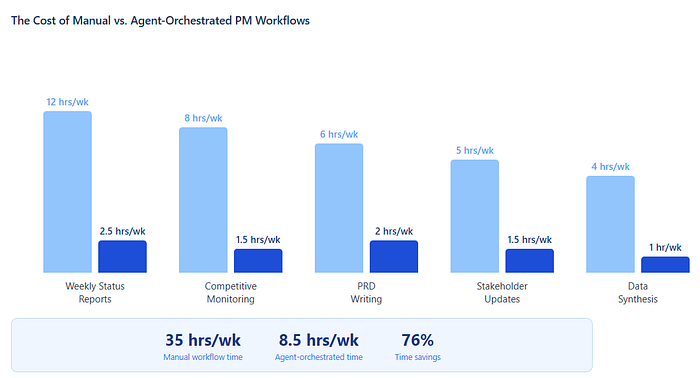
The teams that succeed in this transition are not those with the most sophisticated models. They are those that encode their product judgment into repeatable, named, shareable workflows — skills that capture competitive analysis methods, PRD structures, and prioritization rules so agents run them consistently without the PM in the room. The PM's expertise is no longer trapped in their head. It becomes a system — versioned, shared, running whether they are at their desk or not.