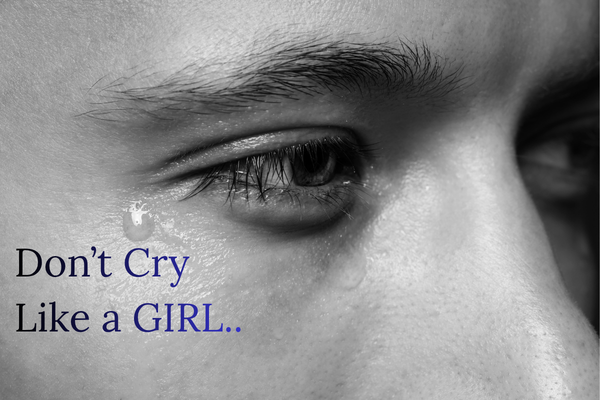

I cry. I'll just say it.
Not often, and not over small things, but when something truly hits me, I let it. And every single time, I feel lighter afterward. Like something that had been pressing on my chest finally got to breathe.
The anger, the frustration, the grief, the overwhelm, whatever it is, crying moves it. It doesn't fix everything, but it releases something real. And I've never once regretted it.
So this piece is for the men who have been told, in a hundred different ways, that this isn't allowed for them. And it's also for everyone around those men, the partners, the parents, the friends, who might not realise how much they've contributed to that silence, or how much they could help change it.
Where Did This Even Come From?
Think about it, in almost every culture, in almost every corner of the world, there is some version of the same message passed down to boys: don't cry. Be strong. Hold it together.
It doesn't always come as a direct instruction. Sometimes it's a father who turns away at a funeral. A brother who laughs when someone gets emotional. A group of friends where vulnerability is always, quietly, a joke waiting to happen. The message gets absorbed without anyone ever sitting down and saying it plainly.
And before long, a boy grows into a man who genuinely doesn't know what to do with what he feels. Not because he doesn't feel it, but because he was never given a safe place to put it.
That's not a strength. That's just a wound that never got treated.
What Crying Actually Has to Do With Gender (Hint: Nothing)
I've thought about this a lot. And I genuinely cannot figure out what emotions have to do with being a man or a woman.
We all feel grief. We all feel frustration. We all reach a point where something is just too heavy to carry quietly. These are not gendered experiences. They're human ones.
The stigma that crying makes you weak, that only women do it, that it's something to be ashamed of, was constructed. Someone decided it. And then it got repeated until it started to feel like the truth.
But it was never truth. It was just a story. And stories can be rewritten.
The Men I've Known Who Got This Right
From my own life, the relationships I've seen work, really work, built on something deep and lasting, have always had one thing in common. The man in them was willing to be soft.
Not weak. Not passive. Soft. There's a difference. It means choosing, in certain moments, to set the ego aside. To say: this person matters more than my need to seem unshakeable. This relationship is more important than being right.
And here's what I've noticed, sensitive men are not hard to be around. They're actually the easiest. Because you don't have to guess what they're feeling. You don't have to tiptoe. There's a kind of safety in being with someone who has learned to be real.
In my experience, those men are the strongest ones in the room. They just don't look like what we were taught strength was supposed to look like.
If No One Showed You How: It's Not Your Fault
I want to say this gently, because I mean it genuinely: if you're a man who struggles with this, who shuts down instead of opening up, who goes quiet when you're hurting, who hasn't cried in years and isn't sure if you even could, none of that makes you a bad person.
You were taught this. Your family, your environment, the world around you, it all pointed in the same direction. You followed the map you were given.
But you can draw a new one. Not overnight. Not perfectly. Just, slowly, with some grace toward yourself, you can start to let things move through you instead of building up inside. You can learn that being real is not the same as being broken.
And for those of us watching the men in our lives carry too much in silence, we have a role too. In what we say. In what we laugh at. In whether we make it safe for them to be human.
· · ·
Crying didn't make me less of a man. If anything, it reminded me I was one — a real one, who feels things, who carries things, and who knows when to finally put them down.