
Afghanistan: The Global Hub of Terror in 2026
When the last American soldier exited Afghanistan in 2021, many assumed the country would fade into chronic instability — but nothing more than a regional problem. Today, official United Nations reporting suggests a far more dangerous reality: Afghanistan has become what some analysts describe as a global hub of terror — a permissive operational environment for multiple extremist organisations with the potential to affect security beyond its borders. This assessment is not rhetorical. It is based on repeated, detailed reporting by the United Nations Security Council Analytical Support and Sanctions Monitoring Team, formal documents that member states review in closed sessions.
How the UN Describes the Security Landscape
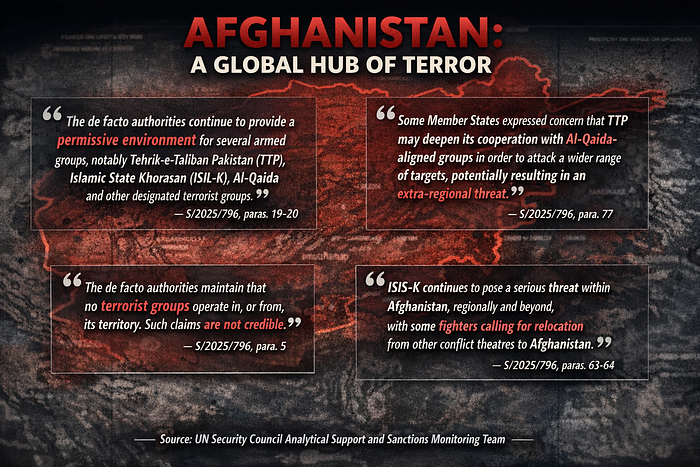
The most recent Monitoring Team report — covering developments up to 11 November 2025 — paints a stark picture of Afghanistan's security conditions. In the document UN Security Council Analytical Support and Sanctions Monitoring Team Report S/2025/796 (11 Nov 2025), the Monitoring Team states directly: "The de facto authorities continue to provide a permissive environment for several armed groups, notably Tehrik‑e‑Taliban Pakistan (TTP), Islamic State in Iraq and the Levant – Khorasan Province (ISIL‑K), Al‑Qaida and other designated terrorist groups." — UN Security Council Analytical Support and Sanctions Monitoring Team Report S/2025/796 (11 November 2025), paras. 19–20 Elsewhere in the same report the Monitoring Team notes: "Some Member States expressed concern that TTP may deepen its cooperation with Al‑Qaida‑aligned groups in order to attack a wider range of targets, potentially resulting in an extra‑regional threat." — UN Security Council Analytical Support and Sanctions Monitoring Team Report S/2025/796 (11 November 2025), para. 77 These statements are worth pausing on. NATO, the US, and other Western governments do not generally use the phrase "permissive environment." That is UN technical language indicating a lack of effective counter‑terror enforcement, freedom of movement for violent actors, and insufficient control over territory and networks. More Than Just a Few Groups — A Dense Militant Ecosystem
The same UN report lists a broad range of extremist entities active in Afghanistan. While the Taliban's public position is that groups like TTP and ISIL‑K no longer operate with freedom, the Monitoring Team directly contradicts this claim:
"The de facto authorities maintain that no terrorist groups operate in, or from, its territory. Such claims are not credible." — UN Security Council Analytical Support and Sanctions Monitoring Team Report S/2025/796 (11 November 2025), para. 5 The same report lists more than a dozen armed groups either active or influencing security dynamics inside Afghanistan, including: Tehrik‑e‑Taliban Pakistan (TTP) Islamic State in Iraq and the Levant – Khorasan Province (ISIL‑K) Al‑Qaida and affiliated networks Jamaat Ansarullah Eastern Turkistan Islamic Movement (ETIM) / Turkistan Islamic Party (TIP) Islamic Movement of Uzbekistan (IMU) This variety of groups points to a dense and ideologically diverse constellation of armed actors, not just isolated factions. ISIL‑K: Resilient and Ambitious The Monitoring Team's reporting makes clear that ISIL‑K remains tactically capable and strategically dangerous. Even though it suffered losses in Afghanistan, it retains: recruitment networks operational cells ability to conduct large‑scale bombings
In the same Monitoring Team report mentioned above, the Security Council body explains: "ISIS‑K continues to pose a serious threat within Afghanistan, regionally and beyond, with some fighters calling for relocation from other conflict theatres to Afghanistan." — UN Security Council Analytical Support and Sanctions Monitoring Team Report S/2025/796 (11 November 2025), paras. 63–64 This is not mere speculation. ISIS‑K's own propaganda and historical attack patterns demonstrate regional ambition, and the Monitoring Team places that in official language. Al‑Qaida: Endurance, Not Extinction The group that once carried out the 9/11 attacks and reshaped international security doctrine — Al-Qaida — has not disappeared. The Monitoring Team's 2025 report states: "Al‑Qaida continues to provide ideological guidance and acts as a service provider and multiplier for other groups, offering training, advice and logistical support." — UN Security Council Analytical Support and Sanctions Monitoring Team Report S/2025/796 (11 November 2025), para. 48 This aligns with earlier reporting — including the publicised killing of Al‑Qaida leader Ayman al‑Zawahiri inside Kabul in 2022 — that confirms senior leadership and networks remain active. TTP and Regional Destabilisation While ISIL‑K draws Western attention due to its external aspirations, Tehrik‑e‑Taliban Pakistan represents a more immediate regional destabilisation threat. The Monitoring Team's report notes: "TTP operates as one of the largest terrorist groups in Afghanistan and its attacks on Pakistani security forces have led to ongoing military confrontation." — UN Security Council Analytical Support and Sanctions Monitoring Team Report S/2025/796 (11 November 2025), para. 78 This reflects a growing consensus among South Asian analysts: Afghanistan's security dynamics directly affect stability in Pakistan, Central Asia and beyond. Historical Continuity: Earlier UN Reporting The Monitoring Team's concerns are not new. An earlier document — UN Security Council Analytical Support and Sanctions Monitoring Team Report S/2024/499 (17 July 2024) — states: "Afghanistan remains the primary source of terrorist threat for Central and South Asia, with multiple groups enjoying freedom of movement due to a lack of effective security strategy by the de facto authorities." — UN Security Council Analytical Support and Sanctions Monitoring Team Report S/2024/499 (17 July 2024), para. 33 This shows a continuity of analysis: where previous reports documented capacity and presence, the latest reports document expansion, collaboration, and potential external linkages.
Weapons, Black Markets and Operational Depth
While UN sanctions reports focus primarily on terrorist actors, other research highlights how Afghanistan's deteriorated economic and governance conditions have fuelled weapons proliferation and black market ecosystems that support extremist resilience. A study by the Global Initiative Against Transnational Organized Crime — Smoke on the Horizon: Trends in Arms Trafficking from the Conflict in Ukraine — demonstrates how conflict zones produce surplus weapons that can leak into illegal markets, strengthening armed actors over time. The mechanisms described in that report align with observed dynamics in Afghanistan: surplus military hardware porous borders criminal smuggling networks decentralised distribution While this study focuses on Ukraine, its analysis of how weapons flow from conflict theatres into black market networks is directly relevant to understanding Afghanistan's security environment.
Other Research Confirming Terror Network Density
Outside of UN work, academic research provides independent confirmation of Afghanistan's role in global terror networks. For example, Husain, Sharma and Chakraborti's 2018 study "Identifying the Global Terror Hubs and Vulnerable Motifs Using Complex Network Dynamics" uses network analysis to demonstrate how certain regions — including Afghanistan — function as central nodes in the global terrorism incident network.
Although this research predates 2021, it supports the notion that Afghanistan's historic structural factors (geography, tribal complexity, porous borders) make it a sustained hub of militant connectivity. Regional Defence and Containment Challenges
Neighbouring states, particularly Pakistan and the Central Asian republics, have expressed concern that Afghan‑based militant groups pose direct security threats. Pakistan has: conducted cross‑border defensive operations fortified sections of the Durand Line highlighted the misuse of Afghan territory for staging attacks However, the Monitoring Team's own reporting suggests these measures have not fully contained the threat, largely because: militant groups adapt quickly they exploit tribal and familial cross‑border networks national security responses are constrained by diplomacy Afghanistan's instability thus radiates outward, rather than remaining an internal problem.
Is Afghanistan Exporting Terrorism Again?
Here's the most important synthesis: Afghanistan is not currently launching mass external attacks on Western soil like the pre‑2001 era But it retains the ingredients that made it dangerous — training spaces, weapons flows, multiple ideologically aligned groups, and opportunities for recruitment and financing The UN Monitoring Team's official language — particularly phrases like "permissive environment" and "extra‑regional threat" — indicates a credible risk trajectory. This is why the country merits being described as a global hub of terror in its own right.
Conclusion: A Threat, Not a Relic Afghanistan's narrative is often reduced to humanitarian crises and geopolitical stalemates. But the underlying security picture — as documented in UN Security Council Analytical Support and Sanctions Monitoring Team reports S/2025/796 and S/2024/499 — shows a far more troubling reality: Afghanistan remains one of the most densely connected operational environments for extremist organisations in the world today. Where successive reports once described presence and persistence, the latest reports describe integration, cooperation, and potential regional and extra‑regional threat pathways. For readers seeking grounded, accountable analysis, these official documents — and their careful quotations — make one thing clear: Afghanistan in 2026 is not behind the world's headlines. It is in front of its most dangerous ones.
References UN Monitoring Team Reports • UN Security Council Analytical Support and Sanctions Monitoring Team Report S/2025/796 (11 Nov 2025) https://undocs.org/en/S/2025/796� • UN Security Council Analytical Support and Sanctions Monitoring Team Report S/2024/499 (17 Jul 2024) https://undocs.org/S/2024/499� Other Research • Global Initiative Against Transnational Organized Crime — Smoke on the Horizon Report https://globalinitiative.net/wp-content/uploads/2024/06/Smoke-on-the-horizon-trends-in-arms-trafficking-from-the-conflict-in-Ukraine-GI-TOC-June-2024.v3.pdf • Husain, S., Sharma, K., & Chakraborti, A. — "Identifying the Global Terror Hubs and Vulnerable Motifs Using Complex Network Dynamics" https://arxiv.org/abs/1802.01147�