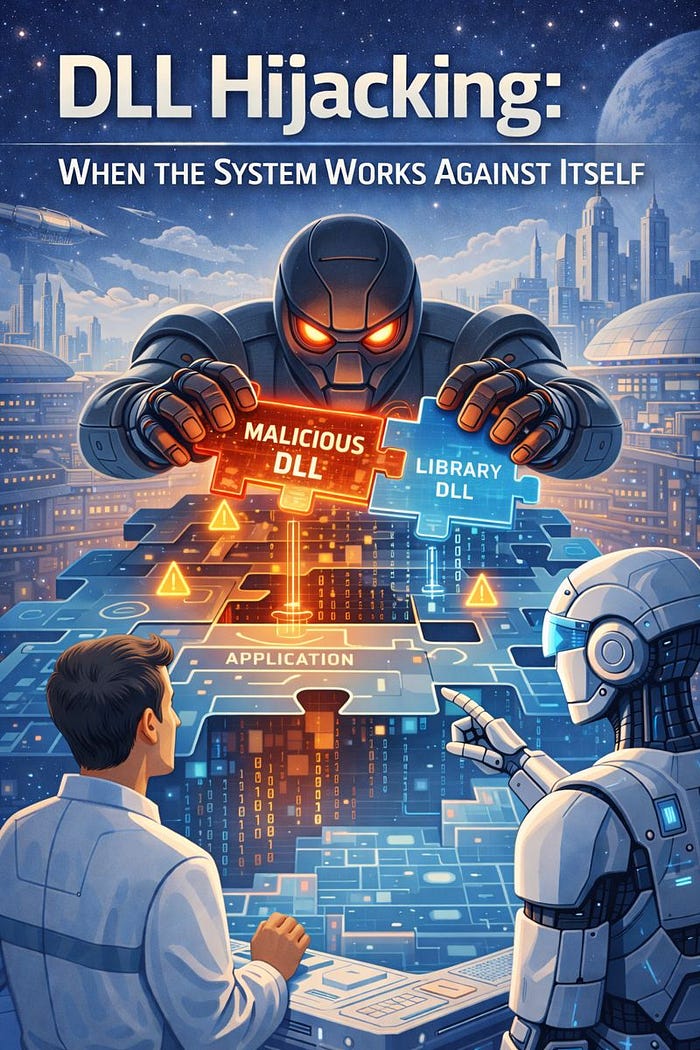

Windows relies heavily on Dynamic Link Libraries (DLLs) to abstract core functionality and reduce complexity for software developers. Through these libraries, applications delegate critical tasks such as cryptography, user interface rendering, and data handling to the operating system instead of implementing them from scratch.
This design greatly simplifies development, but it also introduces an implicit trust relationship between applications and the execution environment. When that trust is misplaced, system DLLs can be abused in ways their designers never intended. Beyond their legitimate use, these mechanisms have historically been leveraged in software cracking, game cheating, and malware development.
I focus on DLL hijacking specifically in the context of software piracy, not as a step-by-step technique, but as a design weakness that allows the operating system itself to undermine software protection.
Common hijacking pattern
In software piracy scenarios, hijacked libraries are rarely chosen at random. Crackers tend to focus on dependencies that sit close to licensing logic or environmental validation, particularly those that are assumed to be present on most systems but are not explicitly distributed with the application. This creates an opportunity where the operating system resolves a dependency in an unexpected way, while the application remains unaware that anything unusual occurred.
Certain hijacking targets tend to cluster around specific functional roles rather than specific libraries. Network-related components are often involved when licensing mechanisms rely on remote validation, as influencing these interactions can cause an application to misinterpret the outcome of a license check. Other targets are tied to filesystem and path-handling logic, particularly when license data, configuration values, or state information are stored or retrieved dynamically at runtime. Finally, user and system information components may be involved when software makes assumptions about the identity or state of the host on which it is running.
Why software piracy loves DLL hijacking
Directly patching application binaries has become increasingly impractical in modern software. Contemporary programs are commonly compiled with multiple exploitation mitigations such as non-executable memory, stack protection mechanisms, and control-flow integrity which raise the cost and complexity of modifying executable code. When combined with file integrity checks and digital signature verification, these defenses also make binary tampering relatively easy to detect.
In contrast, DLL hijacking avoids modifying the target binary altogether. Rather than altering program files, the application is led to interact with a component it already expects to trust. From the software's perspective, execution proceeds normally, while integrity checks remain satisfied because no protected files were changed. This makes such abuses more difficult to detect using traditional integrity-based defenses.
This dynamic is further amplified by the fact that applications often make minimal assumptions about the internal behavior of externally resolved components, as long as they conform to expected interfaces. When trust is granted at this boundary, application logic, such as licensing decisions , can be influenced without directly violating the protections applied to the executable itself.
It's a bad thing for an OS to do exactly what it was supposed to do?
Well.. not always. In DLL hijacking scenarios, the operating system is not acting maliciously or incorrectly. It resolves dependencies according to its documented rules and hands control to the application once those dependencies are satisfied. The failure occurs earlier, when the application assumes that this resolution process is inherently trustworthy.
By delegating critical behavior to components outside its direct control, the software inverts its trust model: protection logic executes inside a process that has already accepted external influence. At that point, integrity checks can confirm that files remain unmodified, but they cannot guarantee that execution semantics remain intact.
In this sense, the system works against itself. The very mechanisms designed to provide flexibility and abstraction are repurposed to influence application behavior, allowing licensing logic to be undermined without violating the assumptions enforced by traditional protection mechanisms
What This Teaches Defenders
DLL hijacking highlights a broader lesson that extends beyond any single technique: client-side protection is ultimately constrained by the trust it places in its execution environment. When applications rely too much on dynamically resolved components, they implicitly grant the operating system authority over critical aspects of their behavior.
From a defensive perspective, this suggests that minimizing dynamic trust is often more effective than attempting to detect its abuse. Each external dependency increases the surface through which application logic can be influenced, even when file integrity mechanisms remain intact. Reducing this dependency surface limits the number of assumptions the software must make about its environment.
Perhaps more importantly, software protection mechanisms should be designed with the understanding that the operating system is not an adversary, but neither is it a guarantor of intent. In piracy scenarios, treating the OS as a neutral but untrusted intermediary leads to more realistic threat models than assuming it will enforce application-level trust boundaries.