
- One floor for the security team
- One for finance
- One for HR
- Another for corporate meetings
- And the top floors reserved for senior leadership and executives
Everything inside the building is organized carefully. Employees can only access areas related to their work. Visitors are restricted to places like:
- the visitor lounge,
- meeting rooms,
- or maybe the cafeteria.
This is usually controlled through RFID badges or access cards issued at the reception desk.
Now imagine if this entire system failed.
What if anyone could go anywhere inside the building?
An unauthorized person could:
- walk into the finance department and access sensitive records,
- enter the server room and plug in a malicious USB device,
- roam around executive floors,
- or access confidential business meetings.
That would become a massive security risk.
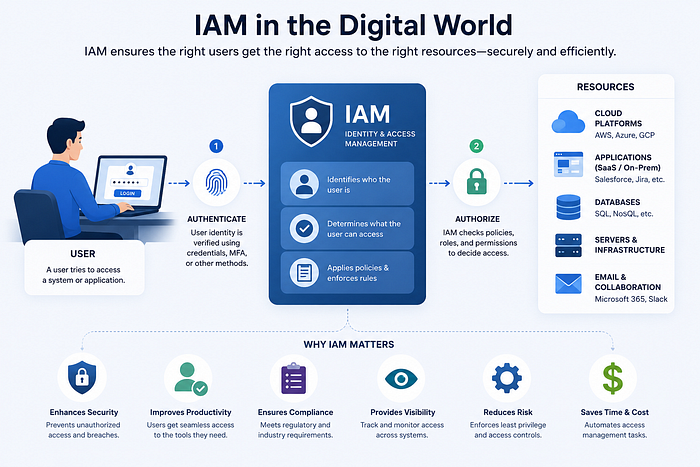
This is exactly the kind of problem Identity and Access Management (IAM) solves in the digital world.
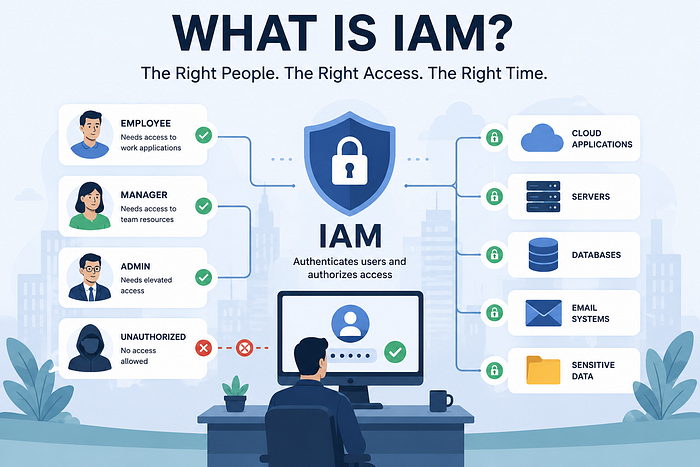
So What is IAM?
Identity and Access Management (IAM) is a cybersecurity domain focused on controlling:
- who users are,
- and what they are allowed to access.
In simple terms:
IAM ensures the right people get the right access to the right systems.
Nothing more. Nothing less.
The Receptionist Analogy
The Receptionist Analogy
- who the person is,
- why they are visiting,
- which department they belong to,
- and what level of access they should receive.
If something seems suspicious or unclear, they ask more questions before granting access.
Similarly, in IT systems:
- users are verified,
- identities are created,
- and permissions are assigned based on roles and responsibilities.
IAM Has Multiple Layers
The RFID badge itself becomes the second layer of access control.
Even if someone has a badge, they still cannot access every floor in the building.
The badge is programmed to allow access only to authorized areas.
For example:
- HR employees may access HR systems,
- developers may access development environments,
- finance teams may access payroll applications,
- while administrators may have elevated privileges.
This is how IAM works in organizations as well.
Different users receive different levels of access depending on:
- their role,
- department,
- responsibilities,
- and security requirements.
IAM in the Digital World
In modern organizations, IAM controls access to:
- emails,
- VPNs,
- cloud platforms,
- databases,
- internal applications,
- and critical infrastructure.
Without proper IAM controls, organizations may face:
- unauthorized access,
- insider threats,
- excessive permissions,
- data breaches,
- and compromised systems.
This is why IAM has become one of the most important areas in cybersecurity today.
As organizations continue moving toward cloud technologies and remote work environments, identity security is becoming more critical than ever.
In fact, many security professionals now say:
"Identity is the new perimeter.