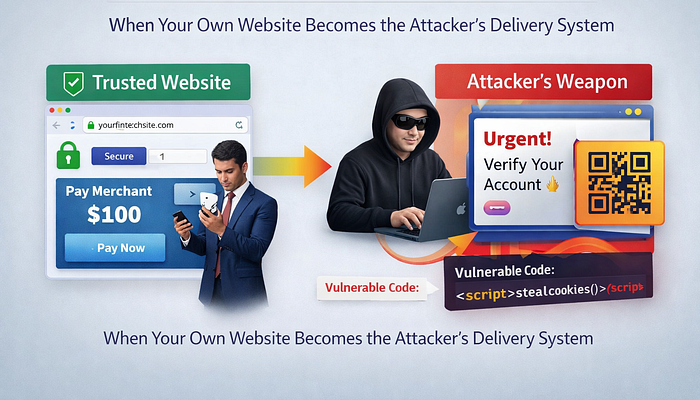

Most people assume that if they are on a legitimate website, the content they see there is safe. The address bar shows the right domain. The padlock is green. The branding looks correct. What they do not expect is that the malicious content they are about to interact with was planted there by an attacker, inside the legitimate site itself. That is Cross-Site Scripting. And it is one of the most consistently exploited vulnerabilities in web applications today.
Here is the plain version. Imagine a community notice board outside a trusted local bank. People post legitimate announcements, event flyers, and information on it daily. One morning, someone pins a fake notice that says, "Scan this code to verify your account." It looks like it belongs there. It is on the bank's own notice board. Customers trust it because of where it is displayed, not because of who put it there. The bank's reputation was used as the delivery mechanism for someone else's trap.
XSS works the same way. An attacker finds a place in a web application where user-supplied content gets displayed back to other users without being properly sanitized. They inject malicious code into that space. When another user loads the page, their browser sees the code, assumes it belongs to the trusted website, and executes it. The attack runs under the full trust and permissions of the legitimate site.
This vulnerability exists across every type of web platform 1. Forums and comment sections that render user input directly. 2. Search results pages that reflect the search term back into the page without sanitizing it. 3. Profile fields that allow rich text input. 4. Error messages that echo user-supplied values back into the response. 5. Notification systems that display user-generated content to other users. Any web surface where one user's input can appear in another user's browser is a potential XSS entry point.
In fintech dashboards, banking portals, and payment platforms, the consequences are severe. A stored XSS payload in a transaction description field gets saved to the database and executes in the browser of every support agent or administrator who views that transaction. A reflected XSS in a balance inquiry endpoint gets weaponized into a phishing link that steals session cookies when clicked. A DOM-based XSS in a digital wallet's frontend JavaScript allows an attacker to silently modify what the user sees, displaying a fake account balance, altering a displayed transfer destination, or capturing credentials as they are typed without the user having any indication that something is wrong.
Technically, XSS comes in three main forms. 1. Stored XSS: This is the most damaging. The malicious script is saved in the application's database through a form field or API input and rendered to every subsequent user who views that content. 2. Reflected XSS: This occurs when the application immediately echoes user input back into a response, typically through URL parameters, and the attacker crafts a malicious link that a victim is tricked into clicking. 3. DOM-based XSS: This lives entirely in the frontend JavaScript. The application's own client-side code reads from an attacker-controlled source like a URL fragment and writes it into the page without sanitization, meaning the malicious execution happens entirely in the browser and never touches the server.
A realistic scenario: a fintech platform allows merchants to set a custom description for each payment request they send to customers. The description field accepts free text and is displayed in the customer-facing payment page. A malicious merchant enters a script tag containing JavaScript as their payment description. The platform stores it without sanitizing the input. Every customer who opens that payment link has the script execute silently in their browser under the full trust of the payment platform's domain. The script reads the customer's session cookie and sends it to a server the attacker controls. The attacker uses those session cookies to access customer accounts without needing any login credentials. Every affected customer visited a legitimate URL on a legitimate domain and saw a legitimate-looking page. Nothing appeared wrong.
Prevention requires; 1. Sanitizing every piece of user-supplied content before it is rendered in a browser without exception. 2. Encode output contextually, meaning the sanitization method must match where the data is being inserted, whether into HTML, JavaScript, a URL, or a CSS attribute, because each context has different injection risks. 3. Implement a strict Content Security Policy that tells browsers which sources of scripts are permitted to execute on your pages, significantly limiting what an injected script can do even if it gets through. 4. Use modern frontend frameworks that handle output encoding by default and avoid directly writing raw values into the DOM using methods like innerHTML. 5. Validate and sanitize input on the server side as a complementary layer, not a replacement for output encoding. 6. Set the HttpOnly flag on session cookies so JavaScript cannot read them even if a script executes successfully.
XSS is a vulnerability of trust. Users trust your domain. Their browsers trust your domain. When that trust is abused to deliver malicious code, the damage it enables is as broad as anything your legitimate JavaScript can do, because from the browser's perspective, there is no difference. Your website's reputation is only as safe as the content it is willing to display.
#CyberSecurity #XSS #CrossSiteScripting #WebSecurity #ApplicationSecurity #FintechSecurity #FrontendSecurity #SecureByDesign #OWASP #DevSecOps #SoftwareEngineering #SecurityEngineering #CTOInsights #Fintech