
What's Going on in the Market?
A viral report by Citrini Research titled, The 2028 Global Intelligence Crisis, has sparked intense debate over the future of the economy. It specifically warns that Indian IT giants like TCS, Infosys, and Wipro are at risk, as their business models face potential destruction from AI-driven automation.
The report pointed out that by 2028, India's IT services sector, which exported over $200 billion annually, came to a halt as clients started using AI coding agents at a fraction of the cost.
Source: NDTV
Going to the Indian Economy.
India's economy is changing very fast because of Artificial Intelligence (AI). AI is also changing the way companies are managed and how decisions are made.
According to the McKinsey Global Institute, AI could add around $15.7 trillion to India's economy by 2035. This shows how powerful and important AI can be for the country's growth.
AI is also creating many new jobs. NASSCOM says that by 2025, India may add about 400,000 new jobs in the AI sector. This shows that AI is already bringing big changes to the job market and the way people work.
Let's understand the value chain of AI.

1. Data>
Data refers to photos, videos, text, number, customer information etc. Also when we do some research AI collect data that publicly (Google search, website) available.
In spite of all of that they collect data from user that you and me search using AI, it help to advance their Model and provide better quality of responses. That is one of the major reason why most of the AI models are now free to use.
2. Data Processing>
Data processing is the step where raw data is cleaned, corrected, organized, and converted into a format that a machine learning model can understand.
When data is first collected, it is usually messy and may contain mistakes, missing values, or different formats. During data processing, these errors are fixed and the data is arranged in a proper structure so the computer can understand it.
3. Model Training>
Just like a student learns by practicing many examples, an AI model learns by studying a large amount of data. It looks for patterns and relationships in that data.
Which known as:
- Machine Learning
- Deep Learning
- Neural Network
For example, if we show it thousands of spam and normal emails, it learns the pattern. After learning, it can decide whether a new email is spam or not.
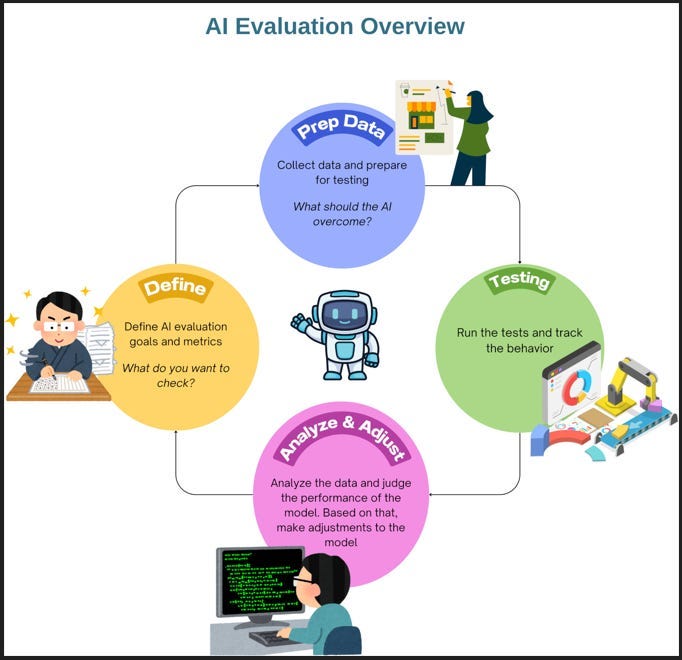
4. Model Testing>
Model testing means checking whether the AI learned correctly or not.
For example, after training an AI to detect spam emails, we give it new emails that it has never seen before. If it correctly identifies most of them as spam or not spam, the model is good. If it makes many mistakes, it needs more training.
5. Deployment>
The deployment phase involves putting the trained and tested AI model into an application, software, or system where users can begin using it. At this point, the model starts making predictions or decisions on new data. This model runs on cloud servers or company infrastructure and needs to be checked periodically to ensure its accuracy, performance, and reliability.
6. Business Value>
Business value means the real benefit a company gets from using AI. It helps the company save costs, work faster, make better decisions, and increase profits. In simple words, business value is when AI helps a company grow and earn more money.
Thanks for reading!