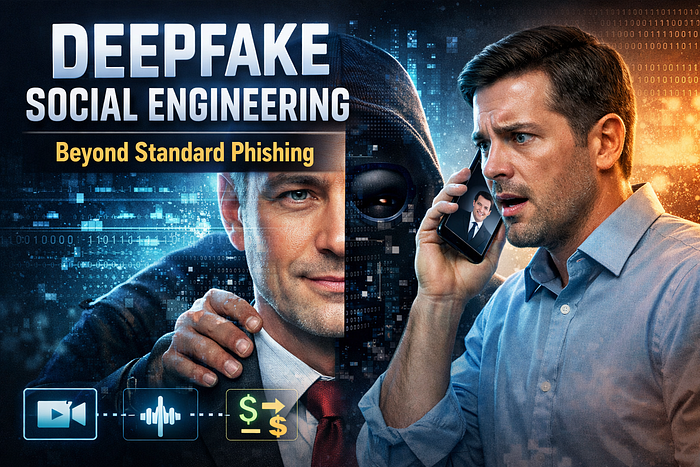

Cybercriminals are no longer limited to poorly written phishing emails or suspicious links to breach organizations. As artificial intelligence advances, attackers are now using deepfake technology to create realistic audio and video impersonations of trusted individuals. This shift marks a dangerous evolution in social engineering tactics, moving far beyond traditional phishing attempts. By combining psychological manipulation with advanced AI, deepfake social engineering makes fraud more convincing and significantly harder to detect. As these attacks become more sophisticated, organizations must understand how they operate and how to protect themselves.
What Is Deepfake Social Engineering?
Deepfake social engineering involves the use of AI-generated or manipulated audio, video, or images to impersonate real people such as executives, managers, or business partners. Unlike traditional phishing, which depends on fake emails or text messages, deepfake attacks simulate authentic human interaction.
For instance, an attacker may clone the voice of a company's CEO and call a finance employee to request an urgent wire transfer. In video-based scams, criminals can appear as senior leaders during virtual meetings and issue instructions that seem completely legitimate. These methods exploit trust, authority, and urgency — three powerful psychological triggers commonly present in workplace communication.
Why Deepfakes Are More Dangerous Than Traditional Phishing
Standard phishing attempts often contain warning signs such as unusual sender addresses, grammatical errors, or suspicious links. Deepfake attacks eliminate many of these red flags. When employees hear a familiar voice or see a recognizable face, their natural reaction is to comply without questioning the request.
Speed is another major risk factor. Deepfake attacks are designed to create pressure and demand immediate action, leaving little time for verification. The consequences can include financial losses, data breaches, and reputational damage. Because these attacks target human judgment rather than technical vulnerabilities, they bypass many conventional security controls, making them far more difficult to stop with email filtering tools alone.
Common Deepfake Attack Scenarios
Deepfake social engineering is appearing across multiple industries in several common forms:
- Executive impersonation: Attackers mimic senior leaders to approve payments or demand sensitive information.
- Vendor and partner fraud: Criminals pose as trusted third parties to request changes in banking details or access confidential documents.
- Recruitment scams: Fake interview videos or voice calls deceive job seekers into sharing personal or financial data.
- Customer service manipulation: Deepfake audio is used to bypass voice-based identity verification systems.
Each of these scenarios relies on realism and emotional pressure to override security awareness and encourage quick compliance.
How Organizations Can Defend Against Deepfake Threats
Defending against deepfake social engineering requires a balanced approach that combines technology, policies, and employee education.
First, organizations should strengthen verification procedures for high-risk actions such as financial transactions or access to sensitive systems. No request should be approved solely based on voice or video communication. Secondary verification methods, including secure internal messaging platforms and multi-step approval workflows, are essential.
Second, security awareness training must evolve. Employees need to understand that video and voice can be manipulated just as easily as email. Training programs should include realistic examples of deepfake attacks so staff can learn to recognize unusual behavior, inconsistent speech patterns, and unexpected urgency.
Third, advanced detection tools can help identify synthetic media. AI-based security solutions are now capable of analyzing voice patterns and video authenticity, providing another layer of defense. While no technology can guarantee complete protection, layered security measures significantly reduce the likelihood of a successful attack.
The Future of Social Engineering Attacks
As deepfake technology becomes more accessible, the barrier to entry for cybercriminals continues to drop. Tools that once required advanced technical expertise are now widely available and inexpensive. As a result, deepfake social engineering attacks are likely to become more frequent and more targeted.
Organizations that rely only on traditional phishing defenses may find themselves unprepared. Proactive strategies, including updated security policies and continuous employee education, will be critical to staying ahead of this evolving threat landscape.
Conclusion
Deepfake social engineering represents a significant shift in how cybercriminals exploit trust and human behavior. By combining AI-driven impersonation with classic manipulation techniques, attackers can bypass existing security controls and cause serious harm. Organizations must accept that seeing or hearing a familiar face or voice is no longer proof of authenticity.
To protect your business from emerging cyber threats such as deepfake social engineering, partner with Digital Defense — your trusted cybersecurity expert in building strong, human-centered security strategies.