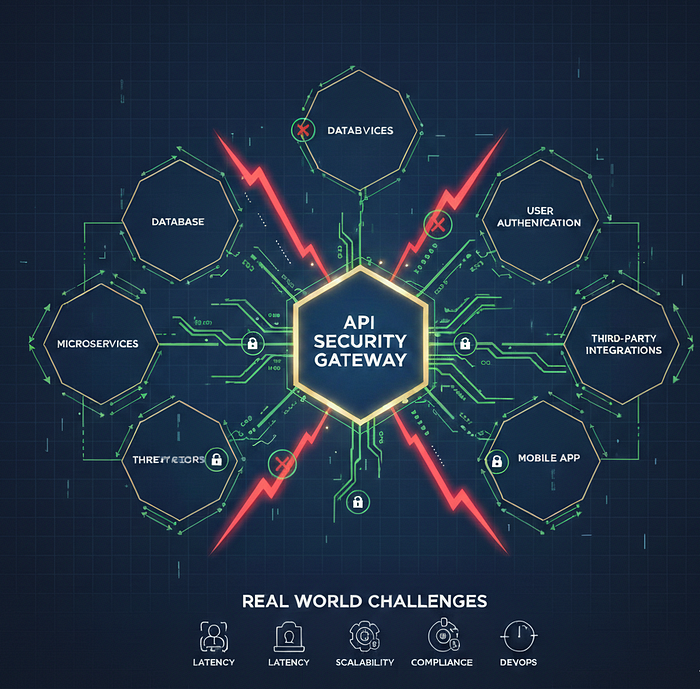

APIs quietly power almost everything we use today. From mobile apps and web platforms to cloud services and third-party integrations, modern systems are stitched together by APIs. Yet despite their importance, API security is often underestimated or neglected.
At first glance, APIs can seem very straightforward and linear: endpoints that accept requests, return results, and connect systems. This was also how I initially understood API security, until hands-on labs and real attack scenarios revealed how fragile that thinking actually is.
Learning API security reveals a very different reality.
An assumption about API security that changed
I believed that security was already a top priority for most organizations. Given how central APIs have become to modern systems, it felt reasonable to assume that they were being secured with the same seriousness as other critical infrastructure. But when you look at the data, a very different picture emerges.
Recent industry analysis suggests that APIs now account for the vast majority of internet traffic, often cited at around 80 percent or more. This clearly highlights how central APIs are to modern digital systems. APIs are no longer a niche technology. They sit at the core of every website, mobile application, and cloud service. What makes this especially concerning is how APIs are tested in practice. Surveys of API developers show that testing efforts are largely focused on functionality, performance, and integration, while security-specific testing is reported far less frequently. This imbalance indicates that highly exposed systems often operate with limited defensive scrutiny.
Another important takeaway was that API security cannot be treated as something added after deployment. Security needs to be intentionally considered from the earliest stages of system design and carried through the entire lifecycle.
The concept that changed how I think about APIs
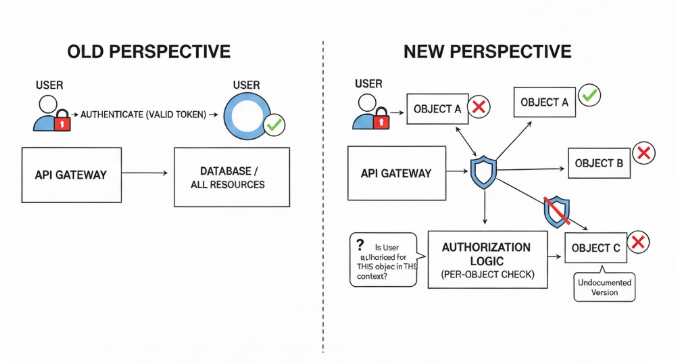
The biggest shift in how I think about APIs was recognizing the importance of authorization at the object level. Earlier, I assumed that once a user was authenticated, the API was doing its job and that a valid token was sufficient.
Learning API security clarified that authentication only confirms who the user is. It does not determine what the user should be allowed to access. The more important question is whether a user is authorized to access a specific object in a given context. This perspective changes how APIs are evaluated, shifting attention to situations such as guessed identifiers, reused tokens, replayed requests, or access to undocumented versions. Many API failures stem not from weak encryption, but from misplaced trust in how requests are expected to be used.
How my perspective expanded beyond just APIs
Learning API security pushed my thinking beyond individual endpoints and tokens. Servers are no longer just infrastructure, but active decision-makers where every request must be evaluated.
Details such as CORS configurations, error messages, and the data returned in responses are important parts of the API attack surface. Rather than viewing API gateways only as routing components, they should be understood as control points where authentication context, authorization decisions, rate limiting, and monitoring can be consistently enforced across APIs.
Compliance and integrations also play an important role. Compliance helps define who can access what and under which conditions. At the same time, modern APIs rarely operate in isolation. Integrations with partners and third-party services require continuous monitoring, as weaknesses in one component can affect the entire system.
A principle API teams should adopt

The most important principle API teams should adopt is to consider security from the beginning and never assume that clients will behave correctly. APIs must remain safe even when requests are malicious, unexpected, or poorly formed.
The same applies to third-party integrations. Trust should not be implicit or permanent and must be continuously validated. To support this, teams need regular training and familiarity with common API risks, such as those outlined in the OWASP API Top 10. Relying only on periodic penetration testing is not sufficient for APIs that change frequently. Ongoing awareness and continuous security review are important.