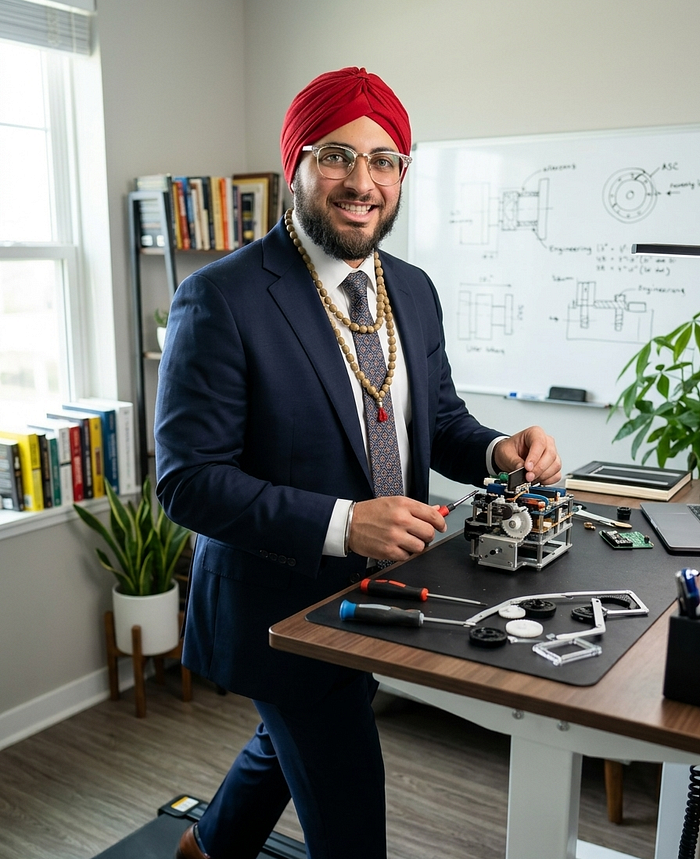
The skills that make a great teacher and the skills that make a great engineer are not as different as the tech industry wants you to believe.
The first time I stood in front of a classroom, I had no idea I was becoming an engineer. I thought I was becoming a teacher. I was preparing lessons, designing experiences, anticipating failure points, and rebuilding systems in real time when they didn't work. Sound familiar? It should. Because that is exactly what a senior software engineer does on any given Tuesday.
I have spent over a decade teaching in classrooms across Minnesota, Wisconsin, and Alaska. I have been an adjunct professor at Marquette University. I have written curriculum that has reached students on three different devices in four different time zones. Somewhere between explaining photosynthesis to a twelve-year-old and deploying a Redis-cached gaming platform to 1,000 monthly active users on AWS, I realized something that no bootcamp will ever teach you:
The best engineers I have ever met think like teachers. The best teachers I have ever met were already engineers — they just didn't have the vocabulary yet.
What classrooms taught me about systems
When you design a curriculum, you are designing a system. You define inputs (what the student already knows), outputs (what they need to demonstrate), error handling (what happens when they don't understand), and feedback loops (how you know the system is working). You account for edge cases. You document your logic so a substitute can run it without you. You iterate, version, and deploy — every single day.
I didn't understand that I was doing software architecture until I started actually doing software architecture. The mental models were identical. The difference was only the medium.
When I built iGameHub — a real-time social gaming platform with Socket.io, JWT authentication, Redis caching, and AWS EC2 deployment — the hardest part wasn't the code. The hardest part was designing the user experience so that a complete stranger could land on the platform and understand exactly what to do within thirty seconds. That is a pedagogy problem. That is lesson design. I had been solving that problem for a decade before I ever wrote a line of Node.js.
Why prompt engineering is just good teaching
Here is something the AI industry does not talk about enough: the people who are best at working with large language models are not always the best coders. They are the best communicators. They understand how to scaffold a concept. They know how to break a complex idea into precise, sequenced steps. They understand that clarity of instruction is the difference between a useful output and a hallucination.
When I built the AI Web3 Wallet Persona Engine — integrating GPT-4 with live blockchain data from the PolygonScan API — the technical architecture was important. The magic was in the prompting. Knowing how to talk to a model, how to constrain its output, how to chain instructions so that each step builds on the last — that is instructional design. That is what I did every morning before school.
You cannot prompt engineer your way to good outputs if you cannot think clearly about what you actually want. That clarity is a teaching skill. It is trained, not innate.
The thing nobody puts on a job description
There is a skill that every great engineer needs and almost no job description names it. It is the ability to explain what you built to someone who did not build it. It is the ability to translate complexity into clarity. It is the ability to sit with a stakeholder, a student, a user, or a teammate and make the invisible visible.
Educators do this every single day. It is not a soft skill. It is the skill. It is what separates engineers who build things that get used from engineers who build things that get abandoned. It is what separates AI tools that transform organizations from AI tools that collect dust in a shared drive.
I have a graduate certificate in Data-Driven Cybersecurity. I have a master's in Educational Technology. I have 950 solved problems on LeetCode and an 800-day streak that I am genuinely proud of. I have published a memoir, illustrated a children's book about technology, and I am writing a 200-page textbook on AI and multimedia. None of those things are separate. They are all the same impulse: understand something deeply, then make it accessible to someone else.
What I want you to take from this
If you are a teacher reading this and wondering whether you have what it takes to transition into tech — you already do. Your patience is your debugging instinct. Your curriculum design is your system architecture. Your classroom management is your stakeholder communication. You have been building, testing, and iterating on human systems your entire career. The syntax is learnable. The mindset you already have.
If you are a hiring manager reading this and wondering whether someone with an education background can perform at the level you need — I invite you to look at what I have shipped. Real applications. Real users. Real deployed infrastructure. The resume does not lie.
And if you are an engineer reading this who has never stood in front of a room and had to explain your work to someone who didn't care about your implementation details — try it sometime. It will make you a better engineer than any course ever could.
The classroom taught me that good systems are designed for the person who will use them, not the person who built them. That lesson lives in every line of code I write, every model I train, every product I ship.
I built a curriculum. I built a game. I built a blockchain AI tool. Every single one of them started the same way — by asking the question every great teacher learns to ask on day one:
What does this person need, and how do I build something that actually gives it to them?
Artificial Intelligence Education Software Engineering Career Change EdTech Personal Essay
Want to collaborate, build together, or just talk shop? This article was written by Don Rivera Díaz — AI/ML engineer, educator, and builder. Reach out at linkedin.com/in/donriveradiaz