
Introduction
During security testing of the Simple Customer Relationship Management System (PHP), I discovered a Stored Cross-Site Scripting (XSS) vulnerability in the Create Ticket functionality.
This vulnerability allows an attacker to inject malicious JavaScript code which is stored in the application's database and executed whenever the ticket is viewed.
Stored XSS is particularly dangerous because it affects every user who views the malicious content.
Vulnerability Details
The vulnerability exists in the Create Ticket feature.
User input from the following fields is not properly sanitized before being stored and rendered in the application.
Affected fields:
- Ticket Subject
- Ticket Description
Because the application fails to perform proper output encoding, an attacker can inject malicious JavaScript payloads.
Steps to Reproduce
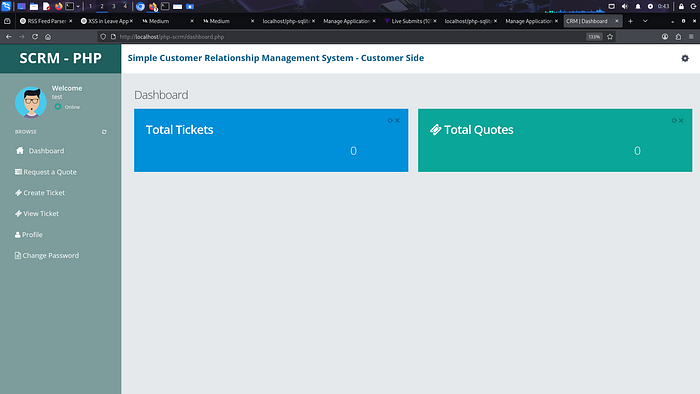
1. Login to the CRM application
Login with a valid user account.
2. Navigate to the ticket creation page
Go to:
Create Ticket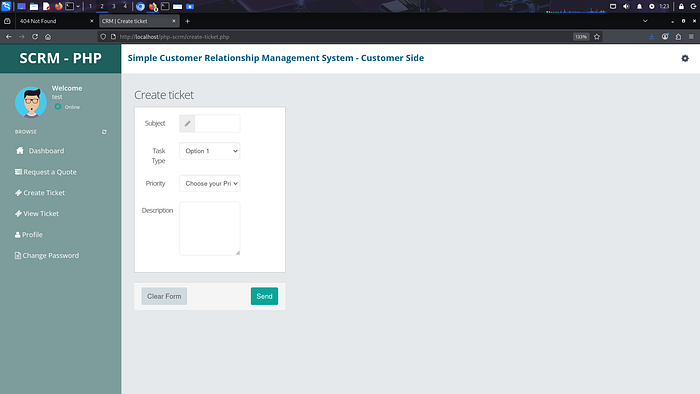
3. Inject a malicious payload
Insert the following payload inside the Description field:
<script>alert(1)</script>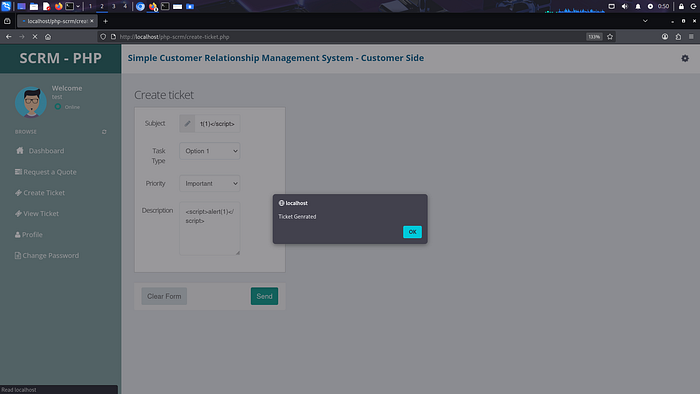
4. Submit the ticket
Click Send to create the ticket.
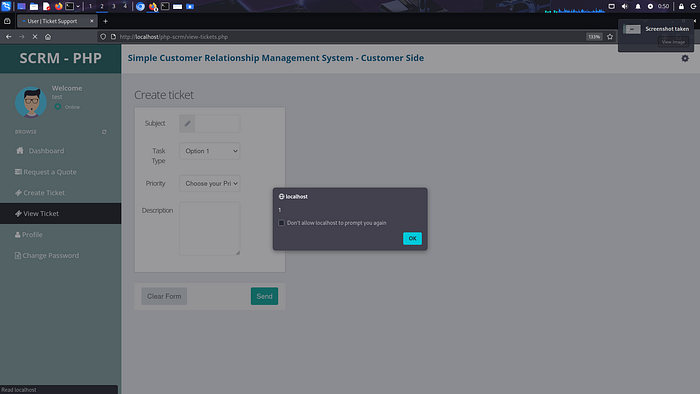
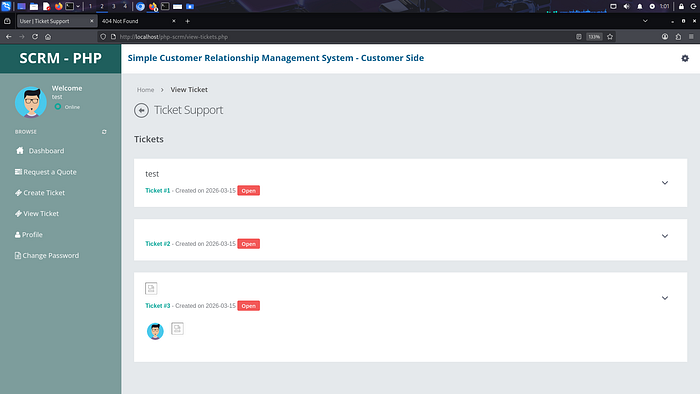
5. Navigate to the ticket list
Go to:
View Ticket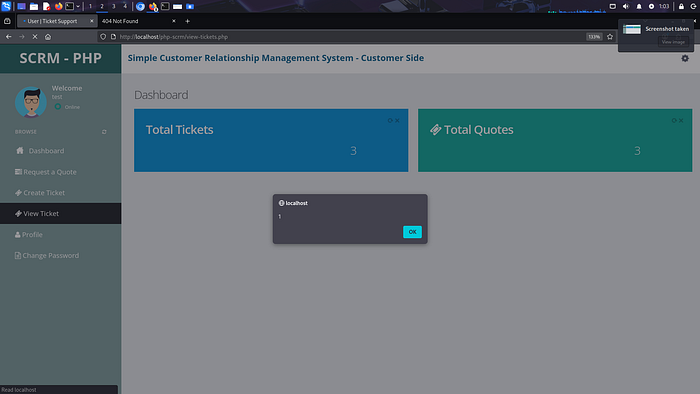
6. Trigger the vulnerability
When the stored ticket is viewed, the malicious JavaScript payload executes automatically.
The browser displays an alert box.
Proof of Concept Payload
Example payload used during testing:
<script>alert(1)</script>Another payload that demonstrates access to sensitive information:
<script>alert(document.cookie)</script>Impact
An attacker can exploit this vulnerability to:
- Execute arbitrary JavaScript in the victim's browser
- Steal session cookies
- Perform actions on behalf of the victim
- Conduct phishing attacks
- Deface application content
If an administrator views the malicious ticket, the attacker may gain access to privileged accounts.
Root Cause
The application does not properly sanitize or encode user-supplied input before displaying it in the browser.
Lack of:
- Output encoding
- Input validation
- Content Security Policy (CSP)
results in the execution of injected scripts.
Recommended Fix
To mitigate this vulnerability:
1. Sanitize user input
Validate and filter user input before storing it in the database.
2. Encode output
Use proper output encoding when displaying user data.
Example in PHP:
htmlspecialchars($input, ENT_QUOTES, 'UTF-8');3. Implement Content Security Policy
Use a strong CSP header to prevent inline script execution.
Example:
Content-Security-Policy: default-src 'self';4. Input validation
Reject input containing malicious scripts.
Conclusion
This Stored XSS vulnerability demonstrates the importance of proper input validation and output encoding in web applications.
By implementing secure coding practices, developers can prevent attackers from injecting malicious scripts and protect users from potential exploitation.
Author
Security Researcher: Hemant Raj Bhati Category: Web Application Security Affected Application: Simple Customer Relationship Management (CRM) System Affected URL: http://localhost/php-scrm/ Vulnerability Type: Stored Cross-Site Scripting (Stored XSS) Affected Feature: Create Ticket / View Ticket Severity: Medium