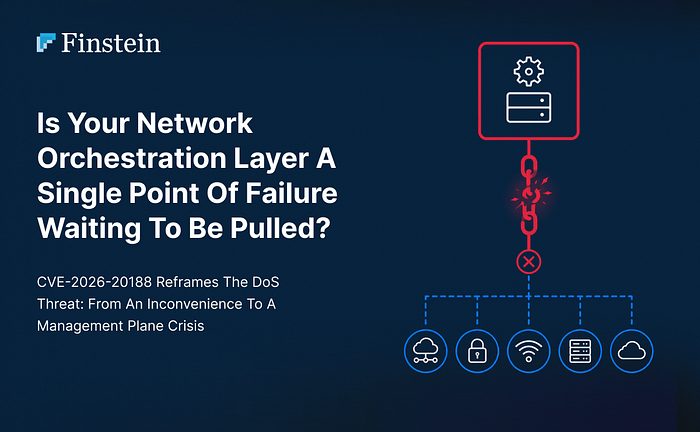

Every enterprise network has a command layer. It is the tier that lets your administrators push configurations, enforce policies, and respond to incidents in real time. Now imagine that layer going completely silent because an unauthenticated attacker on the open internet sent it too many connection requests.
That is not a hypothetical. That is CVE-2026–20188.
Cisco has issued a high-severity advisory for a critical connection exhaustion vulnerability affecting the Cisco Crosswork Network Controller (CNC) and the Cisco Network Services Orchestrator (NSO), both of which serve as backbone tools for managing large-scale network infrastructure.
The CVSS base score is 7.5, and the Cisco PSIRT has confirmed that no public exploits or active malicious activity have been observed in the wild as of this writing. That last point is not reassurance. It is a clock. Organizations have a narrow remediation window before threat actors begin active reconnaissance.
For CISOs, this is not a patch ticket to hand to an engineer. It is a board-level conversation about operational resilience, fiduciary duty, and what happens to your business when your network management plane ceases to exist.
The Architecture of Collapse: What This Vulnerability Actually Exposes
The technical root cause is deceptively simple, and that simplicity is what makes it dangerous.
The vulnerability stems from inadequate rate limiting on incoming network connections. The system lacks proper threshold controls to govern how many connection requests it will accept and process within a given timeframe.
Translated into strategic language for the boardroom and the audit committee, here is what that means:
- Zero barrier to exploitation. An attacker exploiting this flaw does not need any credentials or prior access to the target environment. No spear-phishing. No insider access. No sophisticated toolchain. A determined actor with a commodity connection flood tool is sufficient.
- The management plane is the true target. This is not an attack on a single server or endpoint. CNC and NSO sit above your physical infrastructure. When they go down, legitimate network administrators and any automated services that depend on these platforms lose all ability to interact with the orchestrator or controller. Your NOC goes blind. Your incident response capability is impaired at exactly the moment you need it most.
- Recovery requires human intervention, every time. The system will not automatically restore itself after connection resources are drained. Administrators must perform a manual reboot to clear the connection queue and return the platform to normal functionality. In a 24x7 enterprise or carrier environment, that manual dependency is an operational liability of the first order.
- No workaround exists. There are no temporary workarounds or mitigations available. Organizations cannot apply configuration changes or access control rules to neutralize the risk. A full software upgrade is the only path to remediation. This means any organization running an affected version is fully exposed from this moment until they patch. Full stop.
- The blast radius scales with network complexity. In enterprise or carrier-grade environments where uptime is critical, even a brief management plane outage can cascade into broader network disruptions. For financial institutions, regulated industries, and critical infrastructure operators, that cascade carries direct regulatory, contractual, and reputational consequences.
- Discovered internally, not by external researchers. The vulnerability was first identified during the resolution of a Cisco TAC support case, indicating it was caught through internal operational channels rather than external researcher disclosure. This raises a legitimate question: how many organizations were already experiencing symptoms they attributed to something else?
Four Actions That Separate Resilient Organizations From Reactive Ones
1. Patch Now. Treat This as a P0 Change, Not a Scheduled Maintenance Window.
For Cisco Crosswork Network Controller, all releases up to and including version 7.1 are vulnerable. Cisco strongly recommends immediate migration to CNC release 7.2 or later. For Cisco Network Services Orchestrator, releases 6.3 and earlier require migration to a secure version, release 6.4 should be upgraded to version 6.4.1.3, and release 6.5 is not affected. Map your deployment inventory against these version thresholds today. If your change management process carries a standard 30-day lead time for network infrastructure upgrades, that process needs to be overridden for this specific case.
2. Harden the Management Plane with Network Segmentation and Access Controls.
Your orchestration and management tools should never be reachable from the public internet or from untrusted internal segments. If CNC or NSO are currently accessible beyond a tightly controlled management VLAN or zero-trust network segment, that exposure needs to close immediately, independent of the patching timeline. Rate limiting at the network perimeter, via upstream firewalls or load balancers, can provide a degree of buffer while the patch is being deployed. It is not a substitute, but it is a responsible interim measure.
3. Build Management Plane Availability Into Your SOC Playbook.
A DoS condition against your orchestration layer should trigger an alert within seconds, not be discovered when an administrator tries to log in. Define an explicit runbook for manual reboot procedures so that when the event occurs, recovery time is measured in minutes, not hours. Treat management plane availability as a tier-one SLA, equivalent to your production services.
4. Conduct an Immediate Exposure Assessment Across Your Cisco Portfolio.
CVE-2026–20188 is one advisory in a continuous stream. The real question it surfaces is: do you have a governed, current-state view of every version of critical network management software running across your estate? For most large enterprises and consulting-advised clients, the honest answer is no. This is the moment to establish that inventory. A structured Vulnerability Assessment and Penetration Testing engagement, focused on your network management and orchestration layer, will give you the ground truth required to make defensible risk decisions.
Turning an Advisory Into an Architecture Review: Where Finstein Engages
CVE-2026–20188 is a concrete illustration of the gap that exists between having a patching policy and having an operationally mature cybersecurity posture. Finstein's advisory practice is built specifically to close that gap for CISOs, CFOs, and the professional services firms that advise them.
Cyber Advisory. If your leadership team is asking whether this vulnerability affects your environment and whether the broader architecture around your network management layer is defensible, our advisory team provides the senior-level strategic counsel to answer those questions with precision. We translate technical exposure into business and regulatory risk language that holds up in a boardroom or an audit committee.
VAPT (Vulnerability Assessment and Penetration Testing). We conduct targeted assessments of network management infrastructure, including orchestration tools, controllers, and the segments they operate within. The goal is to identify not just known CVEs, but the structural weaknesses that allow a single unauthenticated connection flood to take down an entire management plane.
Maturity Assessments. Organizations that discover a critical vulnerability through a vendor advisory, rather than through their own detection capabilities, have identified a maturity gap. Our structured maturity assessments benchmark your vulnerability management program, patch governance, and network segmentation practices against recognized frameworks. You leave with a prioritized, actionable roadmap, not a generic score.
AI-Driven Threat Intelligence. Finstein's AI-driven threat intelligence capability continuously monitors the evolving exploitation landscape for vulnerabilities like CVE-2026–20188. When proof-of-concept code begins circulating or when threat actors shift from reconnaissance to active exploitation, your team is informed before the event, not after.
The Window Is Open. For Now.
A CVSS score of 7.5 assigned to a zero-credential, remote DoS vulnerability against your network management layer is not a technical footnote. It is a signal that your infrastructure carries a documented, public attack surface requiring immediate executive attention.
The window between a Cisco advisory and active exploitation in the wild has shortened significantly over the past 24 months. Organizations that treat this as a routine patch cycle event will be reactive. Those that treat it as a trigger for a broader architectural review will be resilient.
Connect with Finstein's Cyber Advisory team today at https://cyber.finstein.ai
#CyberSecurity #CVE202620188 #CiscoSecurity #NetworkSecurity #DoS #VulnerabilityManagement #CISO #CyberResilience #PatchManagement #NetworkOrchestration #CriticalInfrastructure #CyberRisk #InfoSec #ZeroTrust #ThreatIntelligence #CyberAdvisory #VAPT #Finstein
Originally published on the Finstein blog: https://blog.finstein.ai/is-your-network-orchestration-layer-a-single-point-of-failure-waiting-to-be-pulled/