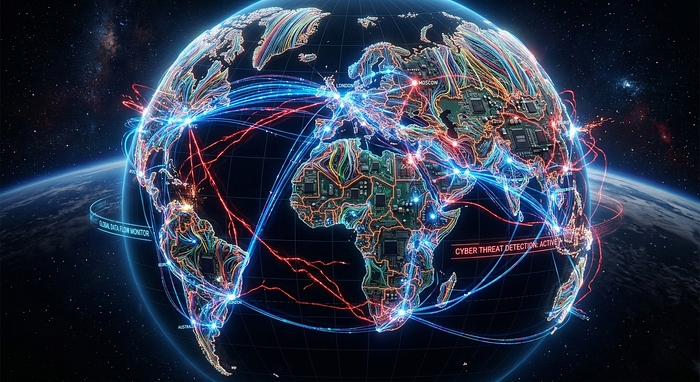
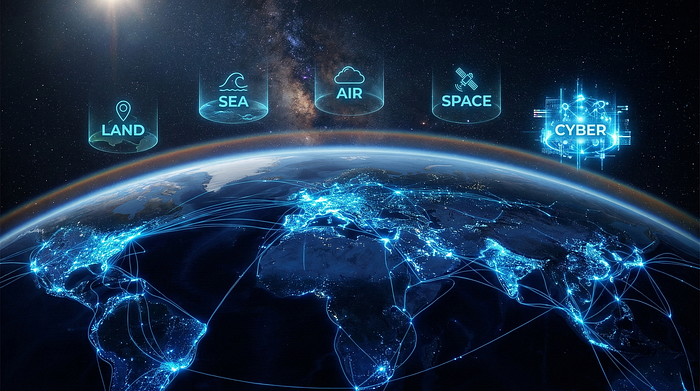
Cyberspace has officially joined land, sea, air, and space as the fifth domain of warfare. This isn't a metaphor. It's a structural shift in how nations compete, coerce, and fight, and it has fundamentally changed what national security actually means.
By exploiting just how deeply industrialized societies depend on digital infrastructure, nation-states are now using cyber operations to achieve political and strategic goals that once required sending in troops or launching missiles. Cyber warfare has given world leaders a crucial third option: more powerful than a diplomatic protest, but deliberately less provocative than a ground invasion. And increasingly, it isn't being deployed in isolation. Modern conflicts are defined by hybrid warfare, where precision cyberattacks are timed and synchronized with physical strikes to sow maximum chaos and degrade an enemy's defenses before the first soldier crosses a border.
1. Introduction
For most of military history, digital networks were seen as tools, not weapons. They existed to enhance traditional command, control, communications, and intelligence systems. Force multipliers, in the jargon of the strategist. Supporting cast, never the lead. That framing no longer holds.
A profound shift has taken place. Information operations and network-centric capabilities have evolved from background functions into primary instruments of grand strategy. In some of the most significant conflicts of the past decade, conventional military action has been used to support cyber objectives rather than the other way around. The script has been flipped.
This piece traces that evolution: how advanced persistent threats, asymmetric advantages, and the vulnerability of critical infrastructure have positioned cyberspace as the defining battleground of our era.
2. Cyberspace as an Operational Domain
Unlike land, sea, air, and space, cyberspace doesn't exist in nature. It's a constructed environment built from physical hardware and the invisible transit of data across global networks. That distinction matters, because it means the battlefield can be shaped, expanded, and exploited in ways that physical terrain cannot.
NATO formally recognized this when it designated cyberspace as an operational domain, committing its member states to defend it with the same seriousness as any physical territory. The logic is straightforward: military forces need freedom of maneuver in digital networks just as they do on the ground or in the air.
What makes this domain unlike any other is that the conflict never pauses. Adversaries are in constant contact, constantly probing for positional advantage, even during peacetime. There is no ceasefire in cyberspace.
3. The Nation-State Threat Landscape
State-sponsored actors now dominate the cyber threat landscape. Russia, China, North Korea, and Iran have each developed distinct digital doctrines tailored to their geopolitical ambitions.
Russia views the information space as a permanent battleground. Its strategy integrates cyber espionage, psychological operations, and destructive malware into a single coherent doctrine of "information confrontation." For Moscow, the conflict is never really over.
China focuses on achieving information dominance. The ability to gather, exploit, and deny information is treated as the decisive factor in future wars. Beijing invests heavily in long-term infiltration of critical foreign infrastructure, prioritizing persistence over immediate disruption.
North Korea, isolated by international sanctions and cut off from conventional revenue streams, has turned cybercrime into a state industry. Ransomware campaigns and cryptocurrency theft fund the regime's military and weapons programs in ways that sanctions were designed to prevent.
Iran has built its cyber capabilities around retaliation and regional power projection. Driven by a perception of ongoing conflict with Western powers, Tehran blends espionage with disruptive influence operations to punch above its weight class on the world stage.
4. Case Studies: Where Theory Became Reality
Stuxnet and Iran's Nuclear Program
When Stuxnet was discovered in 2010, it changed what people thought was possible.
The worm was a bespoke cyberweapon engineered to sabotage Iran's uranium enrichment program at the Natanz facility. It targeted specific Siemens programmable logic controllers regulating the frequency of gas centrifuges. By manipulating motor speeds while simultaneously feeding fake "normal" readings back to human operators, Stuxnet caused the centrifuges to tear themselves apart from the inside.
The operators watching their screens saw nothing wrong. The machines were destroying themselves.
This was the moment that crossed the kinetic threshold. Digital code had inflicted physical destruction. A cyberattack had achieved what a conventional airstrike would otherwise have required.
Estonia 2007
In the spring of 2007, a diplomatic dispute over the relocation of a Soviet-era war memorial triggered something unprecedented. Estonia, one of the most digitally connected societies in the world, was hit by a coordinated wave of distributed denial-of-service attacks. Government ministries, banks, and major media outlets went dark. The country's wired infrastructure buckled.
The crisis caused systemic paralysis and served as a wake-up call that reverberated across NATO. Its direct consequence was the establishment of the Cooperative Cyber Defence Centre of Excellence (CCDCOE) in Tallinn. A small country had just demonstrated what a digital siege looked like, and the alliance was paying attention.
NotPetya and the Architecture of Hybrid Warfare
Launched in June 2017, NotPetya looked like ransomware. It wasn't. Beneath the ransom demands was a destructive wiper designed to permanently encrypt and destroy hard drives. It was a weapon disguised as a crime.
The malware initially targeted Ukrainian infrastructure before spreading globally, paralyzing multinational shipping and logistics companies and causing an estimated $10 billion in damages worldwide. But NotPetya was also a preview. In subsequent years, Russia refined its hybrid warfare playbook in Ukraine, synchronizing destructive wiper malware with kinetic missile strikes to digitally blind targets as physical bombs fell. The sequencing was not coincidental. It was doctrine.
Israel and Iran: The Ongoing Cyber War
The geopolitical rivalry between Israel and Iran has long since spilled into cyberspace, becoming one of the most active and complex digital conflicts in the world.
A recent example came during Operation Epic Fury, a U.S.-Israeli military campaign that combined physical airstrikes with a coordinated cyber dimension. An alleged Israeli operation compromised BadeSaba, an Iranian religious calendar app used by over 5 million people, and used the breach to broadcast anti-regime messages directly to ordinary Iranians as the air campaign commenced. This was not just an attack on infrastructure. It was an attempt to fracture domestic confidence precisely when the regime was under physical pressure.
5. Why Nations Are Drawn to Cyber Warfare
The appeal is structural. Cyber operations offer deniability in a way that cruise missiles do not. They can be calibrated for effect, from nuisance to catastrophic, depending on political intent. They cross borders invisibly and operate below the threshold of what most international frameworks define as an act of war.
For authoritarian states in particular, they offer the ability to project power and destabilize adversaries without triggering a formal military response. For democracies, they offer options in gray zones where conventional force would be politically untenable.
The synchronization with conventional operations adds a further dimension. Used together, cyber and kinetic tools create cascading effects that neither achieves alone. Wiper malware doesn't just destroy data; it paralyzes the systems operators need to respond to the missiles already in the air.
6. The Critical Infrastructure Problem
The most alarming dimension of modern cyber warfare is the targeting of civilian infrastructure.
Industrial control systems (ICS) and SCADA architectures manage power grids, water treatment plants, pipelines, and financial networks. They were designed for reliability, not security. And the more digitally advanced a nation is, the more of its critical functions run through these systems, and the more exposed it becomes.
The 2021 ransomware attack on the Colonial Pipeline made this visceral for an American audience. The largest fuel pipeline in the United States was halted, triggering regional states of emergency and fuel shortages across the East Coast. The attackers weren't a nation-state. They were a criminal group. The implication is sobering: if criminals can do this, state actors operating with greater resources and fewer constraints can do considerably worse.

7. What Comes Next
Several trends are accelerating. Artificial intelligence is being weaponized at scale. State actors are using it to automate vulnerability discovery, generate convincing deepfakes, and run social engineering campaigns at a volume no human team could sustain.
Attackers are increasingly adopting "living off the land" techniques, using legitimate network administration tools rather than custom malware to move through systems undetected. When the weapons are the same tools defenders use every day, detection becomes exponentially harder.
And rogue states are doubling down on cryptocurrency theft and decentralized platforms as mechanisms to extract economic value and circumvent sanctions. Cyber operations are becoming a parallel financial system for the sanctioned.
8. Conclusion
The emergence of cyberspace as an operational domain is not a temporary phase. It's an irreversible evolution in the nature of conflict itself.
The old binary between peace and war has been replaced by something more ambiguous and more persistent: a state of continuous low-intensity digital competition, punctuated by moments of acute crisis. As cyber operations develop the capacity for kinetic-grade destruction and systemic economic coercion, the frameworks built to govern interstate conflict are struggling to keep up.
Navigating this requires more than better firewalls. It requires genuine civil-military cooperation, zero-trust architectures built into critical systems from the ground up, and the collective political will to enforce international norms before the next escalation makes the current ones irrelevant.
The fifth domain is already contested. The question is whether the rules of engagement will be written by democracies, or by the actors who have the least interest in restraint.
Support This Research
Researching and writing pieces like this takes a serious amount of time digging through technical reports, case studies, and geopolitical documentation to bring it all together in a way that's actually readable. If you found this valuable and want to see more deep-dive research in cybersecurity, I'd really appreciate your support. Even a small contribution goes a long way in keeping this kind of independent work going.
☕ Buy me a coffee and fuel the next research