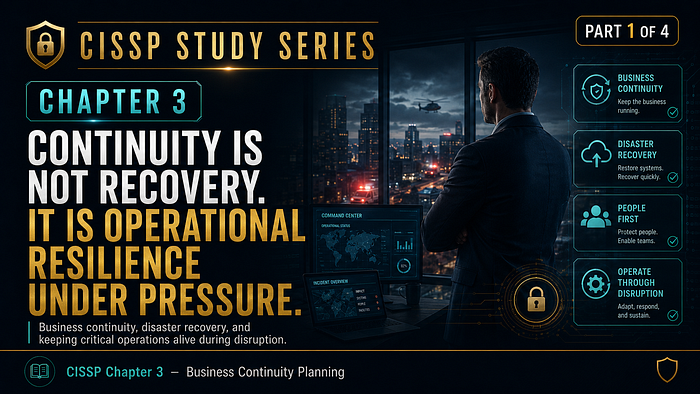

Business continuity, disaster recovery, people-first decision-making, and the management judgment required to keep essential operations alive when disruption becomes real.
Many organizations speak about continuity only after something breaks. That timing is backwards. Business continuity does not begin when systems go down; it begins when leaders decide that certain services must remain viable even while the organization is under pressure. Recovery matters, but continuity is wider than recovery. It is the discipline of staying operational while events are still unfolding.
Why CISSP separates continuity from recovery
Chapter 3 starts by making an important distinction that security teams sometimes blur together. Business continuity planning focuses on how the business keeps operating before, during, and immediately after disruption, while disaster recovery focuses more narrowly on restoring systems, infrastructure, and data after a disruptive event. The two are interdependent, but they are not interchangeable. The chapter emphasizes that both work best when developed in tandem because a business can have a technically sound recovery plan and still fail operationally if communications, staffing, facilities, or customer-facing services collapse at the wrong time.
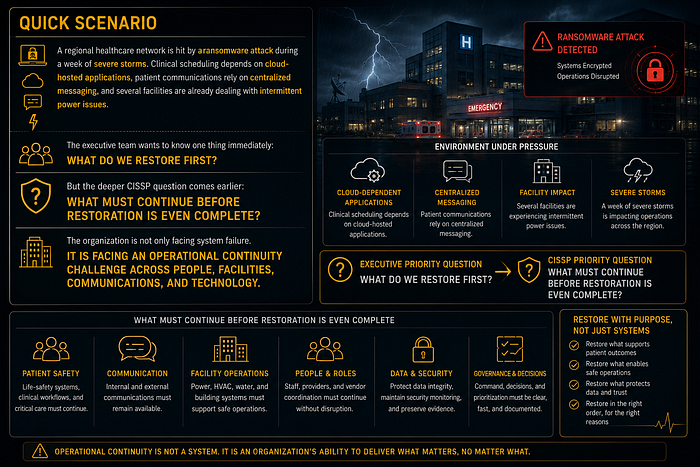
In the healthcare scenario, executives are tempted to ask for a recovery sequence: restore email, restore scheduling, restore records access, restore reporting. That is understandable, but it is incomplete. Patients still need instructions. Staff still need safe work locations. Leadership still needs a chain of command. The public still needs confidence that the organization remains functional. Continuity is therefore broader than restoration. It is operational resilience under pressure.
CISSP insists on this distinction because continuity decisions are made in a business context, not a server room context. If an organization cannot perform essential functions while restoration is underway, then technical recovery may succeed while the business still fails.
People come first, even when technology dominates the headlines
One of the most important principles in this chapter is also one of the easiest to overlook: the top priority in both BCP and DRP is always people. The document makes this explicit. The first concern is to get people out of harm's way; only then does the organization address IT restoration and operational recovery.
That priority sounds obvious until an actual crisis compresses time. Under pressure, leaders often fixate on uptime, public reporting, or technical containment. CISSP pushes in the other direction. It asks whether the organization knows where people should go, who can authorize alternate work arrangements, how responsibilities shift when key staff are unavailable, and how the business communicates when normal channels fail.
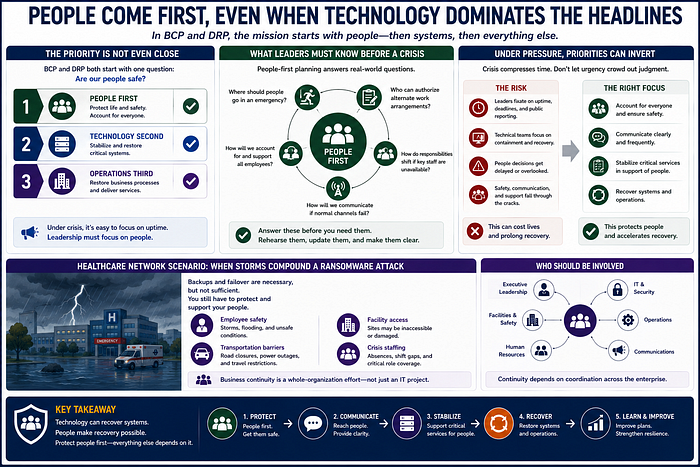
In the healthcare network scenario, the storms complicate the ransomware response. Even if backups exist and failover environments are ready, the organization still has to account for employee safety, transportation barriers, facility access, and crisis staffing. This is why continuity planning cannot be delegated solely to technology teams. It must involve the broader organization.
BCP is a program, not a document
The chapter defines the overall goal of BCP as enabling a quick, calm, and efficient response that minimizes the impact of an emergency and enhances the company's ability to recover promptly. It then lays out four high-level steps: project scope and planning, business impact analysis, continuity planning, and approval and implementation.
That sequence matters because it reveals something mature practitioners already know: continuity planning is not a binder produced once and filed away. It is a program of decisions, dependencies, resource commitments, and rehearsed responsibilities. The document exists because the program exists. Not the other way around.
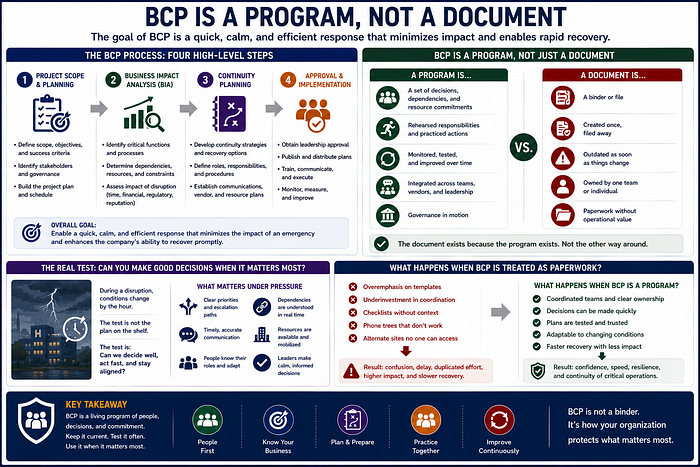
Organizations that treat BCP as paperwork typically overemphasize templates and underinvest in coordination. They may have checklists, phone trees, and alternate site language, but the real test is whether decisions can be made coherently when conditions are changing by the hour. CISSP therefore treats continuity as governance in motion.
Where continuity judgment actually lives
The strongest continuity teams are rarely the ones with the thickest plans. They are the ones that can answer hard questions quickly and defensibly. Which business function cannot exceed its maximum tolerable downtime? Which facility is truly critical and which is merely convenient? Which communication channel can still operate if primary systems are unavailable? Which dependencies are hidden inside vendors, utilities, or transport networks?
In practice, continuity judgment lives at the intersection of mission, dependency, and timing. That is why Chapter 3 reads like more than a planning chapter. It is really a chapter about prioritization under uncertainty. The healthcare network cannot protect everything equally in the first hours of the incident. It must preserve the functions whose interruption would create irreversible harm.
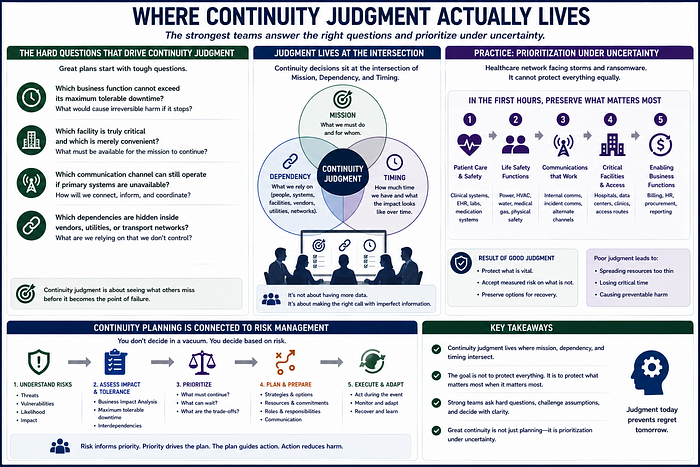
This is also why continuity planning has to be connected to risk management. The organization is not deciding in a vacuum. It is deciding what matters most when time, people, and infrastructure are constrained.
Continuity should make normal operations look less fragile
A good continuity conversation does more than prepare for extreme events. It reveals how fragile the ordinary operating model already is. If a single messaging platform failure disrupts staff coordination, if one building outage stops customer support, or if one vendor dependency freezes scheduling, then continuity planning is surfacing structural weakness that existed before the incident.
In that sense, continuity planning is diagnostic as well as protective. It exposes hidden assumptions about who is essential, which sites are indispensable, how quickly teams can shift roles, and whether critical communications truly have backups. Those discoveries are valuable even if the major disaster never arrives.
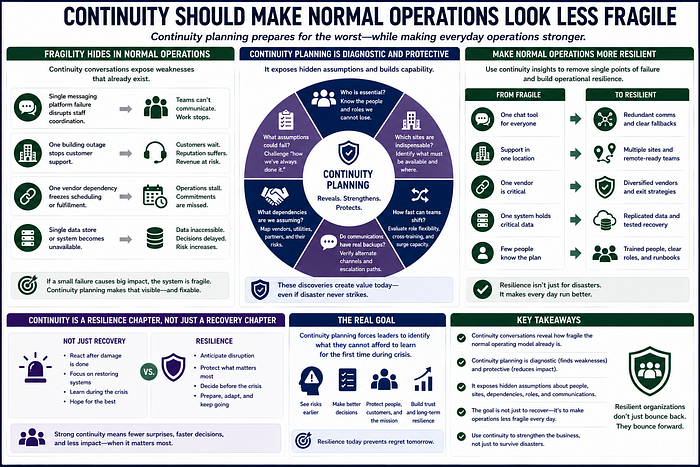
CISSP candidates sometimes think of Chapter 3 as a recovery chapter. It is better understood as a resilience chapter. It forces leaders to identify what they cannot afford to learn for the first time during crisis.
Resilience is revealed by what the organization can still do
When a disruptive event occurs, maturity is not measured only by what broke. It is measured by what still works. Can the organization still communicate with stakeholders? Can alternate workflows be activated? Can decision authority be exercised without delay? Can essential services continue in a degraded but safe form? These are continuity questions, and they determine whether the business remains viable while restoration is still underway.
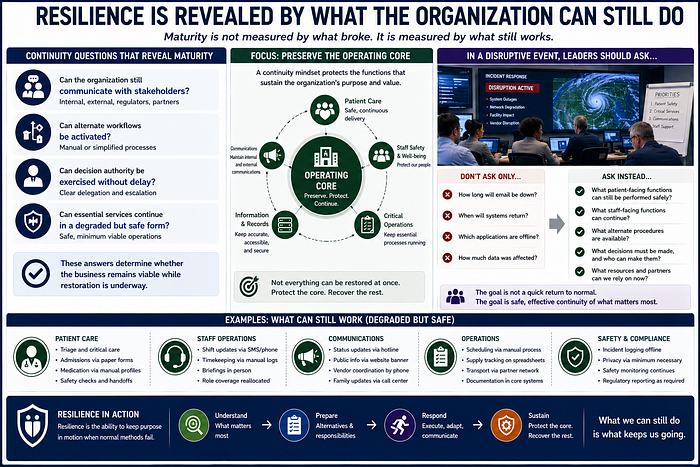
In the scenario, leaders should not ask only how long email will be down or when systems will return. They should ask what essential patient-facing and staff-facing functions can still be executed safely with alternate procedures. A continuity mindset focuses on preserving the organization's operating core even when normal methods are disrupted.
Operational calm is a control in its own right
One of the understated goals in the chapter is the expectation of a quick, calm, and efficient response. That language is more than motivational. Calm is a control because panic produces errors, duplicated effort, inconsistent communication, and avoidable harm. Continuity planning reduces panic by predefining priorities, responsibilities, and escalation paths before emotions dominate the room.
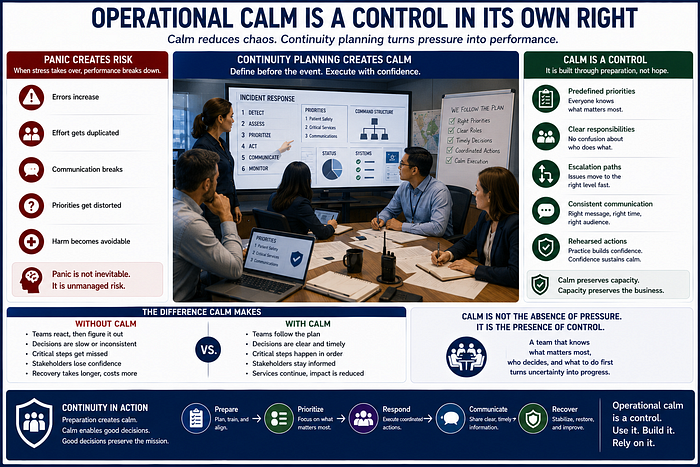
In other words, continuity is not only about spare capacity and alternate facilities. It is also about reducing decision chaos. A team that knows what matters most, who decides, and what the first actions are is far more likely to preserve the business than a technically talented team improvising under stress.
Practical management trade-offs in the real world
Real continuity programs are built in imperfect environments. Facilities cannot all be hardened equally. Alternate sites cost money. Redundancy adds complexity. Workforce availability changes with weather, transportation failures, illness, and competing obligations. Because of that, continuity planning is rarely about perfect protection. It is about deliberate prioritization.
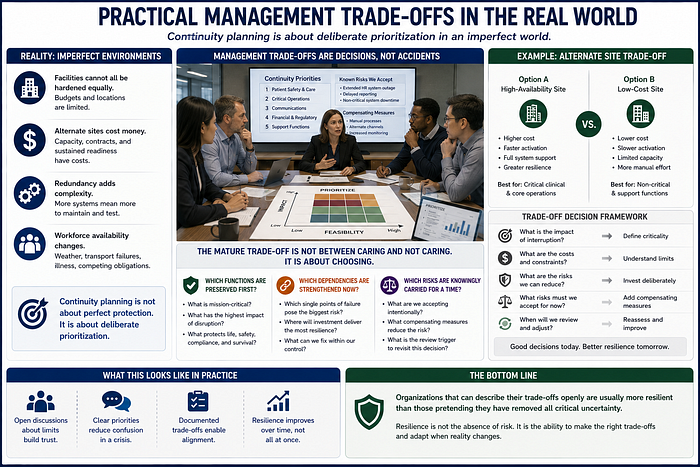
The mature trade-off is not between caring and not caring. It is between which functions are preserved first, which dependencies are strengthened now, and which risks are knowingly carried for a time with compensating measures. Organizations that can describe those trade-offs openly are usually more resilient than those pretending they have removed all critical uncertainty.
Question set 1 — aligned with the scenario
Question 1: Regional healthcare network is hit by ransomware during severe storms. Clinical scheduling depends on cloud-hosted applications, patient communications rely on centralized messaging, and several facilities are already dealing with intermittent power issues. Why must leadership discuss business continuity separately from disaster recovery in this scenario?
A. Because continuity is mainly documentation, while disaster recovery is the real operational work B. Because the organization must keep essential operations functioning even before full technical restoration is complete C. Because disaster recovery always starts only after all continuity issues are resolved D. Because continuity applies only to weather-related events, while recovery applies only to cyber incidents
This is the core distinction Chapter 3 is trying to reinforce. Business continuity is about how the organization continues essential operations during disruption, even in a degraded state. Disaster recovery is about restoring systems, data, and infrastructure to normal or safe operation. In this healthcare scenario, leaders cannot wait for complete restoration before acting, because patient communications, staffing coordination, and essential clinical operations must continue immediately. B is correct it captures the CISSP distinction precisely: continuity preserves mission-critical function while recovery work is still underway.
Question 2: During the first hours of the disruption, the executive team asks what should happen first. Which response best reflects a mature continuity mindset?
A. Restore every affected system in parallel to show immediate momentum B. Focus exclusively on ransomware containment and defer business communication until technical certainty improves C. Protect people first, preserve essential functions, and sequence restoration according to business priorities D. Wait until the full scope of the outage is confirmed before activating alternate procedures
Chapter 3 emphasizes two major principles here. First, people come first. Second, continuity decisions should preserve critical business function while recovery proceeds in a prioritized way. In a healthcare environment during ransomware and severe weather, leaders must think beyond systems alone: staff safety, alternate work arrangements, communication channels, and patient-facing continuity all matter before full technical normalcy is restored. C is correct answer because it reflects the people-first and mission-preservation logic CISSP expects. It also recognizes that restoration should follow business criticality, not technical instinct alone.
Question 3: A post-incident review finds that the healthcare network's technical recovery plans were detailed, but leaders still struggled with staff coordination, alternate workflows, and communications when primary systems were disrupted. What is the best CISSP-style conclusion?
A. The organization mainly needs more backup capacity B. The organization has a disaster recovery problem but not a continuity problem C. The organization improved restoration planning more than operational continuity planning D. The organization should avoid continuity planning until technical recovery is fully modernized
This question tests whether you can distinguish technical restoration success from operational resilience. The document repeatedly stresses that an organization can have a solid recovery plan and still fail operationally if communications, staffing, facilities, or decision authority break down at the wrong time. If leaders struggled with alternate procedures and human coordination, then the deeper issue is that continuity planning was weaker than recovery planning. C is correct best explains the mismatch: the organization planned how to restore systems, but not how to preserve mission and coordinate operations while restoration was incomplete.
What this part should make you question
This part should make you question whether your organization understands the difference between continuity and recovery well enough to make good decisions. Do leaders know which essential functions must survive even in degraded form? Would the organization prioritize people before systems when time is compressed? Are there alternate communication paths that work when the primary platform does not? Does your current operating model assume resilience that has never been tested?
It should also make you ask whether continuity planning has surfaced hidden fragility in normal operations. If the answer is no, the organization may be confusing documentation with preparedness.
Scenario debrief: what mature review would change
A mature review of the healthcare network scenario would separate urgent visibility from true priority. The most visible systems are not automatically the most important ones. The review would identify which clinical, communications, and staffing functions must continue immediately, which can operate in degraded mode, and which can wait for later restoration. It would also confirm whether employee safety decisions, alternate work procedures, and stakeholder communication were activated early enough.
It would almost certainly reveal that continuity and recovery must be synchronized but not conflated. If the organization improved only technical restoration without strengthening operational continuity, then the same crisis would remain destabilizing next time.
CISSP mindset check
The CISSP mindset here is to think beyond restoration and ask what the business must still be able to do while restoration is incomplete. A mature practitioner sees continuity as a mission-preservation problem, not merely an infrastructure problem. That means people, communications, roles, facilities, and essential services all belong in the first conversation, not the second.
In exam terms, the strongest answer is often the one that protects life and preserves essential business function before pursuing full technical normalcy.
Questions to carry forward
Carry these questions into the next parts of the chapter. What exactly counts as an essential function in your environment? Which dependencies make those functions more fragile than leadership realizes? If the main site becomes unavailable, what still operates and who decides how? And if technical recovery is delayed, how long can the business continue in alternate mode before damage becomes irreversible?
Why reassessment matters
Continuity assumptions age quickly. New cloud dependencies, reorganizations, vendor reliance, staffing shifts, facility changes, and business expansion can all make an old continuity posture inaccurate. A plan that once seemed proportionate may become dangerously optimistic when operations scale or interdependencies deepen.
That is why continuity planning requires periodic reassessment. Resilience decays quietly when complexity rises faster than the plan is updated.
A final operational reminder
Operationally, continuity planning should always begin with the question of what must continue safely, not simply what should be restored first. Protect people. Preserve essential functions. Clarify decision authority. Communicate early. Then sequence recovery work in a way that supports business viability rather than only technical momentum.
Final perspective
If I had to summarize this first part in one sentence, it would be this: business continuity is what turns recovery planning into operational resilience. That is why Chapter 3 deserves to be read as more than a disaster chapter. It is a chapter about preserving mission, protecting people, and keeping the organization coherent when normal conditions disappear.
Closing thought
In Part 2, I will move from continuity principles to business impact analysis: how priorities are identified, how MTD, RTO, and RPO shape decision-making, and why recovery choices should always follow business value rather than technical instinct.