
The Phone Call That Never Happened
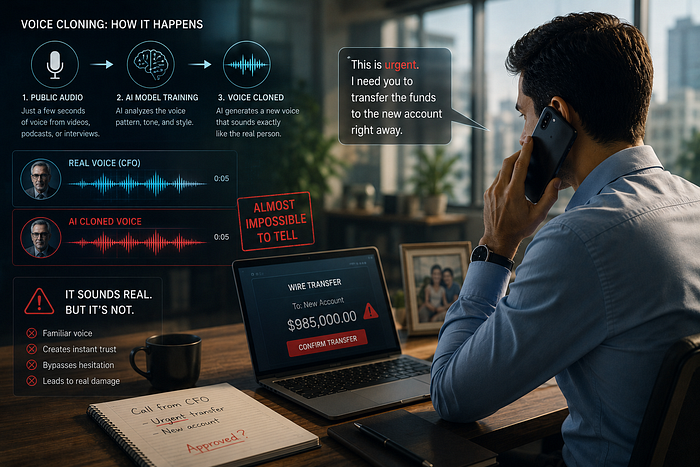
A finance employee receives a call late in the afternoon.
The voice on the other end sounds exactly like the company's CFO — calm, confident, slightly impatient. He explains that a confidential acquisition is underway and an urgent transfer must be completed before the market closes. The employee hesitates for a moment, but the voice removes doubt almost instantly. It sounds familiar. Authoritative. Real.
The transfer is approved.
Hours later, the company discovers the CFO never made the call.
There was no emergency.
The voice itself had been cloned by AI.
What once sounded like science fiction is now becoming one of the most unsettling developments in modern cybersecurity. Artificial intelligence can now imitate human voices with remarkable precision — not just the sound, but the rhythm, emotion, pauses, and personality behind it. In many cases, only a few seconds of publicly available audio are enough to recreate someone's voice convincingly.
The implications extend far beyond novelty or entertainment. Voice cloning is rapidly becoming a weapon for social engineering, fraud, impersonation, and identity manipulation.
More importantly, it challenges one of the oldest assumptions humans rely on in communication:
If we recognize a voice, we believe we recognize the person.
That assumption is beginning to collapse.
Cybersecurity Has Shifted from Systems to Humans
For years, cybersecurity discussions focused heavily on technical vulnerabilities — weak passwords, outdated software, malware, network breaches. But many modern attacks no longer begin with breaking systems.
They begin with manipulating people.
Cybercriminals have understood something fundamental for a long time: humans are often easier to exploit than machines.
Phishing emails succeeded because they created urgency. Fake login pages worked because people trusted appearances. Business Email Compromise attacks became profitable because employees trusted authority.
Voice cloning pushes this manipulation into far more dangerous territory because the human voice carries emotional credibility in a way text never could.
A familiar voice bypasses scepticism.
It creates instinctive trust.
And AI is learning how to weaponize that trust.
How AI Learned to Imitate Human Speech
The technology behind voice cloning has evolved at an alarming pace.
Modern AI models analyze speech patterns using machine learning systems trained on massive audio datasets. These systems can replicate tone, pronunciation, accent, cadence, emotional delivery, and even subtle breathing patterns.
Not long ago, producing convincing synthetic audio required specialized studios and advanced technical expertise.
Today, AI voice tools are:
- publicly accessible
- inexpensive
- highly realistic
- increasingly difficult to detect
A podcast episode. A conference presentation. A YouTube interview. An Instagram reel.
Every public recording can potentially become training material.
In cybersecurity terms, publicly available voice content is turning into an intelligence resource.
Open-source intelligence gathering — commonly known as OSINT — traditionally involved collecting leaked credentials, metadata, organizational information, or employee details from public sources. Now it increasingly includes harvesting voice data.
The more digitally visible we become, the easier we become to imitate.
Why Humans Fall for Voice-Based Attacks
What makes this threat particularly dangerous is not merely the realism of the cloned voice.
It is the psychology behind how humans react to sound.
People are conditioned to trust familiar voices almost automatically. A recognized voice can trigger emotional responses before logical analysis has time to intervene. Panic, urgency, fear, and authority all become amplified when delivered through speech that sounds authentic.
That is why voice cloning fits perfectly into social engineering operations.
Imagine receiving a call from your child asking for help after an accident.
Imagine hearing your manager instructing you to urgently share confidential credentials.
Imagine receiving verbal approval from someone whose voice you have trusted for years.
Under pressure, people do not always stop to verify.
They react.
Attackers understand this extremely well.
The Rise of AI-Enhanced Social Engineering
Traditional cybercrime often depended on volume. Attackers sent thousands of phishing emails hoping a few victims would respond.
AI changes that equation completely.
Today's attackers can combine:
- breached personal data
- social media intelligence
- deepfake audio
- AI-generated messaging
- behavioral profiling
to create highly targeted attacks that feel disturbingly personal.
An attacker may already know:
- your workplace
- your reporting manager
- your recent travel
- your family members
- your financial role
- your communication style
When voice cloning is combined with this level of intelligence gathering, impersonation becomes significantly more convincing.
Social engineering is no longer generic deception.
It is becoming precision manipulation.
When Authentication Stops Being Reliable
This shift is forcing cybersecurity professionals to rethink the very concept of authentication.
For decades, voice has been treated as informal proof of identity. Banks used voice verification systems. Companies approved sensitive requests over calls. Customer support systems relied on speech recognition technologies to authenticate users.
But what happens when voices themselves can no longer be trusted?
AI voice cloning exposes a deeper problem within digital security: identity is becoming increasingly difficult to verify in an environment where artificial systems can convincingly simulate human behavior.
The challenge is no longer just protecting accounts or devices.
It is protecting authenticity itself.
Why Zero Trust Security Matters More Than Ever
Many organizations are now embracing Zero Trust security models, built around a simple but powerful principle:
Never trust. Always verify.
Voice cloning demonstrates exactly why that philosophy matters.
Trust can no longer depend solely on:
- familiarity
- confidence
- authority
- recognizable speech patterns
A convincing voice is no longer reliable evidence of legitimacy.
This changes how organizations must approach cybersecurity operations. Sensitive actions now require:
- layered verification systems
- callback procedures
- multi-factor authentication
- contextual validation
- approval chains
- behavioral analysis
Human instinct alone is no longer enough.
Ironically, as artificial intelligence becomes better at imitating humans, cybersecurity must become less dependent on human assumptions.
The Bigger Threat Beyond Financial Fraud
The implications extend beyond corporate scams.
Deepfake audio creates long-term concerns for:
- law enforcement
- journalism
- politics
- digital forensics
- national security
In the near future, societies may struggle to determine whether recorded conversations, public speeches, or leaked audio evidence are genuine or artificially generated.
The phrase:
"Hearing is believing"
is becoming dangerously outdated.
We are entering an era where:
- videos can be fabricated
- images can be synthesized
- voices can be cloned
- identities can be simulated
And when reality itself becomes easier to imitate, trust becomes one of the most valuable targets in cybersecurity.
The Real Target Is Human Perception
The most unsettling aspect of voice cloning is not the technology's sophistication.
It is how naturally it exploits human behavior.
Cybersecurity has always been a battle between defense and deception. Firewalls can protect networks. Encryption can secure data. Authentication systems can reduce unauthorized access.
But human trust remains far harder to defend.
A cloned voice does not attack a server.
It attacks perception.
And perception is often the first security layer every human being relies on.
When Trust Itself Becomes the Vulnerability
Artificial intelligence will continue to evolve. Voice synthesis will become more realistic, faster, and more accessible. Detection systems will improve as well, but the larger challenge will remain psychological rather than technical.
The future of cybersecurity will not simply depend on stronger infrastructure.
It will depend on whether humans can adapt to a world where even the most familiar voice on the other end of a phone call may no longer belong to the person, they think it does.
As AI-driven cyber threats continue to evolve, institutions like ISOEH are helping build the next generation of cybersecurity professionals equipped to understand, detect, and defend against emerging digital threats.