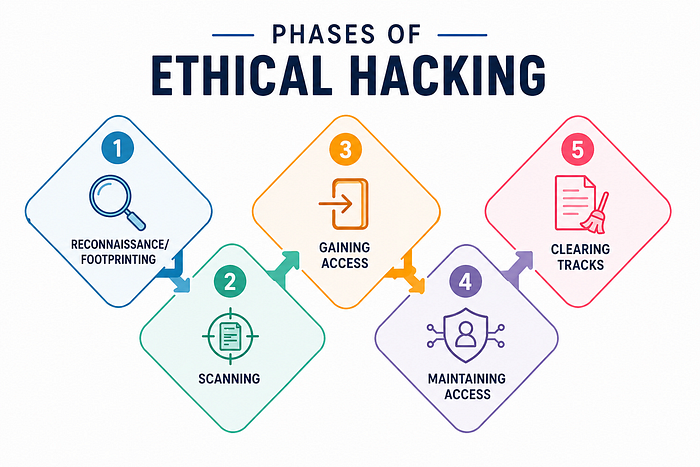
Reconnaissance, also known as footprinting, is the first phase of ethical hacking and penetration testing in which information about a target system, network, or organization is collected before attempting any attack. The main purpose of this phase is to gather as much useful information as possible to understand the target environment and identify potential vulnerabilities. Reconnaissance can be divided into two types: passive reconnaissance and active reconnaissance. Passive reconnaissance involves collecting information without directly interacting with the target system, such as using search engines, social media, company websites, WHOIS lookup, and DNS records. Active reconnaissance involves direct interaction with the target system through methods such as ping sweeps, port scanning, network scanning, and banner grabbing. Ethical hackers use various tools during this phase, including Nmap, Maltego, Wireshark, and theHarvester. Reconnaissance is considered one of the most important phases of ethical hacking because the information gathered helps security professionals plan security assessments, detect weaknesses, and improve the overall protection of systems against cyber threats.
2. SCANNING
Scanning is the second phase of ethical hacking and penetration testing, performed after reconnaissance or footprinting. In this phase, the ethical hacker actively examines the target system or network to identify open ports, running services, live hosts, operating systems, and possible vulnerabilities. The main objective of scanning is to gather detailed technical information that can help determine the security weaknesses of the target environment. Scanning can be divided into different types such as network scanning, port scanning, and vulnerability scanning. Network scanning is used to discover active devices on a network, while port scanning identifies open ports and services running on a system. Vulnerability scanning helps detect known security flaws that could be exploited by attackers. Ethical hackers commonly use tools such as Nmap, Nessus, OpenVAS, and Wireshark during the scanning phase. Scanning plays an important role in ethical hacking because it helps security professionals identify weaknesses in systems and networks, allowing organizations to improve their security and defend against cyber attacks.
3. GAINING ACCESS
Gaining access is the third phase of ethical hacking and penetration testing, where the ethical hacker attempts to enter the target system or network by exploiting identified vulnerabilities. The main objective of this phase is to test whether unauthorized access can be achieved and to determine the level of risk associated with the discovered weaknesses. During this phase, attackers or security testers may exploit weak passwords, unpatched software, misconfigured services, or application vulnerabilities to gain control of systems. Techniques such as password attacks, privilege escalation, social engineering, and exploit execution are commonly used. Ethical hackers use tools like Metasploit, Hydra, John the Ripper, and Burp Suite during this phase. The purpose of gaining access in ethical hacking is not to cause damage, but to identify how attackers could exploit vulnerabilities and to help organizations strengthen their security by fixing those weaknesses before real cybercriminals can take advantage of them.
4. MAINTAINING ACCESS
Maintaining access is the fourth phase of ethical hacking and penetration testing in which the ethical hacker checks whether continued access to a compromised system can be maintained over time. The main objective of this phase is to understand how attackers may stay inside a network without being detected and how much damage they could potentially cause. Attackers often use techniques such as creating backdoors, installing remote access tools, escalating privileges, or using hidden accounts to maintain long-term access to a system. Ethical hackers simulate these activities in a controlled and authorized manner to test the effectiveness of security measures and monitoring systems. Common tools used during this phase include Metasploit, Netcat, Empire, and Mimikatz. Maintaining access helps organizations understand the risks of persistent attacks and improve their security by detecting unauthorized activities, strengthening access controls, and enhancing system monitoring and incident response capabilities.
5. CLEARING TRACKS
Clearing tracks is the fifth phase of ethical hacking and penetration testing, where the ethical hacker studies how an attacker might remove or hide evidence of their activities after gaining access to a system. The main objective of this phase is to understand how attackers attempt to avoid detection by system administrators or security monitoring tools. This may include removing log files, modifying timestamps, deleting command histories, or hiding malicious activities to prevent forensic analysis from tracing the intrusion. Ethical hackers perform this phase in a controlled and legal environment to evaluate how well security systems can detect and respond to attempts at covering tracks. Common tools that may be used in this phase include Metasploit, BleachBit, CCleaner, and Rootkit. Understanding clearing tracks helps organizations strengthen logging mechanisms, improve intrusion detection systems, and ensure proper monitoring so that any unauthorized activity can be identified and investigated quickly.