
Let's be honest.
Most "communities" built by tech companies today aren't really communities.
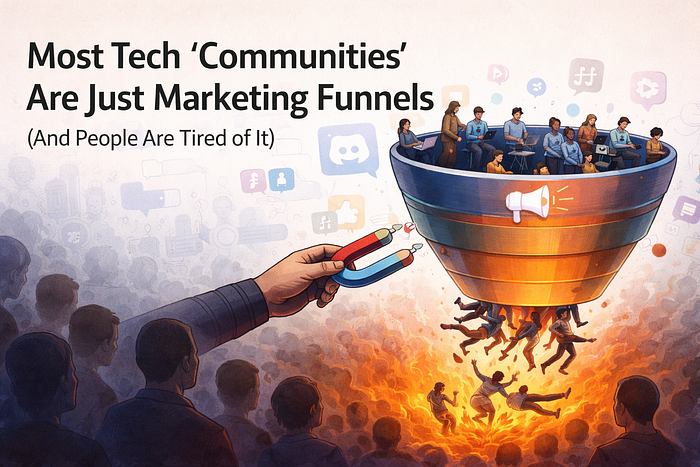
They're funnels.
Polished, branded, content-filled funnels designed to capture attention, nurture leads, and eventually convert users into customers.
And people are starting to notice.
The illusion of community
On the surface, everything looks right:
- A Slack or Discord group
- Regular posts and announcements
- Events, webinars, newsletters
- Thousands of "members"
But if you look closer, something feels off.
Conversations are one-sided. Engagement is shallow. And most people are just… lurking.
Because the truth is: 👉 These spaces weren't built for people. They were built for growth metrics.
People didn't join for your product
Here's the uncomfortable reality:
If your community disappeared tomorrow, most members wouldn't even notice.
Why?
Because they didn't join for connection. They joined for utility.
- To get updates
- To learn something
- To maybe get an opportunity
That's not a community. That's an audience.
Real communities don't feel like marketing
The strongest communities don't operate like funnels.
They feel like:
- A place where people talk to each other, not just to the brand
- A space where members contribute, not just consume
- An environment where value isn't always tied to a product
People show up because they want to, not because they're being nurtured toward something.
That's a completely different dynamic.
The shift that's happening
We're entering a phase where people crave:
- Smaller, more meaningful interactions
- Authentic conversations (not polished content)
- Real relationships over "networking"
Big, generic communities are losing their appeal.
Depth is replacing scale.
And brands that don't adapt will keep seeing:
- low engagement
- high churn
- silent members
So what actually works?
If you're building a community, this is where things change:
1. Stop trying to control everything
Real communities are messy. Let them be.
2. Design for connection, not consumption
Don't just post — create reasons for people to interact with each other.
3. Create moments, not just platforms
Small events, niche discussions, shared experiences > constant content.
4. Make members feel ownership
The best communities feel like they belong to the people, not the company.
The uncomfortable question
If people would only stay in your "community" because of your product…Do you really have a community at all?
Final thought
The future of community isn't about building bigger groups. It's about building spaces where people actually care. Because in the end, people don't stay for brands. They stay for people.