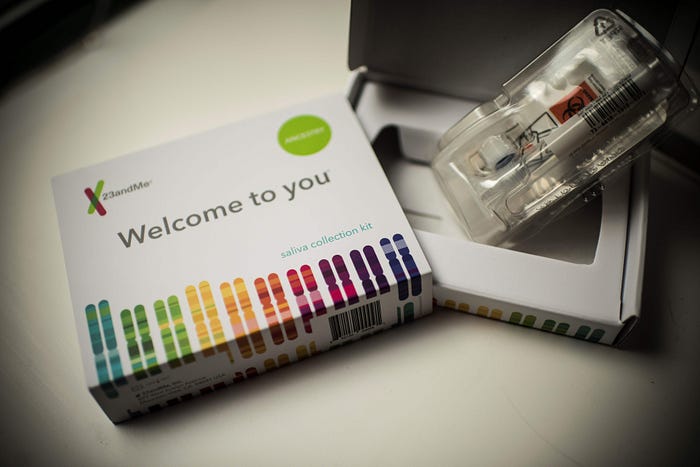

For years, 23andMe looked like the kind of company Silicon Valley loves to celebrate. It took something once confined to laboratories and elite medical settings, turned it into a simple consumer product, and sold millions of people on the idea that identity itself could be mailed in a tube. The company did not merely offer ancestry reports or genetic curiosities. It sold a story about the future. It promised that DNA could become a personal dashboard, a gateway to self-knowledge, preventive health, and eventually better medicine for everyone. That promise helped 23andMe become one of the most recognizable names in consumer genomics. It also helped convince investors that the company was not just selling test kits, but building a powerful data-driven health platform with massive long-term value. As the user's background paper puts it, the company rose from a direct-to-consumer genomics pioneer to a firm later forced into bankruptcy and restructuring, exposing the contradictions of treating highly sensitive biological data as a scalable business asset.

23andMe is a direct-to-consumer genetic testing company that sells saliva-based DNA kits designed to give individuals information about their ancestry, traits, and certain health-related genetic risks. Founded in April 2006 in Mountain View, California, by Anne Wojcicki, Linda Avey, and Paul Cusenza, the company aimed to make personal genetic information accessible to ordinary consumers while also building a large-scale research platform. It launched its first commercial saliva-based genotyping kit in November 2007 for about $999, offering ancestry and health insights through an online portal, and gained major public attention in 2008 when Time named it "Invention of the Year," helping popularize at-home DNA testing. In 2013, however, the company faced serious regulatory pressure when the U.S. FDA ordered it to stop marketing many health-related reports until proper authorization was obtained, forcing a pause and redesign of its health offering. Over the following years, 23andMe gradually secured FDA clearances, and by 2017 it became the first company authorized to provide certain direct-to-consumer genetic health risk reports without requiring a physician, restoring a regulated health product line. Beyond consumer testing, 23andMe also pursued broader ambitions through major partnerships, including a 2018 collaboration with GlaxoSmithKline to use its large genetic database for drug discovery, and in 2021 it went public through a merger with a special-purpose acquisition company under the ticker ME.
But 23andMe's downfall is what makes the company so important as a business case study. This was not simply a story about a cyberattack, and it was not simply a story about weak IT controls. It was the story of what happens when cybersecurity is treated as a support function while trust is actually the core product. In businesses built on intimate customer data, security is not back-office plumbing. It is revenue protection, brand protection, legal protection, strategic protection, and in many cases survival itself.

Even before the breach, there were structural weaknesses inside 23andMe's model. The company's main consumer product had an obvious limitation. Most people only need to buy a genetic test once. Unlike software subscriptions, cloud services, or other recurring-revenue businesses, the customer does not need a new genome every quarter. That meant the long-term investment thesis had to rest on something bigger than kit sales. 23andMe tried to solve that by treating its real crown jewel as the database produced by those kits. Millions of users were not just customers. They were raw material for research partnerships, pharmaceutical discovery, and future health products. The company's partnership with GlaxoSmithKline, including a $300 million equity investment, showed how much commercial value the market believed could be extracted from that data. But it also revealed something more dangerous: once the business model depends on long-term public trust in data stewardship, any security failure becomes existential rather than incidental.
That is why the 2023 breach mattered so much. Attackers used credential stuffing, taking login credentials stolen from other breaches and trying them against 23andMe accounts over time until they found matches. The first compromised accounts were not, in isolation, the whole disaster. The deeper problem was architectural. Because 23andMe had social and relational features such as DNA Relatives, compromising a relatively limited number of accounts allowed the attackers to scrape information connected to millions of other people. According to a joint investigation by the Canadian and UK privacy authorities, 18,222 accounts were accessed worldwide, and from there information tied to almost 7 million customers was exposed. The investigators found that the attackers operated over roughly five months, that 23andMe failed to detect the credential stuffing campaign in a timely way, and that one account was hit more than a million times in a single day, even crashing the platform, without the company recognizing the broader breach underway.
That alone should end the old argument that cybersecurity is "just an IT issue." A purely technical reading says users reused passwords and attackers exploited that weakness. A business reading sees something else. Optional multi-factor authentication, weak detection, insufficient response speed, and poor control around highly connected data were not merely technical oversights. They were strategic decisions, or failures to make strategic decisions, in a company whose value depended on customers believing their most intimate data would remain protected. The official investigation concluded that 23andMe had not implemented appropriate safeguards for highly sensitive information, including genetic and health-related data. When a company's main asset is trust tied to permanent biological information, security posture is not separate from product design. It is product design.
The breach also carried a particularly ugly social dimension. Some of the stolen data was reportedly marketed in ways that pointed to ethnicity-based targeting, including categories involving Ashkenazi Jewish and Chinese users. That transformed the event from a generic data incident into something more severe. This was no longer just about leaked usernames or reset passwords. It was about the exposure of identity-linked data that people cannot change the way they change a card number or password. A password can be rotated. A genome cannot. That distinction should have made 23andMe more conservative, not less, about access control, authentication, anomaly detection, and privacy-first design. Instead, the company learned too late that for a genomics firm, the blast radius of a breach is wider and more durable than in most consumer apps.
What followed was a familiar but devastating sequence. The breach damaged confidence. Lawsuits and regulatory scrutiny intensified. In September 2024, 23andMe agreed to a $30 million settlement tied to the incident. By then the company was already struggling with declining demand and weak economics. The settlement did not create those weaknesses, but it compounded them at exactly the wrong time. Markets that might tolerate losses in pursuit of future growth become much harsher when the growth story is broken and the brand has been wounded. Reuters reported that the company's crisis deepened through 2024, including the resignation of all seven independent directors after dissatisfaction with Anne Wojcicki's buyout proposal, followed by major layoffs and the shutdown of its therapeutics programs.
By March 23, 2025, 23andMe had filed for Chapter 11 bankruptcy protection. The firm that once rode the glamour of Silicon Valley and the promise of consumer genomics had become a distressed asset. Reuters tied the bankruptcy directly to declining demand and the lingering fallout from the 2023 breach. The Kroll restructuring docket confirms the filing date and the formal reorganization process. This is the moment where the lesson becomes brutally clear. Cyber incidents do not need to be the sole cause of collapse in order to be decisive. In many real companies, the breach acts as the accelerant that turns existing weaknesses into terminal failure. It destroys the margin for error. It tightens access to capital. It invites regulators, litigators, and public suspicion all at once. It forces leadership attention away from growth and toward damage control. That is strategy, not just IT.
The final irony is that 23andMe did not disappear. In 2025, after a contested process, Anne Wojcicki's nonprofit TTAM Research Institute won the auction for 23andMe with a $305 million bid, beating Regeneron's $256 million offer. The sale proceeded despite legal challenges from states concerned about the handling and transfer of customers' genetic data. TTAM committed to maintaining existing privacy policies and keeping user rights to delete data. In other words, even in bankruptcy, the central issue remained the same as it had always been: not servers, not code, not hardware, but who controls the trust embedded in a vast archive of human genetic information.
That is why 23andMe is such a strong example for executives, founders, and boards. Too many companies still speak about cybersecurity as though it belongs only to the CIO, the CISO, or the infrastructure team. That view is dangerously outdated. In data-rich businesses, especially those handling health, biometric, financial, identity, or industrial information, cybersecurity is inseparable from corporate strategy. It shapes whether customers buy, whether partners collaborate, whether regulators trust, whether investors remain patient, and whether the company can keep operating after a crisis. The technical controls matter, of course. MFA, detection engineering, segmentation, logging, anomaly analysis, secure product architecture, and rapid response all matter. But the bigger point is that these are not just technical line items. They are commercial defenses.
23andMe did not collapse because a few attackers guessed that people reuse passwords. It collapsed because the company's operating model made trust its most valuable asset, while failing to protect that asset with the seriousness it required. Once that trust broke, the breach exposed every other weakness that had been hiding beneath the company's growth story: the one-time purchase model, the fragile monetization thesis, the leadership turmoil, the legal exposure, and the market's fading patience. That is why the company's story deserves to be taught not as a breach case alone, but as a modern business failure. The real product was never the plastic tube. It was confidence. And once confidence was lost, the business went with it.