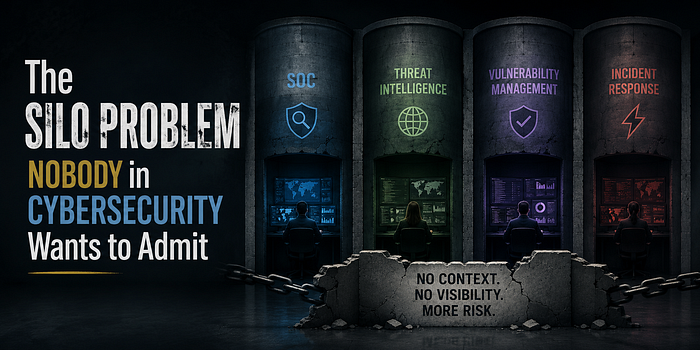

Imagine you needed to recite the alphabet. Simple enough — except your organization decided it was too complex for one person to handle. So they hired 26 specialists. One for each letter. The A person knows A deeply. The B person? World-class B. But when you need to spell a word, you need to schedule a meeting, wait for availability, align on the sequence, and pray nobody is out sick.
That's not a thought experiment. That's most cybersecurity teams right now.
I've worked in security long enough to see the same failure repeat itself across organizations — not because the people were incompetent, but because the structure made competence irrelevant. The threat doesn't wait for your org chart to catch up. The attacker doesn't file a ticket and wait for triage.
What I've seen on the ground
Let me be specific — because vague criticism is easy, and the industry deserves honesty.
Vulnerabilities sit unpatched for weeks — not because nobody noticed, but because the person who identified them doesn't have the access, the mandate, or the skillset to fix them. Finding a vulnerability is one team's job. Patching it belongs to another. And somewhere in that handoff, urgency quietly dies.
Access reviews happen regularly, but they're almost always focused on human accounts. Who has admin rights? Which employees still have access to systems they shouldn't? Good questions. But nobody is asking: what about the service accounts? The API keys? The access tokens sitting in a GitHub repository provisioned two years ago by an engineer who left the company? Programmatic access — its provisioning, rotation, expiration, permissions, and purpose — is a massive blind spot we collectively pretend doesn't exist.
SOC teams are expected to monitor and respond to threats, but they often don't have a complete picture of the organization's digital ecosystem. They're watching dashboards of a house they've never walked through. When something fires, they know the alert — but not the architecture behind it.
And then there's the one that keeps me up at night: when a real attack hits, most organizations discover, in real time, that nobody knows what to do. Not because they didn't invest in security tools. But because individuals were never trained, never drilled, never made to feel personally responsible for the outcome.
"We trained people to detect threats. We never trained them to fight back."
The certification culture trap
The cybersecurity industry loves certifications. CISSP, CEH, CISM, CompTIA Security+, the list goes on. And to be clear — they have value. But they've also created a mental model where depth in one domain excuses total ignorance of adjacent ones.
We reward the specialist. We have no career track for the generalist. And so people optimize for the lane they're in — because that's what gets recognized, promoted, and paid.
The result is a security team that is technically impressive and operationally fragile. Every individual is good at their letter. Nobody can spell.
What a white blood cell actually does
Your body doesn't hire a specialist to detect infections and a separate one to respond to them. A white blood cell identifies the threat and attacks it — in the same motion, as the same entity.
That's the model security professionals should aspire to.
Not just the analyst who files a report and closes the ticket. Not just the engineer who patches when told. The security professional who sees something wrong, understands it deeply enough to fix it, and has the access and authority to act — without waiting for three approvals and two team handoffs.
This doesn't mean everyone needs to know everything. It means the gap between "I found it" and "I fixed it" should be measured in minutes, not weeks. And it means building teams — and building yourself — to be capable of crossing lanes when the situation demands it.
The challenge I'm issuing
If you work in cybersecurity, I want to ask you something uncomfortable: what is the last vulnerability you not only identified, but personally resolved?
If the answer is "that's not my job," the silo problem lives in you — and no amount of tooling, dashboarding, or headcount will fix it.
The industry needs security professionals who can do both. Who study the attack surface and can close it. Who understand the architecture well enough to protect it. Who treat the organization's security posture not as a report to deliver, but as a body to defend.
Be the white blood cell. Identify the threat. Then eliminate it.
Because the alternative — an organization full of people who can each recite one letter, but nobody who can spell — is exactly what attackers are counting on.