Introduction
Cyber security professionals must blend technical knowledge, analytical thinking, and strategic awareness to protect modern digital environments. Whether you are exploring advanced training or a Cyber Security Course in Kottayam, building a focused skill set that spans network fundamentals to incident response improves employability and career growth in security operations centers, enterprise teams, and cloud-first organizations.
Core Technical Foundations
A solid technical foundation enables effective threat detection and remediation across systems and networks.
- Understand network security fundamentals, TCP/IP, routing, firewalls, VPNs, and secure remote access.
- Master operating system internals for Windows and Linux to investigate artifacts and harden endpoints.
- Learn secure coding basics and application security to identify vulnerabilities like injection and broken authentication.
- Gain hands-on experience with SIEM platforms for log aggregation, correlation, and alert tuning.
- Familiarize with virtualization and container security to secure modern deployment stacks.
Offensive Security and Testing
Offensive skills help identify weaknesses before attackers exploit them and support penetration testing programs.
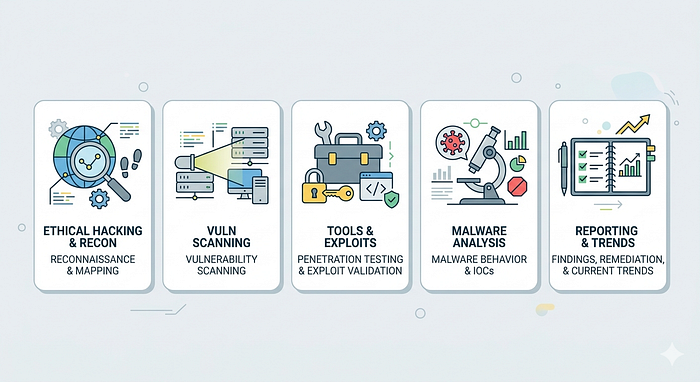
- Practice ethical hacking methodologies, reconnaissance, vulnerability scanning, and exploit validation.
- Use penetration testing tools and frameworks for web, network, and wireless assessments.
- Build competencies in malware analysis basics to recognize payload behavior and indicators of compromise.
- Document findings and remediation steps clearly to support risk management and compliance efforts.
- Stay current with red team techniques and exploit development trends.
Defensive Operations and Monitoring
Defensive expertise is essential for real-time protection and threat lifecycle management.
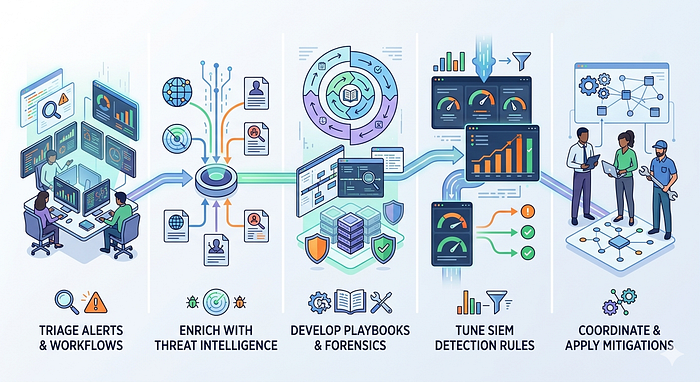
- Operate within a SOC environment and follow analyst workflows for triage and escalation.
- Implement threat intelligence feeds to enrich alerts and anticipate adversary tactics.
- Develop incident response playbooks, forensics skills, and containment strategies for rapid recovery.
- Tune detection rules, dashboards, and use cases in SIEM to reduce false positives and increase signal-to-noise.
- Coordinate with IT and DevOps to apply mitigations across environments.
Cloud and Infrastructure Security
Cloud-first architectures require distinct controls for confidentiality, integrity, and availability.
- Understand cloud security models, shared responsibility, and secure configuration for AWS, Azure, and GCP.
- Implement identity and access management, least privilege, and multi-factor authentication across cloud services.
- Secure cloud workloads, storage, and APIs, and apply infrastructure as code scanning and runtime protection.
- Adopt zero trust security principles for network segmentation and continuous verification.
- Monitor cloud-native logs and use cloud SIEM integrations for unified visibility.
Risk, Compliance, and Governance
Strategic security depends on aligning technical controls with business objectives and legal requirements.
- Perform risk assessments and prioritize remediation based on business impact.
- Apply data protection practices, encryption, and privacy-by-design to safeguard sensitive information.
- Understand regulatory compliance frameworks such as GDPR, PCI DSS, HIPAA, and industry-specific mandates.
- Communicate risk appetite and security posture to stakeholders through concise reporting.
- Integrate security into development lifecycles to reduce compliance gaps.
Emerging Technologies and Analytics
Adopting modern tools and analytical techniques improves proactive defense and automation.
- Explore artificial intelligence in cyber security for anomaly detection, behavioral analytics, and automated triage.
- Use security orchestration, automation, and response to streamline repetitive tasks and speed up containment.
- Leverage threat intelligence platforms and attribution analytics to map attacker infrastructure and motives.
- Learn about blockchain security considerations and IoT device hardening for expanded attack surfaces.
- Keep pace with evolving attacker tradecraft and defensive innovations.
Conclusion
A successful cyber security career requires a balanced mix of technical mastery, practical experience, and strategic thinking. Cultivate skills across offensive testing, defensive operations, cloud security, risk management, and emerging analytics while maintaining continuous learning. This versatile skill set positions professionals to contribute effectively in SOCs, as security analysts, penetration testers, or cloud security specialists and helps organizations stay resilient against sophisticated threats.